







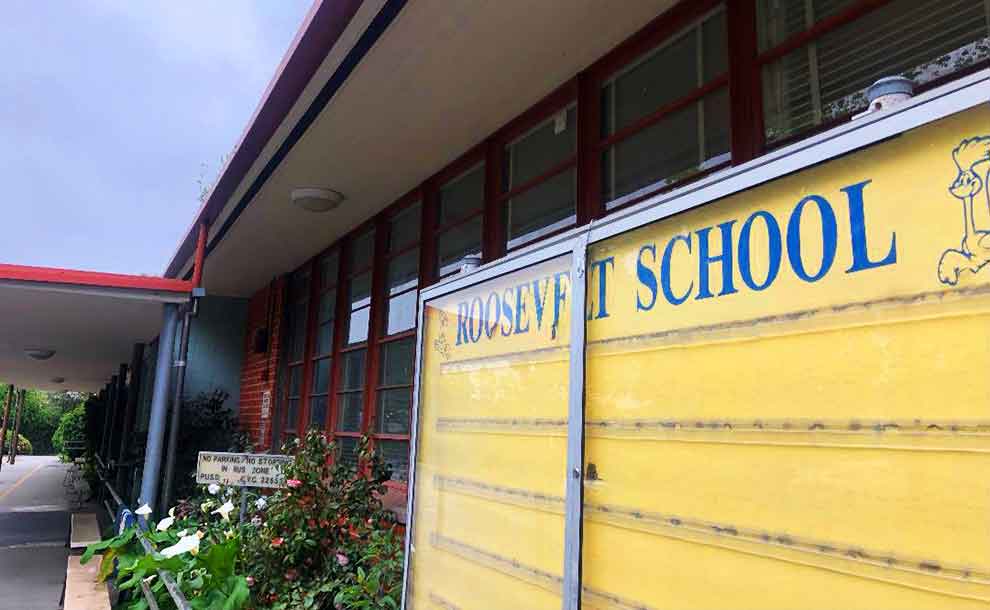
Roosevelt campus (Photo – ©Colorado Boulevard Newspaper)
After months of debate, public comment, and multiple rounds of review, the Pasadena City Council unanimously voted Monday night to reject a proposal to designate Roosevelt Elementary School as a historic landmark under local preservation laws.
By Nicolas Perez
The vote followed a lengthy public hearing centered on whether the school’s main building, originally constructed in 1953 with additions in the early 1970s, qualified under Criterion C of Pasadena’s zoning code. That criterion considers whether a property “embodies the distinctive characteristics” of a particular architectural style or period.
While the city’s Historic Preservation Commission narrowly recommended landmark designation in April, citing the building’s Mid-Century Modern design and its historical use of a “finger/cluster” plan, city staff recommended denial. Staff argued the school had undergone substantial alterations that disrupted key architectural features and undermined the integrity necessary for landmark recognition.
Roosevelt sits on a five-acre site and has undergone many transformations over the years. Originally constructed in 1907, it began as a two-story brick building facing a residential neighborhood. Initially serving as an elementary school and later a high school, the building was renamed the Roosevelt School for Mentally Handicapped Children in 1929. (It later expanded to admit children with a range of disabilities.) In 1933, the original structure was condemned following an earthquake.
The campus evolved significantly after that. What was once a finger-cluster design has been remodeled numerous times. Today, it stands as a connected complex facing the freeway, an infrastructure change that, according to an architectural historian, “obliterated the street grid.”
The current application focused exclusively on the original structure, evaluating it as an example of Mid-Century Modern educational architecture.
Applicant Rene H. Gonzalez, a Pasadena resident, submitted the application in September 2024 after an earlier effort to designate the school under Criterion A was denied. Gonzalez presented historical imagery and narratives linking the school to broader social movements, including the education of disabled children during the polio era and racial integration during segregation. He criticized omissions in the city’s historical record, particularly the lack of Japanese representation during WWII internment.
The hearing drew a large volume of public comment, both in support and opposition. Supporters cited the building’s architectural merit and the school’s progressive legacy in serving disabled and marginalized children. Opponents overwhelmingly focused on the urgent need for affordable housing in Pasadena, with many urging the council to prioritize redevelopment of the vacant site for teachers and school staff.
Representatives from Pasadena Unified School District (PUSD), which owns the site, opposed the designation. PUSD attorney Stan Barankowitz argued that the landmark application misapplied historical criteria and should focus solely on Criterion C. He also questioned the impartiality of Historic Preservation Commissioner Juan de la Cruz, who initiated the review and has ties to Pasadena Heritage.
Architectural historian Mark Holbert, speaking for the district, criticized the application as inaccurate and misleading. He noted that major changes to the site, including those by the original architect in the 1970s, were not properly documented.
Councilmembers largely aligned with staff findings. Councilmember Jason Lyon emphasized that the vote was limited to Criterion C, not broader historical themes, while Councilmember Tyron Hampton said he did not see how the application met the required threshold. Councilmember Gene Masuda cited the building’s alterations as key to his decision.
Mayor Victor Gordo expressed broader concerns about the future use of public school properties. While affirming Pasadena’s long-standing commitment to preservation, he warned against permanent disposal of school sites and voiced skepticism about school districts entering the housing business.
“We’re not just preserving buildings, we’re preserving public education,” Gordo said, before joining the council in supporting the staff recommendation.
The vote marks the conclusion of a lengthy process that began with the first application in January 2024. Despite multiple appeals and revised historical reports, the council’s decision Monday aligns with two separate staff determinations that Roosevelt Elementary School does not meet the criteria for landmark designation.













Leave a Reply