







Acoustic Corner
 Music, chess and card tricks have uncanny connections. This analysis of similarities between them is based on a discussion with Devin Thomas.
By Jean Sudbury
Devin Thomas is owner-engineer at “SouthWest Sound”*, a recording studio in Sierra Madre. Through strategic planning, timing, and with help from friends, he developed his rehearsal studio into a high quality recording studio.
Artists who had used the rehearsal studio now have the ability to record anything from a quick demo to a fully produced CD. Mr. Thomas has been a business owner in Sierra Madre for 32 years. He attended Citrus College in Glendora, then transferred to Cal Arts in Valencia, where he received a BFA in music. In college, his educational concentrations were piano performance and film composition. He is a successful studio engineer, writes and arranges music, and he performs with local bands. Devin teaches classes in recording, digital editing, and chess. He has played chess since he was a child, and he is well-practiced in card tricks. Currently, in his spare time, he is writing and editing a volume of card magic, and has fashioned a beautiful new playing card design to be released in conjunction with the book.
Music

Devin Thomas at SouthWest Sound (Photo – Jean Sudbury).
With music, we have a temporal process; a time line travel. Although many rules have been made based on rhythm and tempo, the artist is always in control of just how far to bend or break the rules. If a musician uses improvisation as a skill, the rules are bent further and the music is even more conversational between players. This has the potential of adding more dimensions to the journey. Time lines, rhythm and melody lines, and resolutions corroborate to create the magic of music.
Chess
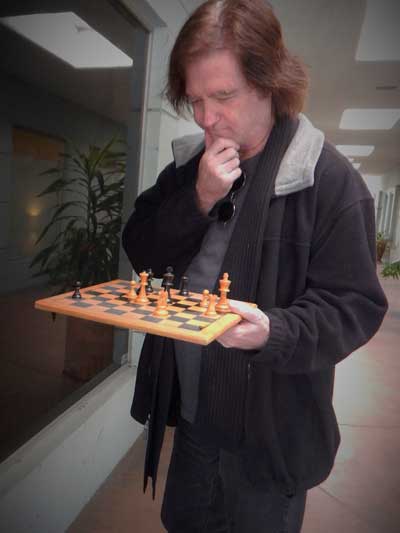
Devin Thomas (Photo – Jean Sudbury).
In a chess game, a time line occurs between the beginning, the middle and the end of a game. From the first move to the last move, time is set to be either free, or on the clock. Each move is determined by the previous and future moves of the opposing players. A chess game has a conversational flavor, even in total silence. Each player determines how far to bend the rules, and how each move will lead to the final resolution.
Card trick
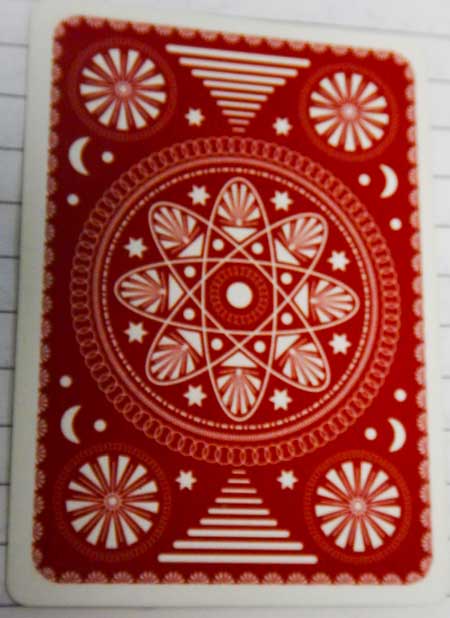 In a card trick, an outline is presented, parameters are set, and the conclusion is sought. Psychology and deceptions are used in conjunction with math principles, and timing is everything. A card trick can be solved using infinite varieties of possibilities. Only one solution is accurate.
The connections
In a piece of music, the observer’s focus is on the melody line, which creates a story line through rhythmic patterns. Chess and card tricks are more visually than aurally oriented. These skills require intensive study of games, tricks and strategies. To become a master of chess and card tricks requires countless analyzation of each step, and exploring all possibilities. Listening to music performed by others often helps singers and instrumentalists to develop unique styles. Practicing music, chess and card tricks helps to develop the artistic flow. Performing brings it all together.
Strategy, concentration, development, imagination, communication, and resolution are words which come to mind as connections between music, chess and card tricks. These creative skills are treasures to be used in daily life.
*SouthWest Sound, 49 S. Baldwin Ave # B, Sierra Madre, CA 91024.











Leave a Reply