








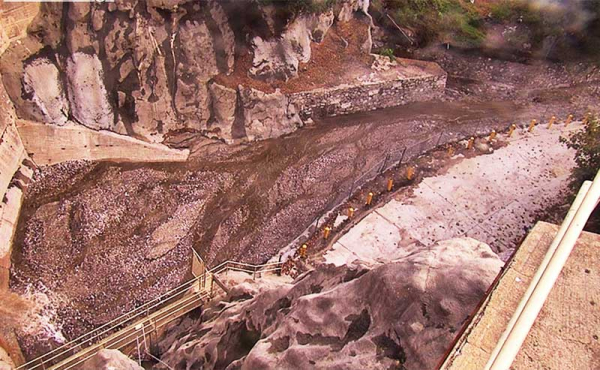
Sierra Madre Canyon (Photo – AlertCalifornia)
Sierra Madre’s foothill neighborhoods are protected by a network of debris basins and a rail-and-timber structure designed to manage the risks of mudslides and debris flows from the surrounding hills.
By News Desk
These protective measures, maintained by the City of Sierra Madre and the Los Angeles County Department of Public Works, play a critical role in reducing storm-related hazards. However, the city’s infrastructure has faced its share of challenges, and ongoing maintenance and improvements are necessary to ensure these systems remain effective.
Post-Fire Vulnerabilities and Ongoing Efforts
Following the Eaton Fire in 2011, the slopes above Sierra Madre became more vulnerable to debris flows during storm events, prompting both the City and County to take action. Since then, city and county crews have focused on restoring basin capacity and removing sediment to ensure these structures are capable of handling stormwater runoff and debris.
Recent storms have tested the system’s effectiveness, and while the cleared debris basins generally performed as designed, capturing debris without significant overflows or damage, there remain areas of concern. The City is continuing to monitor and maintain these basins, and there are ongoing efforts to address some of the remaining vulnerabilities.
A Summary of the Debris Basins and Their Status
Sierra Madre’s debris management system includes nine basins and one rail-and-timber structure, each serving a distinct role in protecting the city.
Below is a snapshot of their current condition and management:
- Sunnyside Debris Basin (Pasadena):
Managed by Los Angeles County, this earth-fill basin has been regularly maintained and continues to perform its role in stormwater management. - Bailey Canyon Debris Basin:
Located at the mouth of a major canyon, this basin was cleared of large debris volumes prior to the most recent storms, helping to reduce risks. - Auburn Debris Basin:
Another County-maintained earth-fill basin, cleared in advance of the storm season and regularly monitored throughout the year. - Carter & West Carter Debris Basins:
These basins are part of the County’s standard maintenance program, and both performed well during recent weather events. - Sierra Madre Dam Debris Basin:
After significant sediment removal in the wake of the Eaton Fire, this concrete arch dam structure has been restored to its full capacity and is functioning as intended. - Sturtevant Debris Basin:
Located in the upper slopes of Sturtevant watershed, this basin saw minimal debris accumulation during the recent storms and remains effective. - Lannan Debris Basin:
Another earth-fill basin maintained by the County, it showed no issues during recent storms. - Floral Debris Basin:
Managed by the City of Sierra Madre, this basin was cleared after the February 2025 storm, with contractors removing over 6,000 tons of sediment to restore its capacity.
Challenges with the Yucca Trail Rail and Timber Structure
The Yucca Trail rail and timber structure, located above Woodland Drive, remains one of the City’s more unique debris management features. Built in 2009 following the Santa Anita Fire, the structure captures debris while allowing muddy water to pass through. The City took ownership of the structure in 2015, agreeing to assume responsibility for its maintenance after the County concluded that the immediate risk had subsided.
However, maintaining the Yucca Trail structure has posed challenges. With limited funding for ongoing maintenance, the structure and its associated basin have not always been cleared as promptly as needed. Currently, the Yucca Trail basin is the only one in need of clearance before the next storm season. A contractor has been selected, and work is scheduled to begin in early December 2025, with an estimated two-month completion time. The project is being funded through the Fiscal Year 2025/26 budget, with $60,000 allocated for the work.
Looking Ahead: Sustaining Efforts and Addressing Vulnerabilities
While Sierra Madre’s debris basins and infrastructure have generally performed as intended, ongoing challenges remain, particularly with funding for maintenance and the need for periodic sediment removal. The City and County continue to prioritize these efforts to safeguard foothill neighborhoods, but residents and officials alike are aware that maintaining these systems is an ongoing process.
With future storm seasons expected to bring more challenges, the City’s ability to clear and maintain debris basins in a timely manner will be crucial in mitigating risks. As work on the Yucca Trail structure moves forward and other basins undergo continued maintenance, the City of Sierra Madre remains focused on improving its stormwater management infrastructure to keep the community safe.
For further details on the status of Sierra Madre’s debris basins and upcoming projects, residents are encouraged to visit the City’s website or contact the Public Works Department.











Leave a Reply