





GUEST OPINION
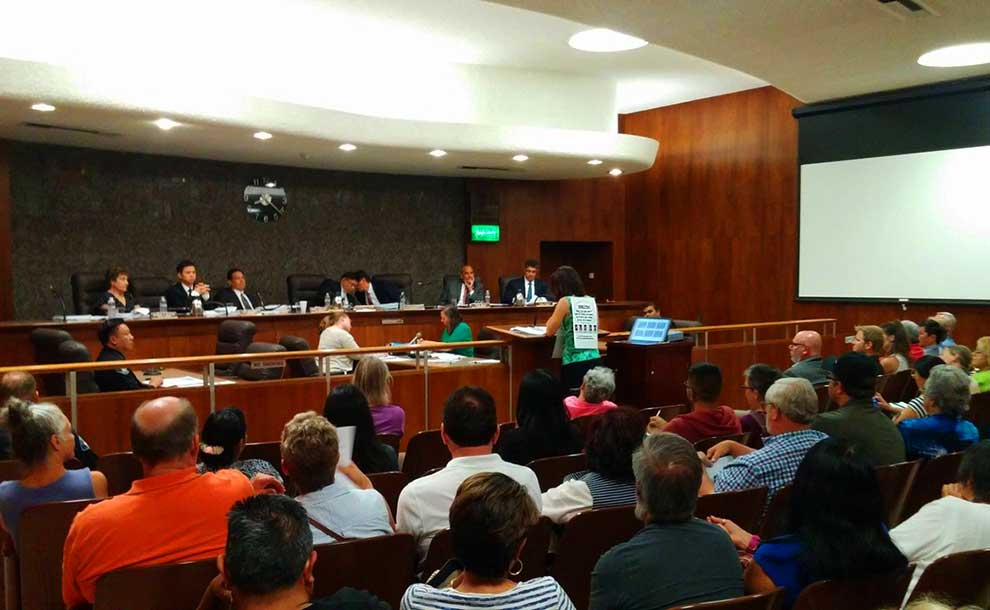
Alhambra City Council, Sept. 11, 2017 (Photo – Rohan Sabnis).
Alhambra City Council met again on September 11 to consider the fate of 268 trees at Sunnyview Care Center (formerly the Scripps Kensington Home for the Aged) at the corner of Marengo and Valley in Alhambra. After several hours of public testimony, the city council unanimously approved the first reading of a zone change and the razing of 209 trees to make way for 126 townhouses, again without discussing the environmental impacts of chopping down so many mature trees.
By Melissa Michelson
The issue for residents isn’t only about protecting Alhambra’s green space, but about lack of governmental due diligence, making decisions with adequate answers, doing so with transparency, and avoiding conflicts of interest.
Mayor Stephen Sham was asked by residents to recuse himself from the vote or return the money because TAG 2 Medical Investments, the owners of the property, had donated $5,000 to his latest city council campaign. However, Sham still granted the zone change and approved the developer’s study.
Residents and protestors have been calling for the city to conduct an environmental impact study to determine what effects the destruction of so many trees would have on the local environment and residents. According to the California Environmental Quality Act (CEQA), if there are facts, reasonable assumptions predicated upon facts, or expert opinions supported by facts that demonstrate the project may have a significant effect on the environment, an Environmental Impact Report [EIR] shall be prepared.
St. Claire Partners, developers out of Orange County, contended there would be no significant environmental impacts to razing 209 mature trees, yet they did not discuss the shade these 268 mature trees provide, how long it would take for new trees to grow to the same height, the physical and psychological benefits these trees provide, or the cooling benefits of the existing trees compared to the crape myrtles they intend to plant in their place. During public testimony, one resident explained to the council that one crape myrtle gives approximately 50 square feet of canopy compared to a Chinese elm tree, which gives 1,963 square feet.
Planning commission’s recommendation to “save as many mature trees as possible” ignored!

A sign protesting the cutting down of 227 trees in Alhambra (Photo – Melissa Michelson).
On April 17, the planning commission approved the development on the condition that the developer preserve “as many mature trees as possible” and relocate “as many trees on site as possible.” Their stipulation, titled “PL53,” also requires that the report be prepared by a certified arborist, that it includes the age of the trees and recommendations for on-site retention, and that the report be approved by the Director of Development Services.
To date, the planning commission’s conditions have still not been met.
At the June 12 meeting, city planner Paul Lam told the city council the planning commission approved the project, but failed to mention the pre-condition to the approval. Even after community members pointed out in a letter to the planning commission and the city council, and directly told two planning commissioners that the arborist conducting the report was unlicensed and the other stipulations had not been upheld, city staff didn’t mention it at the September 11 meeting, either.
Unlicensed arborists?

Horticultural Tree Reports.
The leading arborist and president of Trees, Etc., Richard Ibarra, has no arborist license. His associate, Donald Rodrigues, has a pest control license and lists an arborist license number that does not exist (PCA #3505, ISA #WC-272).
Paul Lewis, Landscape Architect #3620, is listed on the second revision, but his certification is unclear. Dillon Reynolds (ISA Certified Arborist WE-9690A) is the only one with a valid arborist license, but he is not the leading arborist for the project and has not participated in creating the tree report, as his name only appears on the July 31 report and not on the July 1 report, and both reports are almost identical.
Ibarra and Rodrigues produced the first tree report, conducting their field reviews in just 5 days. On April 27-28 alone, they apparently inventoried and rated 200 trees. According to William McKinley, an independent and licensed arborist hired by a local resident, the scope of his project should have taken at least a month to complete. (Watch live walk-through with McKinley).
City accepts tree report that is contradictory and incomplete

Tree evaluations
According to the tree report, 210 trees on site are considered vigorous/healthy in the “Excellent to Good” categories, yet the arborist’s summary statement is that “most trees are poor quality, not worthy of transplanting.” For example, page 221 of the report lists 5 Shamel ashes that have a rating of 30, and all are slated for removal; Chinese Elms # 13 and #106 have ratings of 31 and 30 points respectively, and Avocado #88 has 31 points, etc., and will also be bulldozed.
Some pages of the report are incomplete. Trees # 221-230 on page 231 of the July 1 report don’t have health-points totaled and calculated, yet they “shall be removed for proposed project construction” as per the summary page.
Pages 6-7 refer to tree mitigation and list certain species of tree that should not be planted or “may not be wise” to plant in California, according to the California Invasive Plant Council. They total 20. This also does not provide a data-driven rationale for tearing out so many healthy trees that are on site. (Click to view arborist documents).
Which trees will be donated, and will they survive?
According to the Revised Tree Counts document (only pages 4-5 are made public), 40 trees will be transplanted. Included are 34 crape myrtles, one live oak, three gold medallions, and two figs. It is unclear where and whether those are the trees to be offered to the Margarita and Ramona Convent School. (See “Revised Tree Counts.”)
Despite meetings between Alhambra Unified and the developers, it is surprising that George Murray, Alhambra Unified School District’s Assistant Superintendent of Facilities and Transportation, did not know which trees or how many would be donated. He has not seen any agreement in writing.
After public comment closed, council member Luis Ayala asked how likely these mystery-tree donations would survive relocation. With no mention of tree species, age, or current health of the trees, Dillon Reynolds, did not answer the councilman’s inquiry, but said in general success rates can be high if certain conditions are present.
The elephant in the room!

Citizens protesting outside of Alhambra City Council Chambers (Photo – Melissa Michelson).
The tree reports are not available online for public consumption. Instead, they are “under separate cover,” and to view them, the public has to go in person to city hall.
The latest list of 19 trees that will be saved on the property and 40 that will be transplanted appears copied and pasted next to a “Tree Salvage Plan” map. This document was neither in the July 31 tree report nor in the city council’s staff report. The information seems to be on pages 4 and 5 of a 6-page document, but the rest of the pages are not public. The developer projected that in extremely small print at the September 11 council meeting, impossible for anyone to see, and he did not discuss the list.
Neither draft of the full arborist report is included in the Mitigated Negative Declaration, which was voted on by the council on June 12 and later on September 11, so technically it is considered an attachment but not part of the vote. The first arborist report was not approved by anyone, just “signed off as having received” on July 5 by city planner Paul Lam. It hadn’t even been prepared yet when the city council approved the project the first time on June 12.
Even at their meeting of September 11, the second draft of the report wasn’t discussed at all.
Paul Padilla, a member of the Marengo Avenue Water Brigade, the grassroots community group of residents that is opposing how the city council is handling this development, sums it up: “PL53 called for a licensed arborist to do a thorough report of high-quality with specific demands. Instead, it’s a shoddy piece of work done by unlicensed arborists misrepresenting themselves and misrepresenting factual information about the trees, in order to satisfy the pre-existing desire of their developer-employer to chop down the trees, while pretending to satisfy the demands of the Planning Commission. It’s a fraud — no, it’s a sham.”
Melissa Michelson is a resident of Alhambra and a member of Grassroots Alhambra.
Read More:
Alhambra:
Hypocrisy Is Unbecoming of Elected Leaders
The Guest Opinion section reflect the opinions of the responsible contributor(s)/writer(s) only, and do not reflect the viewpoint of ColoradoBoulevard.net. ColoradoBoulevard.net does not endorse or guarantee the accuracy of any posting. ColoradoBoulevard.net accepts no obligation to review every posting, but reserves the right (with no obligation) to delete comments and postings that may be considered offensive, illegal or inappropriate.










Alhambra City Council, irresponsibly developing, keeps rolling and bulldozing along. The comparison to Trump fits.