






KNITTING CORNER

KnitPics in Flamingo Pink (Photo – Robin Southworth).
It’s not really enough to know the ins and outs of knitting. When you are new to knitting, sometimes it’s about where to start.
By Robin Southworth
After last week’s article on cables posted, my friend, Claire, messaged me and asked how to start knitting. Not HOW to knit, but WHERE to start. What kinds of yarn are best for a beginner. Appropriate needles for the yarn? The best thing to make as a beginner? I thought about picking her up and taking her to a yarn shop, but since she lives in Texas and I live in California, that wasn’t going to happen. So, I wrote an article instead.
Claire, this is the beginning-beginning for all beginners…just like you!
Beginning
Knitting starts with the DESIRE to knit. Wanting to knit makes it more fun and a good challenge, rather than something tedious.
Purchasing
Sometimes, you live in places where local yarn shops just don’t exist. A travesty, but not insurmountable. My local Walmarts (all 4 of them) carry yarn and a selection of needles and knitting accessories. Not the greatest selection, mind you, but good, solid, serviceable stuff. Hobby Lobby, Michael’s, and smaller craft stores, like Ben Franklin, also carry knitting supplies. Think “craft shop”, not “yarn shop”, and you should be able to find some place close to home.
If you CAN’T find something suitable close to home, the internet is your friend. Joann’s and Michael’s both ship yarn and accessories and most yarn companies sell on-line. Knitpicks is a strictly on-line retailer with lovely prices on terrific yarns, needles, and accessories. I have purchased yarn from them and found the products to be exactly what they were described to be, plus the colors on the website were accurate when my yarn arrived (see the photo at the top of the article).
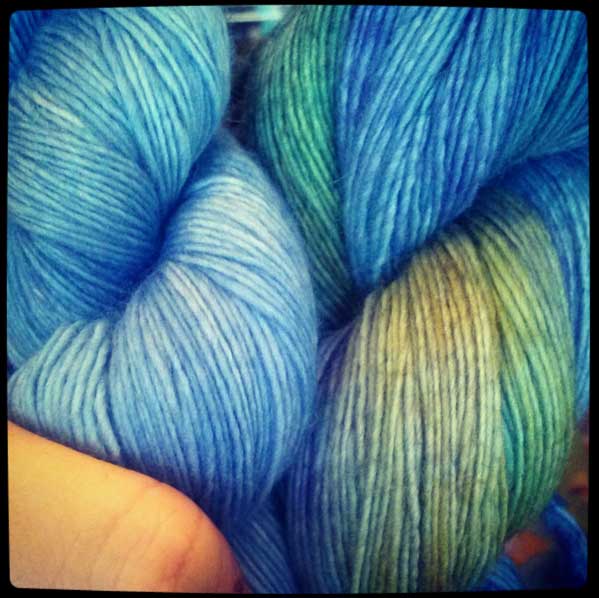
Hank (closeup) (Photo – Robin Southworth).
The only thing you need to know about Knitpicks is that the yarn is NOT wound into a ball for you. It comes in what’s called a “hank” (see photo above). I usually borrow a friend’s winding apparatus (see photo below), but when I can’t, I have wound a hank into a ball by hand. It took an entire evening to wind two hanks (mostly because my cats thought it was fun to play with Mama’s yarn and the dog wanted his three-quarters of the bed back). Just so you have full Knitpicks’ disclosure.
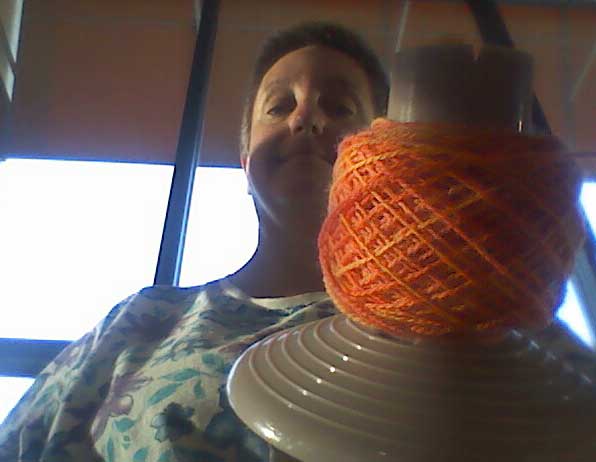
Winding a Hank (Photo – Robin Southworth).
Yarn
A beginning yarn should not fill your hand, nor should it be invisible. You need a moderate yarn. After knitting regularly for over ten years, I suggest a worsted weight yarn (also noted on yarn labels as a 4). It is a medium-size yarn that will be easy to find in your hand, the stitches will be easier to see, and the pattern will be evident as you knit along.
As for fiber, pick what you can afford. Wool is nice, but sometimes a soft acrylic will do the same job at a distinct savings. Lion Brand Yarn makes a 80% acrylic/20% wool yarn called Wool-ese that is nice to work with. I use it when I am learning a new stitch or working up a pattern. It is forgiving to the abuse I hurl at it from my needles when learning. Pick what you can afford.
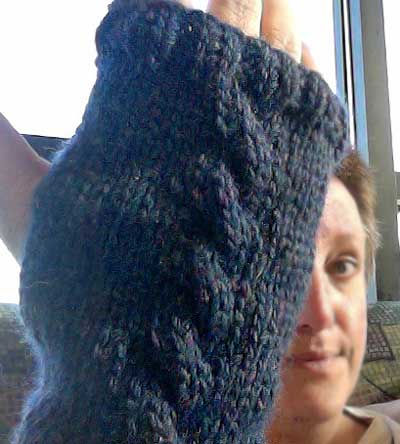
Mitts In Wool-ese (Photo – Robin Southworth).
I didn’t start with an easy, forgiving yarn. When I had the desire to knit, I picked up a bulky yarn, specifically Lion Brand Homespun (in the Tudor colorway), and started knitting. I didn’t know until much later that my knitter friends find this yarn difficult to knit with. They say it splits and is hard to pick up with a needle. That’s okay. If it is the yarn you WANT to start knitting with, KNIT WITH IT. I still knit stuff with it today (see sweater photo below). Sometimes I can knit better with the Homespun than I can with a gorgeous baby alpaca and silk yarn. Go figure.
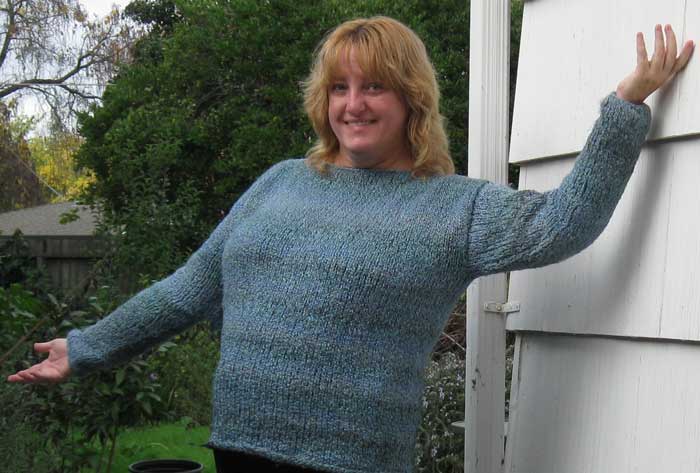
Berkshire Sweater (Photo – Robin Southworth).
Needles
Knitting needles come in sizes from the microscopic (#000) to the ginormous (the largest I’ve worked with is #35). You want something a bit more manageable. Yarn labels will suggest the size needle for that particular yarn. If you are just picking up a needle for the first time, I suggest a #10 needle. It is big enough to feel in your hands, but not so large as to be unwieldy. It also works well with worsted weight yarn. Important decision, however: aluminum or wood? Depends. I started with (and continue to use) aluminum needles until about 2 years ago when I added bamboo needles into the mix. I like wood/bamboo needles for their ability to cling to a smooth yarn, keeping the yarn on the needles better. If I have a rougher yarn, I use aluminum. For YOU? Start with aluminum. They are not as pretty, but they are slightly less expensive.
The Perfect Pattern
Ahhhhh, such an individual thing. A lot of people start with a scarf. It’s a simple rectangle – easy. My first project was a throw for my mother: ribbed on either end and stockinette stitch in between. My suggestion (and it is ONLY that…a suggestion) is to join Ravelry.com and use their pattern search. You can search by yarn, needle size, type of garment, whether the pattern is free or if you have to pay for it, or if it is in a book. You can go to your local library and peruse the craft section. Check out the craft section of a bookstore in your area. Ask friends if they have a pattern they can share with you. Browse the internet (Google is your friend in this search). You can browse until you find a pattern that makes your heart flutter in anticipation of knitting it. That’s really my criteria: does my heart flutter when I first see the finished garment. That tells me I’m more likely to finish the project.
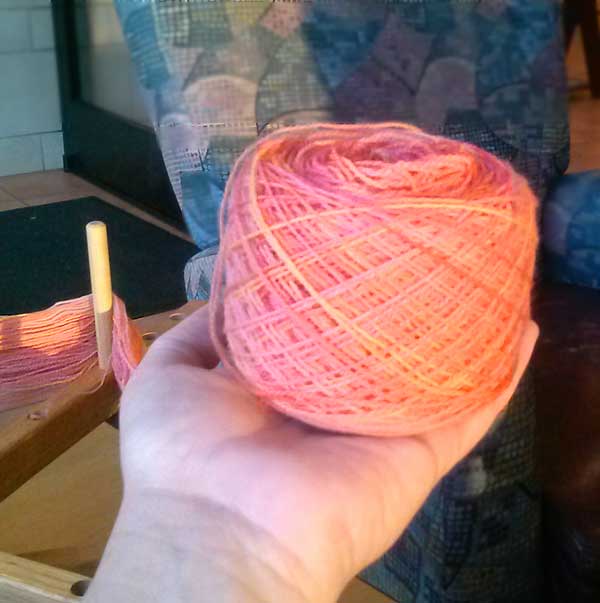
Ball from Hank (Photo – Robin Southworth).
To Start Knitting
Really, all you need are needles, yarn, a pattern, and sharp scissors. That’s it to starting at the beginning-beginning.
Now get out there and begin knitting!










Leave a Reply