







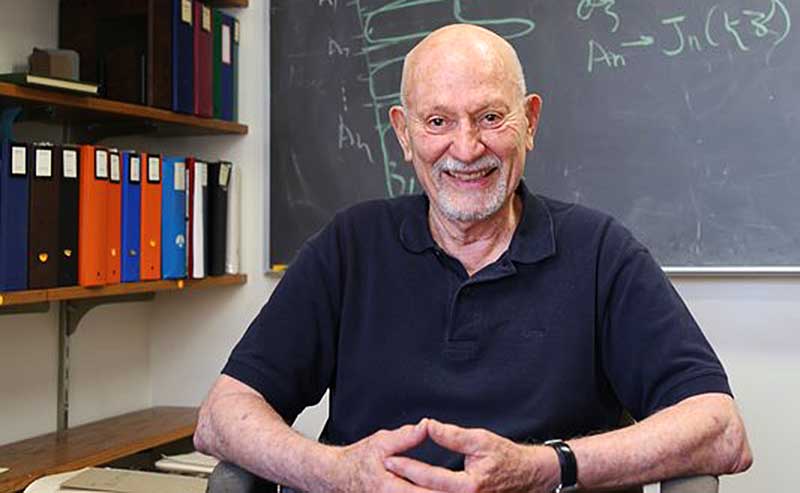
Amnon Yariv (Photo – caltech.edu)
During the hot summer of 2020, confined to his Pasadena home during the COVID-19 pandemic, physicist Amnon Yariv took frequent and long showers to cool off.
By Kimm Fesenmaier, Caltech
A surprising result, to go with his record-breaking water bill, was a proposal and theoretical model for a new class of vibrations that can convert a constant force, such as wind or water, to a mechanical oscillation.
It wasn’t exactly a Eureka moment. The thought did not come all at once in the bathtub, a la Archimedes. But it was in the shower that Dr. Yariv first noticed something unusual about the way the water-spraying showerhead behaved when left dangling by its hose. To Yariv—a scientist who has been studying waves and their properties for most of his 70 year career—that showerhead was more than just a fixture on a flexible tether spraying water at the wall. It was part of an oscillating system.
Oscillations are the rhythmic, or periodic, variations in the world around us. The ebbing and flowing of the sea is an oscillation. The vibrations of a plucked guitar string are oscillations. Even light is an oscillation, according to quantum theory.
Yariv observed that as he increased the water flow in the shower, the system began to behave unexpectedly. In fact, he saw a bimodal, joint oscillation—two different oscillations synchronized with each other. While the shower head was swinging back and forth like a pendulum, it was also twisting in sync in one direction and then the other. It was clear that those two oscillatory modes were driving each other since a damping of one would immediately cause the other mode to cease oscillating. What’s more, Yariv saw that the joint oscillation was predictably unstable. Once a certain threshold of water pressure was reached, the oscillation kept increasing in amplitude even when the water flow remained constant.
“This bimodal oscillation is like an Argentinian tango, where each dancer has to remain completely in sync with the other or else they stumble on each other,” says Yariv, National Medal of Science-winning applied physicist, Caltech’s Martin and Eileen Summerfield Professor of Applied Physics and Electrical Engineering. “The idea that a steady force can be used to excite this kind of entangled bimodal oscillation has never been proposed nor demonstrated.”
Yariv spent the next few years working out the mathematical model explaining what he had observed during those hot summer months. The mathematics underlying Yariv’s two-mode model, which he nicknamed “Yariv’s groove,” constitutes a sweeping extension to two modes of a model of a single mode oscillation proposed by the physicists Michael Faraday and Lord Rayleigh a century and a half ago.
“My study only follows the system through the onset of the bimodal oscillation and into the early stage of the unstable oscillation, and stops before the heavy showerhead craters the wall,” says Yariv. “But the new entangled bimodal oscillation is unstable. It doesn’t reach a steady state. It keeps getting larger.”
Implications far beyond the shower
The oscillation Yariv first took note of in the shower serves as a model system for a whole class of oscillations, and his mathematical analysis should apply to all members of that class, he says. Yariv points to other examples that very likely belong to the class. A stop sign fluttering on a windy day is one example. A more infamous example, he says, is very likely that of the 1940 collapse of a suspension bridge that spanned the Tacoma Narrows in Washington. The bridge, nicknamed Galloping Gertie for the way it bucked and swayed in the wind, eventually collapsed during a windstorm in 1940. Videos of the bridge collapse show the roadbed undergoing vertical as well as transverse oscillations leading to the breakup. Some of the key features of the showerhead oscillation exist in both cases: bimodality, steady force threshold, and instability.
“The abundant occurrence of steady forces in nature will provide rich areas of investigation to identify bimodal oscillations which can be excited by these forces,” says Yariv. He notes that the mechanical motion generated by such bimodal oscillation could also be converted to rotary motion and, thus, to electric power generation. The finding could also have applications in optics, electronics, and cosmology, where Yariv says the bimodal oscillations could be related to the pre-merger dance between colliding black holes.
The paper describing Yariv’s theory, “On a class of bimodal oscillations powered by a steady, zero-frequency force—Implications to energy conversion and structural stability,” appeared in the September 11, 2023, issue of the journal Proceedings of the National Academy of Sciences. A commentary on the work by Demetrios Christodoulides of USC, appeared in the October 4, 2023, issue of the same journal. The work was supported by funding from Caltech’s Division of Engineering and Applied Science.
This article has been edited for clarity and brevity.












Leave a Reply