






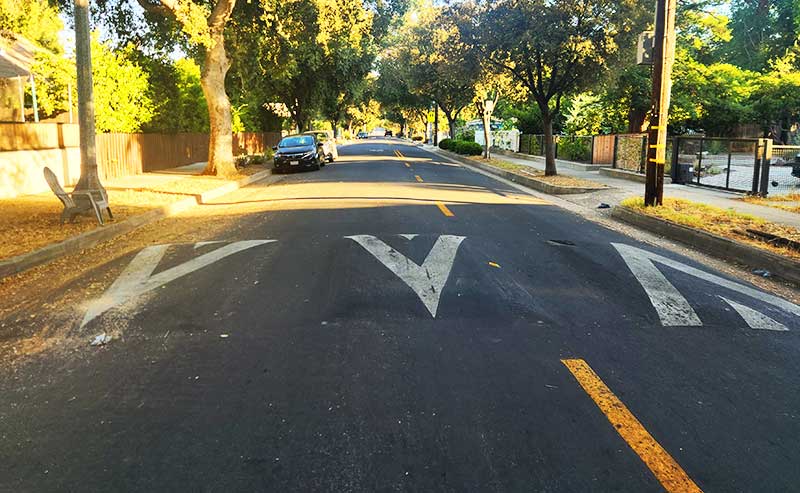
A speed hump in Pasadena (Photo – Colin Bogart)
Speed humps can save lives. We can change policies that have made them nearly impossible to get approved.
By Colin Bogart
The Pasadena Department of Transportation (DOT) is recommending an update to the City’s Speed Hump Policy. It is expected to go to the Municipal Services Committee, and to the City Council for approval. I strongly support this update. I would like to see the Council add Neighborhood Greenways as streets also eligible for speed humps. Full disclosure: I’m a member of the City’s Transportation Advisory Commission (TAC) for District 1, and I supported the proposed changes at a recent TAC meeting. These are my own thoughts. I am not representing the TAC, Councilmember Tyron Hampton, or the Pasadena DOT. Here’s how I got to my current stance on speed humps.
For years, there was egregious speeding on my street, North Marengo Avenue, between Octavia Butler Middle School and the northern Pasadena border near Woodbury. I requested speed humps. They were approved following a speed study showing that the 85th percentile of drivers were, indeed, going too fast. The next step was to get 67% of residents, a super majority, to vote yes for speed humps. Ballots would be mailed out to every resident for completion and return in a pre-addressed, stamped envelope.
A super majority is already a high bar. Then I learned that people who didn’t respond at all would be counted as voting “No.” This current policy makes no sense! We don’t vote on ballot initiatives or elected officials this way. I knew I couldn’t change the policy, so I enlisted a few neighbors to help make sure we got as many of our fellow neighbors to vote as possible.
My concern was soon borne out. We found that many of our neighbors couldn’t recall if they had received their ballot. Some speculated that they probably threw it away. Some neighbors remembered getting it, decided it was junk, and threw it away. All of these neighbors would have been counted as “no” votes if we had not knocked on their doors. We got extra copies of the ballot and gave them to every neighbor we could contact who hadn’t sent in their ballot.
While knocking on doors and talking to our neighbors, we found that most people were quick to vote yes. The majority of the people we spoke with said they wanted something done about the speeding drivers and they voted accordingly. A few people debated us a bit, saying they’d like to see more enforcement. My response was this: speed humps work 24 hours a day, 365 days a year with no overtime pay. Road design, such as speed humps, is truly the most effective way to reduce speeding. Pasadena Police can’t be everywhere all the time. The possibility of profiling could come with increased enforcement. Enforcement really isn’t the solution.
We ultimately got the speed humps, but it easily could have gone the other way. The proposed revised speed hump policy states that 67% of ballots RETURNED have to be “yes” for the humps to be approved and installed. Still a high bar (not a simple majority of 51%), but at least we’d be counting only the ballots turned in, which is aligned with how we vote for everything else.
A note about the installed speed humps. DOT calls them “speed cushions.” The difference is that they are made with two gaps, spaced apart so that large emergency vehicles like fire engines and ambulances can pass through without slowing down. This is the type of speed hump that the City plans to install going forward. Eventually old speed humps will be reconfigured as well. Speed cushions eliminate the concern that emergency response might be hindered. I salute Pasadena DOT for switching to this standard.
The change in how votes are counted is an important step in fixing a broken policy. There’s another step our City Council can take to improve our speed hump policy. The current policy says that any street being considered for speed humps must be classified as a “local residential” street. Any other classification means that speed humps cannot be considered. Marengo’s classification in my neighborhood had to be changed because it was classified the same as North Fair Oaks, which is four lanes wide with parking on both sides. Marengo north of Orange Grove is two lanes with street parking on one side only. It is entirely residential. It makes sense to be classified as local.
Now consider El Molino, Wilson, Sierra Bonita, and Craig. These four north-south streets have been designated to become Neighborhood Greenways. The City has funding to make these streets safer by reducing traffic volume and speed, an All Ages and Abilities approach that is a key feature of Neighborhood Greenways. One might be surprised to find how these streets are classified according to the Caltrans Functional Classification street map. For example, El Molino is classified as a Minor Arterial for its entire length and Wilson is a Major Collector from Washington Blvd. to California Blvd. Wilson already has speed humps on the north end in Bungalow Heaven, but the current policy excludes any future speed humps for Wilson as well as El Molino, and the same is true for significant portions of Sierra Bonita and Craig.
If the City Council were to modify the new policy so that speed humps could be included on designated Neighborhood Greenways, the problem of exclusion would be solved. DOT would still do community outreach and present all potential street treatments for the Greenways, but at least speed humps would be an option. This is a very simple fix that can be written into the language of the new policy. I urge everyone’s support for this.
During the process of getting North Marengo approved for speed hump installation, a speeding motorist killed my neighbor, Anna Polerana, in a hit and run collision, mid-day on Sunday, September 18, 2022. She was putting her grandchildren in her car in front of their home. They were going to the park. The children witnessed everything. The family still has a memorial in front of their house. When doing a speed study, egregious speeders are considered “outliers” and don’t factor into the calculation for the 85th percentile that’s used to approve a street for speed humps. Outliers are left to be caught by enforcement, but that’s less certain to be effective compared to street design. There previously had been enforcement on our street. Pasadena Police on more than one occasion waited on the side street by my house to catch speeding drivers. But it only takes one outlier to kill someone, and that’s what happened to Anna. I mention this not to lay blame on PPD, but to emphasize the importance of street design and specifically speed humps where needed to make a given street safer and prevent injuries or deaths.
Colin Bogart, a Pasadena resident, is the Active Transportation Director for Day One and a lead volunteer with Pasadena Streets Coalition.










Thank you for this excellent article, Colin!
Thank you for this article! What also needs to be added to the “approved list” for speed humps, bumps, or other calming asphalt installations are “thoroughfares”! Calming can also be achieved on these residential streets with these methods without disrupting commercial, aggressive drivers.