







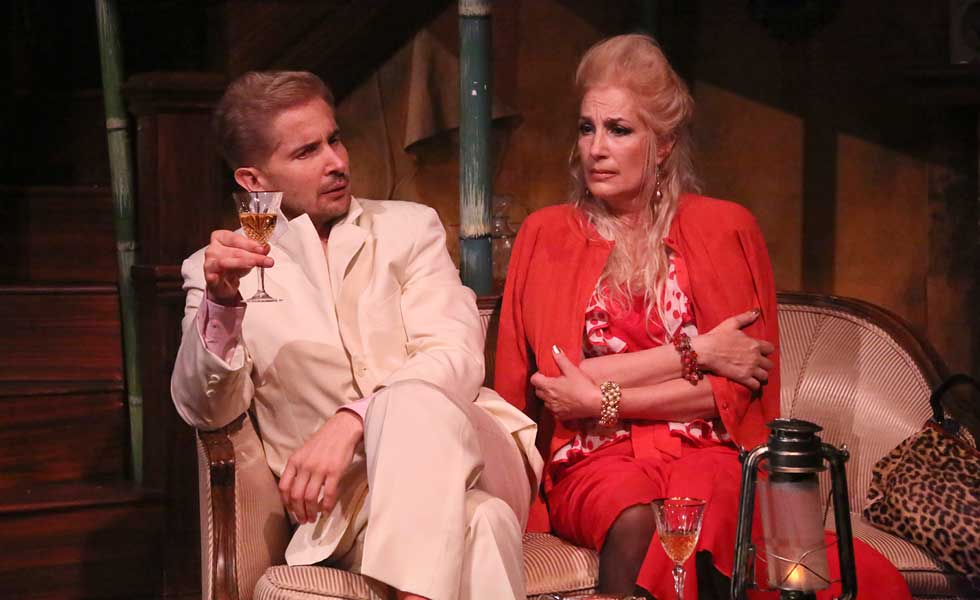
Daniel Felix de Weldon and Susan Priver (Photo – Michael Lamont).
Kingdom of Earth is one of Tennessee Williams’ lesser-known and less frequently produced plays. This summer, the Odyssey Theatre presents the visiting production, directed by Michael Arabian. It runs now through August 14. Colorado Boulevard sat down with the Pasadena residents and stars of the show, Daniel Felix de Weldon and Susan Priver.
By Rebekah Seeger
Kingdom of Earth was written in the 1960s and tackles themes of loss and deterioration. The dysfunctional family at the center of it is threatened by disease, natural disaster, and each other. Issues of race and gender are explored. Set in the Mississippi Delta during the 20th Century, some of the subject matter feels incredibly relevant today.
Daniel Felix De Weldon regards the character of Lot – a very complicated guy – as the most challenging role of his career. In his extensive research for the character, he mined the origins of the characters’ names and traits. He uncovered allusions to the Bible, traditional medicine, and even spirit animals. This is a play with a lot of depth.
De Weldon has worked with Arabian, his mentor and former teacher, frequently. In the past, they have revisited other forgotten plays together. For example, the two worked on a production of John Patrick Shanley’s Danny and the Deep Blue Sea.
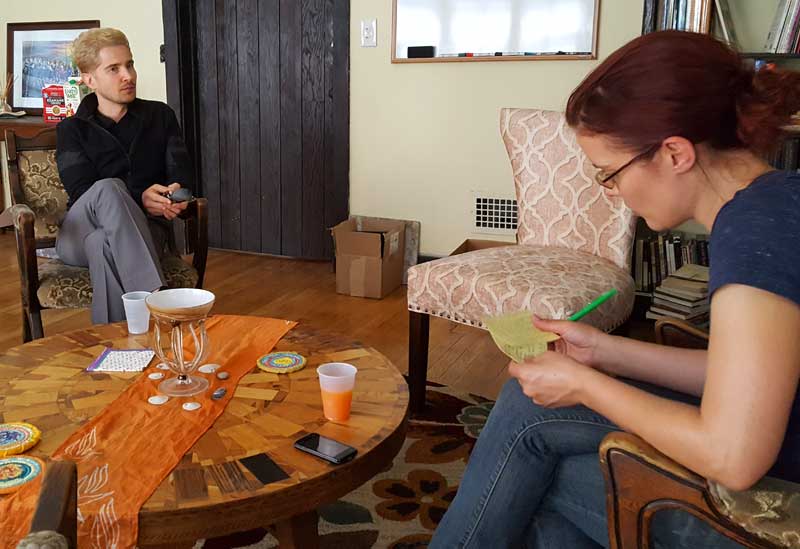
Daniel Felix de Weldon with Rebekah Seeger at Colorado Boulevard offices (Photo – Maelane Chan).
Recently, I had the chance to sit down with Daniel Felix de Weldon to talk about the play and production.
Could you talk a little bit about your connection to Pasadena?
It’s like a vacation outside of Los Angeles, living here. So grounded! And it was a great change for me from living in Hollywood. It’s an incredible city. And my girlfriend’s family has resided here for close to 30 years now.
What do you think sets this play apart from some of Williams’ other work?
The timeliness of it is now.
It’s sort of ahead of its time in a way.
I just think it takes an audience into the depth of every human beings’ humanity. [Williams] writes in strong abstract extremes to really push out and cause thought-provoking scenarios and situations, not just with individuals but in society.
How did you approach the character of Lot?
Via the director – it was so interesting, a review came out yesterday…literally almost word for word touched on what Michael Arabian’s direction was to me in the beginning before we started rehearsal. “I want the audience to think that you’re a ghost.” And at the end of [the review] she said that Lot bows to the audience with a type of spectral bow.
Personally for me, I just, I was excited that the world had a very deep spiritual sense. I don’t think that most people will get that just by reading the play. I hope by seeing the play, they’ll get that from our performance and Michael’s direction.
Ο Ο Ο
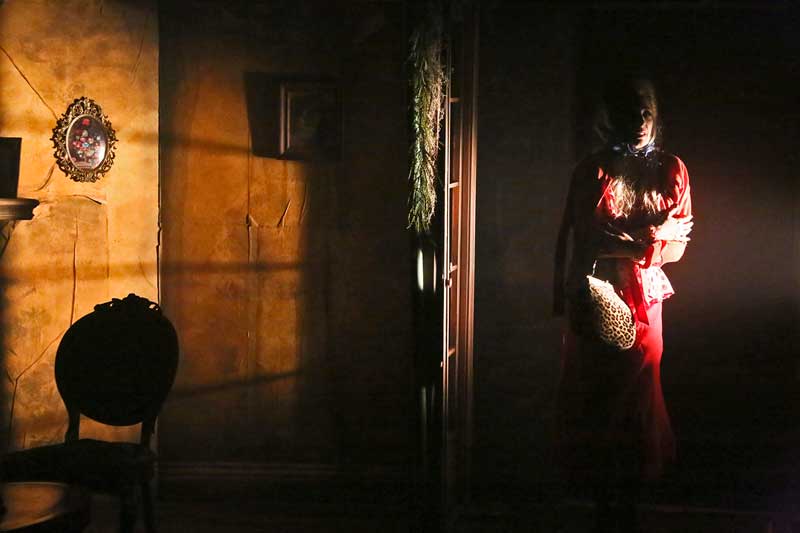
Susan Priver in “Kingdom of Earth” (Photo – Michael Lamont).
Susan Priver (Myrtle) has graced Pasadena and Los Angeles stages and screens for years, including Tennessee Williams’s one-act “Talk to Me Like the Rain and Let Me Listen.” She’s also inspired an extremely loyal following as a teacher for over a dozen years at Pasadena’s Yoga House.
By Melanie Hooks
Somehow in her spare time, Priver has authored the forthcoming memoir as well – “Dancer, Interrupted” about her struggle to overcome depression as a ballet dancer and reclaiming her life as an artist.
Perhaps then it is no surprise that the play’s run itself exists because Priver turned her dream of leading a full-length Williams play into reality.
Priver applied for the rights five years ago, and couldn’t get them because the play was going to be produced in New York. When it was never done, she tried again and got them, after convincing them she’s not affiliated with any local theater. She contacted Michael Arabian and he seemed interested and loved the challenge of directing it. She then contacted the Odyssey Theatre, an “intimate space and well run, with an amazing set designer.”
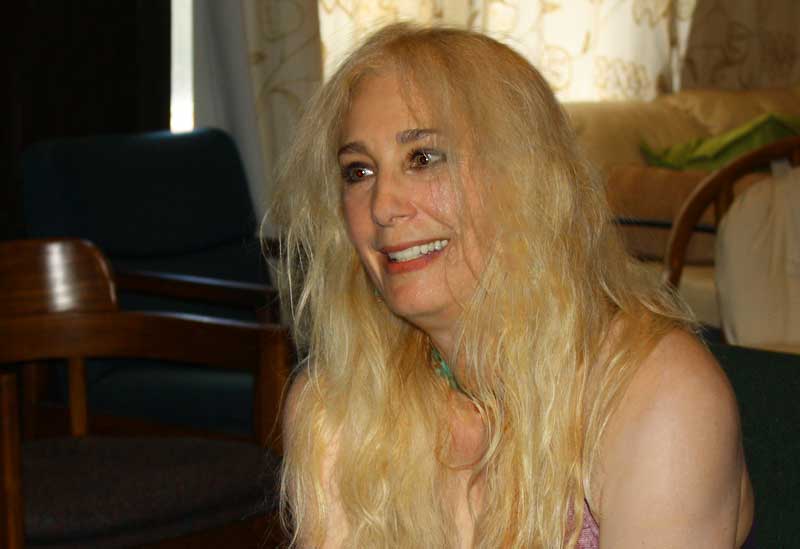
Susan Priver being interviewed by Melanie Hooks (Photo – Maelane Chan).
How has it been, playing one of Williams’s famously textured female characters?
It’s been the hardest rehearsal period…it’s really difficult, but I’m just so delighted to be playing [it]. I’ve been looking forward to playing one of his ‘women’ for a long time. Blanche is a great one, but everybody does Streetcar [Streetcar Named Desire]. And it’s very hard to get the right to any Tennessee Williams play these days…in L.A. and New York. You can get it for any community theater [outside that], but if it’s for what they call Showcase Theater, they don’t give it out. But I actually got them on my own.
“Kingdom of Earth” is lesser known now, though it got wonderful reviews when Williams premiered it in 1968. How did you first come into contact with it, and what about it spoke to you?
I first came into contact with it many years ago working on it in class a little bit and liking it…I never thought, “Oh, I’ll do this one.” But as I got older…you have to have tons of life experience to play his women, even if maybe they aren’t that old. Because they come in with a huge amount of life experience…this is a woman who’s been around the block and was a showgirl.
We’re running to the house because I’ve just married my husband. There is a flood ensuing; my character ‘ain’t too smart.’ She doesn’t know that it’s going to flood the entire house…we’re going there to preserve my new husband who I married on television. It’s kind of a jokey marriage, but it is a marriage nonetheless. After I won Queen for the Day on the streets of Memphis. I find my husband there. He’s kind of lurking, waiting for some woman to take the house away from his half-brother who has black blood in him. They hate each other, so there are racial issues.
And some celebrity culture?
There’s some of that too. He wrote this in ’67-’68. And it’s revealed through it that my husband is not a straight man. But she loves him; she needs him. [Williams] was really ahead of his time.
What has surprised you about this character?
How much I’m like her, not on a superficial level…but on a very deep level, on a universal level for a lot of women, I think…a sort of desperation for how it would be without something or someone to take care of me, which is not something I show, but it’s very deeply in there unfortunately, even being as modern a woman as I am, pretty much able to take care of myself…what Tennessee writes is so close to the human soul, and that is what I connect with throughout.










Leave a Reply