








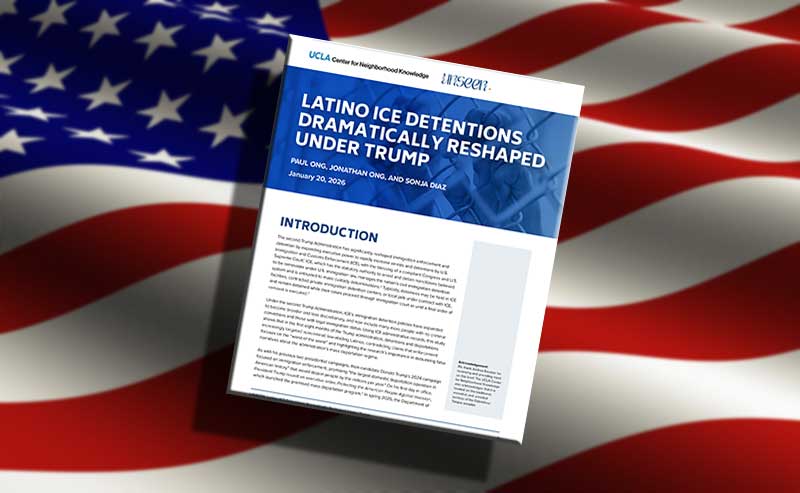
A UCLA study finds that during the administration’s first eight months, U.S. Immigration and Customs Enforcement (ICE) increasingly targeted noncriminal, law-abiding Latinos (Photo – Graphics Dept.)
A sweeping new analysis of federal immigration records reveals that the second Trump Administration has dramatically expanded the detention of Latino immigrants with no criminal history, transforming the nation’s immigration system into what researchers describe as a mass‑detention regime operating at unprecedented scale.
By John Boucher
A UCLA study authored by Paul Ong, Jonathan Ong, and Sonja Diaz finds that during the administration’s first eight months, U.S. Immigration and Customs Enforcement (ICE) increasingly targeted noncriminal, law-abiding Latinos, despite repeated claims that enforcement prioritizes “dangerous criminal illegal aliens.” The findings directly challenge the administration’s public narrative and underscore the scale and speed of its escalating deportation agenda.
A System Reshaped by Executive Power
Trump took office in January 2025 pledging to carry out “the largest domestic deportation operation in American history.” On his first day, he issued an executive order titled Protecting the American People Against Invasion, which expanded ICE’s authority and accelerated arrests. Without objection from Congress or the U.S. Supreme Court, the administration broadened the categories of immigrants subject to detention.
In May 2025, White House Deputy Chief of Staff Stephen Miller proposed a target of 3,000 immigration arrests per day. The administration soon deployed National Guard units to support ICE operations in major cities, including Los Angeles, Chicago, Portland, and New Orleans. According to the report, ICE agents increasingly relied on racial profiling—such as ethnicity, language, and presence in immigrant neighborhoods—a practice the Supreme Court upheld.
FINDING 1:
Noncriminal Latino Detentions Increased Sixfold
The number of noncriminal Latino immigrants entering ICE detention each month increased sixfold during the first eight months of the Trump administration compared with the same period under President Biden.
Monthly entries rose from an average of 900 under Biden to 6,000 under Trump, peaking at nearly 10,500 in September 2025. The share of noncriminal detainees grew from less than one-eighth of all detentions in 2024 to more than one-third by late 2025.
This surge was driven largely by at-large arrests at homes, workplaces, and public spaces—operations that disproportionately targeted Latino communities.
FINDING 2:
Most Detainees Were Working‑Age Adults in Their Prime Years
The increase in detentions was concentrated among working-age adults:
- Ages 18–34: nearly sevenfold increase
- Ages 35–54: more than ninefold increase
Men accounted for the vast majority of this growth. The number of detained Latino men rose from 3,500 under Biden to more than 38,700 under Trump, increasing their share of all detainees from 51% to 80%.
Detentions of women and minors also increased, though at far smaller scales.
FINDING 3:
Detentions of Mexicans and Guatemalans Increased Eightfold; Venezuelans Increased Fourteenfold
Although detainees came from 19 countries, five nationalities accounted for three-quarters of all noncriminal Latino detainees:
- Mexico: nearly 8× increase (1,500 → 13,300)
- Guatemala: nearly 8× increase (under 1,000 → 8,600)
- Honduras: nearly 10× increase (700 → 6,000)
- Venezuela: 14× increase (under 400 → 5,600)
- Ecuador: 1,100 → 2,800
The sharp rise in Venezuelan detentions represents one of the most dramatic shifts in recent immigration enforcement patterns.
FINDING 4:
Detainees Were Held Longer and Moved More Often
Under Trump, noncriminal Latino detainees were held far longer than under Biden:
- Biden median stay: 1–3 days
- Trump median stay: over 25 days
Nearly seven in ten detainees were held for more than two weeks, compared with four in ten under Biden.
Transfers between detention facilities also increased:
- Average stints under Biden: fewer than two
- Average stints under Trump: three
Frequent transfers disrupt access to legal counsel, family support, and medical care, and often result in harsher detention conditions.
FINDING 5:
Out‑of‑State Transfers Increased Twelvefold
The number of detainees transferred out of state rose from fewer than 900 to 24,800 — a twelvefold increase.
The share of detainees moved out of state jumped from 18% under Biden to 55% under Trump. While some transfers reflected capacity constraints in Texas and the Southeast, the report cites evidence that other relocations were intended to limit access to legal representation and community support.
FINDING 6:
Only 9% Were Released Back Into the Community; 88% Were Removed
The Trump administration sharply curtailed discretionary releases:
- Community releases: fell from 42% to 9%
- Deportations: rose from 57% to 88%
The number of deported noncriminal Latino detainees increased nearly eightfold, from fewer than 3,900 to 34,400.
Voluntary departures Remained Rare
Despite efforts to incentivize self-deportation, voluntary departures among noncriminal Latino detainees remained limited:
- Biden period: fewer than 50
- Trump period: 1,250
Even with this increase, voluntary departures accounted for just 3% of releases under Trump.
Conclusion:
A System Producing Widespread Hardship
The researchers conclude that the administration’s detention practices have produced four major forms of harm:
1- Direct harm to detainees
Longer detentions, frequent transfers, out-of-state relocations, and harsh conditions, including reports of sleep deprivation, inadequate nutrition, and unsanitary facilities.
2- Harm to families
Many detainees belong to mixed-status households, estimated at up to 5 million nationwide, where detention intensifies financial strain, health challenges, and emotional distress.
3- Community‑wide fear
Latino communities across the country report avoiding work, school, medical care, and everyday activities due to fear of ICE operations.
4- Economic harm
The loss of immigrant workers, particularly working-age men, reduces labor supply in key industries and slows economic growth.
The authors warn that conditions are likely to worsen. With billions in new funding from the president’s “Big Beautiful Bill,” ICE has become the nation’s largest federal law-enforcement agency, fueling what the researchers describe as a growing “Deportation-Industrial Complex.”
The researchers argue that these policies may ultimately reshape the country’s racial and ethnic demographics, aligning with political objectives to reduce the presence of racially and ethnically diverse communities.












It’s never been about immigration. It’s never been about crime.