







Editor’s Note: This article was first published in our December 2024 print edition and was scheduled for online release shortly thereafter, but its publication was postponed in response to the unfortunate events that unfolded in January.
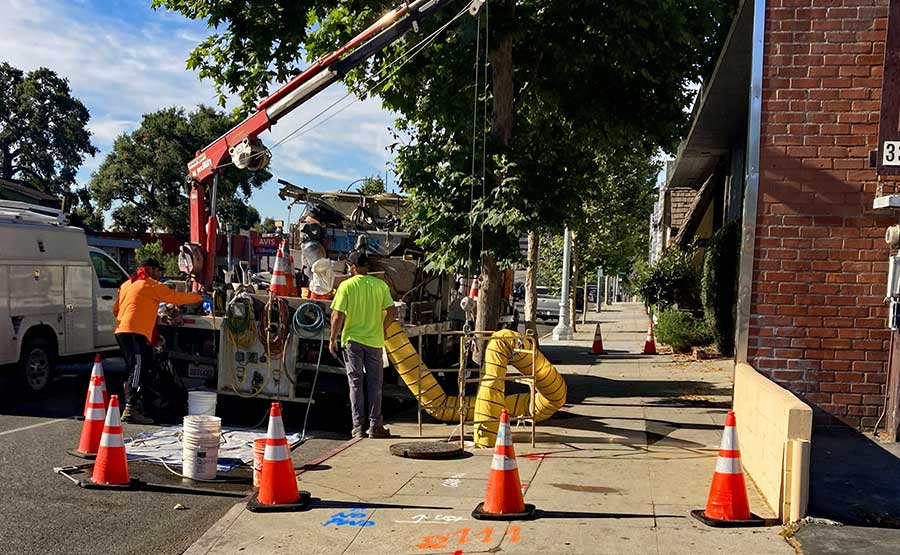
PWP at work (Photo – Sharon Hawley)
Pasadena, for all its affluence, is underlain with a network of ugly sewers. Nobody likes sewage. It’s impolite to even mention the subject.
By Sharon Hawley
It’s ugly, and it stinks. But some of our people are charged with keeping things flowing away from our thoughts, our eyes and our noses, until it surfaces at the treatment plant for final disposal or for use in irrigation. We say nothing when sewer workers and designers of sewers succeed. But we raise a stink when something goes wrong. This is a story about what sewer workers do and how much we owe them.
Working with civil engineers designing subdivisions, I prepared plans for use by contractors for installing water and sewer systems. They put me in the sewer department because it’s repulsive and fits my style. I’m a lover of maps and working outside, so they figured I’d be good at finding manholes, pumps and force mains in the field, then showing how they connect on plans in the office. Having the existing system shown on maps, engineers could then proceed with design. When architects needed help in getting rid of you know what, their thoughts landed on my desk. Solutions flowed downhill from there.
But more than once the maps of record didn’t match what I found in the field. What is a mapper of sewers to do? Go down the manholes for a closer look? No, I found sewer workers with gear designed for hazardous gas and liquid and the fortitude for the most obnoxious environment imaginable. They often provided better data than I could find on engineering drawings. The men who go down under, into manholes, facing the stench and danger, know firsthand what’s causing the clog, the backup, the cave-in. When necessary, they go down under, where life is far from pleasant.
It wasn’t my job, but I wanted to go there just once, because if the blame for a mis-design falls on the company, I want to see it firsthand. “Just once I’d like to go down,” I said to a sewer worker. “Do you know about SO2?” he asked, “hydrogen sulfide?” “It can be deadly you know. “And ammonia, NH3 can explode.” I didn’t want to, but I said I did. His smirk said it all.
He put on a hazard suit, hood on over his head, his body completely covered, and strapped on a device for measuring his breathing. A hose attached to his hood, a cable snapped onto his harness. He looked like Neil Armstrong on the moon. They lowered him down, and he stayed there three hours. Men on the surface gave him tools on ropes when he called for them. A man on the surface monitored his breathing. My feelings for him as he worked down in that stinking hole, be they kind or hateful, had to be set aside. It was job that somebody had to do.
When he finally surfaced, he said, “Your plan is wrong, but it’s ok, I made it work.” The best report I could have heard. I missed him while he was down there, while he worked in the most hostile part of Pasadena, doing a job that nobody wants to even hear about.












This is an interesting article. Good information, what lies below.