





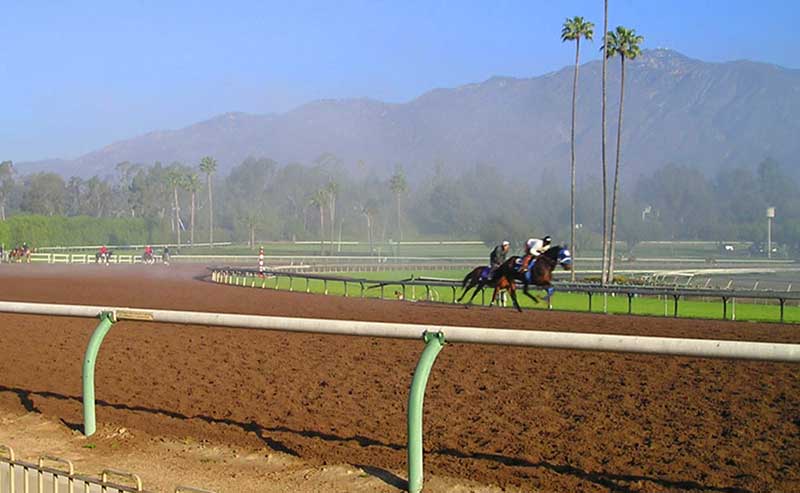
Santa Anita Park (File Photo – Ellen Levy Finch)
Santa Anita Park is bracing for a major legal fight after California authorities confiscated a set of newly installed gaming terminals, setting off a dispute that could have far-reaching consequences for horse racing in the state.
By John Boucher
The confrontation unfolded Saturday, January 17, when an estimated 15 to 25 agents from the California Department of Justice entered the track’s grandstand during a live race card, according to the Los Angeles Times. Investigators seized 26 gaming terminals known as Racing on Demand, along with the cash inside the machines, and removed them from the facility using handcarts.
The seizure came just two days after the terminals were quietly installed. Santa Anita placed the machines on the floor Thursday, January 15, characterizing the rollout as a limited “soft opening.” The installation was not formally cleared in advance with the California Horse Racing Board.
The machines at the center of the dispute allow patrons to wager on previously run horse races through a digital interface resembling a slot machine. During their brief period of operation, the terminals reportedly processed about $26,600 in bets.
At issue is whether the devices fall within California’s existing framework for legal pari-mutuel wagering or instead constitute illegal slot machines. Santa Anita’s owner, The Stronach Group, which operates its racing business under the banner 1/ST Racing, maintains the machines are lawful. Company officials say the terminals rely on a wagering format approved by regulators in 2024, known as a “three-by-three” bet, which requires players to select multiple trifecta outcomes. They also contend that a detailed legal analysis supporting the machines’ legality was shared with the Attorney General’s office nearly a year ago.
State officials and tribal gaming representatives strongly disagree. Attorney General Rob Bonta’s office has taken the position that the terminals are fundamentally games of chance, placing them outside the scope of permitted horse racing wagers. Tribal leaders have echoed that view, noting that California law grants tribes exclusive rights to operate slot machines, protections they argue would be undermined if the terminals were allowed to remain in use.
The state has indicated that, absent a court order, the seized machines could be destroyed after a 30-day holding period. Santa Anita executives have responded by signaling their readiness to challenge the action in court, framing the dispute as a pivotal test for innovation and revenue generation in California horse racing.









Leave a Reply