




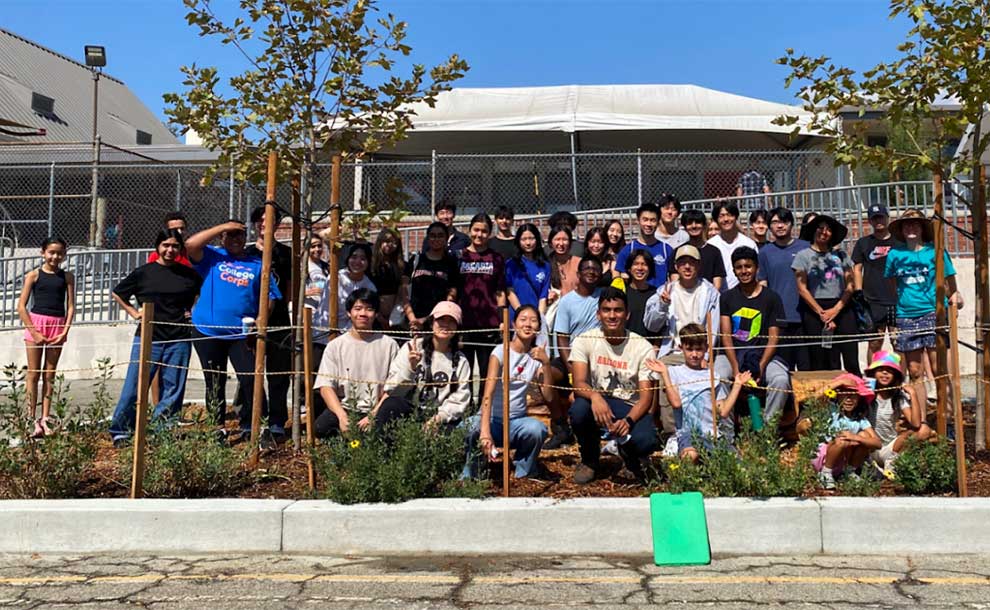
Over 60 volunteers descended on San Rafael Elementary school to celebrate CA Clean Air Day (Photo -Max Reutimann)
Addition of new native plants and trees will help cool and clean the air at the west Pasadena campus.
By Wesley Reutimann
On Sunday, October 6th, San Rafael Elementary School in west Pasadena celebrated California Clean Air Day with a morning of volunteerism. A diverse group of over 60 students, parents, neighbors, and California Climate Action Corps members came together to take another step towards realizing a greener, healthier campus.
Volunteers carried out a wide array of tasks, with the support of staff from Altadena-based non-profit Amigos de los Rios and members of the San Rafael Elementary Outdoor Education Committee. Two raised planter beds were assembled and filled with soil. Sheet mulching utilizing cardboard donated by parents and oak tree mulch provided free of charge by Navarro Tree Service was completed around the school’s art room and central courtyard. New homes were found for a variety of California native plants and trees, including Pink and lilac colored Yarrow, Eriogonum Grande Rubescens, Encelia Californica, Dwarf Pigeon Point, Chilopsis Linearis (Desert Willow), and Desert Museum Palo Verde.
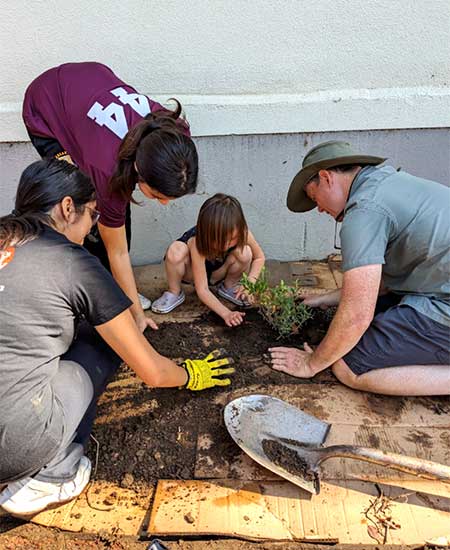
Volunteers pack soil around a native Encelia Californica – California Bush Sunflower (Photo – Wen Lee)
The event was one of dozens highlighting actions individuals and communities can take to support cleaner air. After decades of steady improvements, air quality in southern California has been on the decline over the past decade, a problem exacerbated by rising temperatures that worsen air pollution. The San Gabriel Valley currently averages 32 days per year where daytime temperatures exceed 95°F. According to UCLA researchers, this could rise to 74 days per year by 2050, and an average of 117 days annually by 2100. These long-term changes will make reaching federal clean air standards, something southern California has yet to do, more difficult in the years ahead.
Thankfully the technology and steps to clean our air are available. Investing in cooler, greener schools and neighborhoods offers numerous mental, physical, academic, and social developmental benefits, in addition to helping reduce air pollution and urban heat islands. Replacing gas powered tools, appliances, and cars/trucks with zero emission alternatives is underway and accelerating, with options becoming more affordable and accessible to the general public each year. Improving conditions for walking, bicycling, and taking public transit to school to further reduce transportation related pollution – and support student health and wellness – is another opportunity local communities can embrace. For the San Rafael Elementary ‘Pandas’, the choice is clear. A cooler, greener school is a win for clean air and the community. Sunday was another step towards that future.
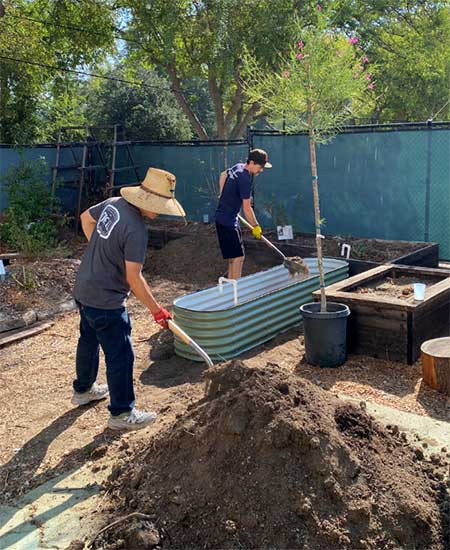
Among the new plantings were a Desert Willow (Chilopsis) and Desert Museum Palo Verde, two drought-tolerant species native to the southwest US (Photo: Wes Reutimann)












Leave a Reply