






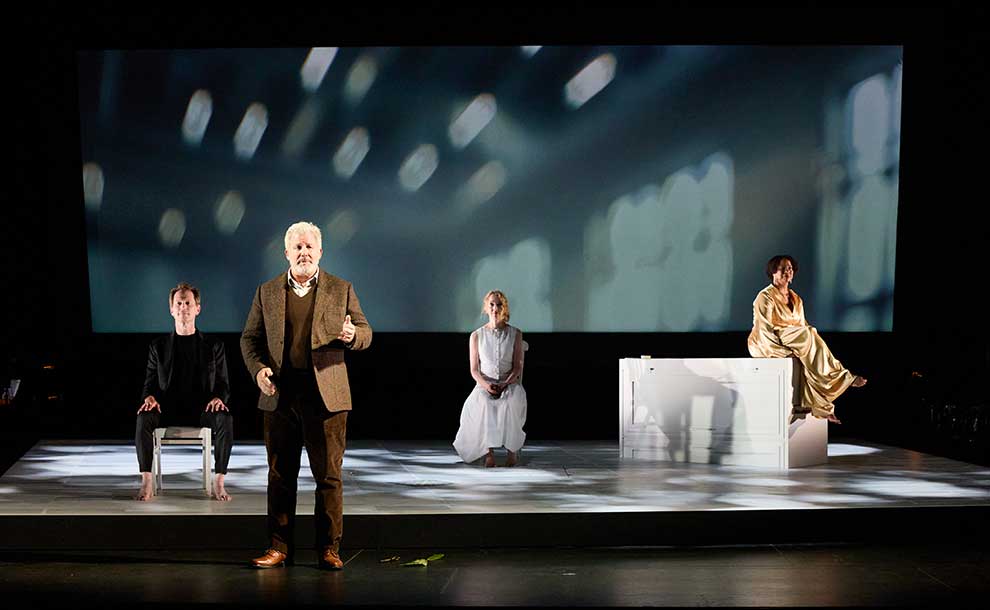
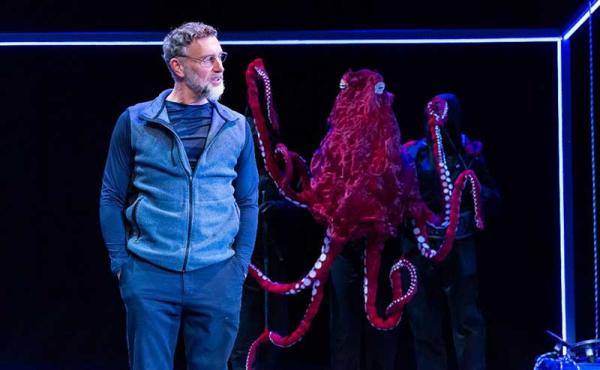
(L-R) Leo Marks (Maurice Ravel); Larry Poindexter (Dr. Bruce Miller); Lucy Davenport (Dr. Anne Adams); Tracey A. Leigh (Ida Rubinstein) (Photo – Stan Evans)
My studies in Theatre Arts and Linguistics taught me to see performance and language as portals to human connection. Judging by his latest work, Unravelled, actor and playwright Jake Broder seems equally drawn to what happens on the other side. In Unravelled, Broder parallels the stories of cell biologist Anne Adams and composer Maurice Ravel to explore an unlikely mode of human connection: modern art.
By Natalia Rose
The play centers on the cognitive decline of dementia, embodied through Anne Adams (Lucy Davenport), whose illness compels her to trade her love of science for abstract painting, and for a metaphysical companion also in decline, Maurice Ravel (Leo Marks). The non-linear narrative leaps between Anne’s and Ravel’s homes, punctuated by commentary from Anne’s doctor (Larry Poindexter), who breaks the fourth wall to reflect on the purpose of modern art.
Already, we have a protagonist whose illness unlocks a raw, instinctive capacity for modern art and a narrator who breaks the fourth wall to ponder its meaning. But Broder goes further: through the layering of theatrical design elements and shuffled directorial motifs, the entire production becomes one large, living piece of modern art.
A five-piece band encircled the rhombus-shaped platform where most of the performance took place. Mark Grey’s score alternated between providing cinematic emphasis to heighten the drama and translating Anne’s intimate moments as she struggled to communicate with both an equally perturbed Ravel and her bewildered husband (Andrew Borba). The set and props, painted a stark hospital white, became a blank canvas for projections of Anne’s abstract artwork, mirroring the small collection of her original paintings displayed in the lobby.
Throughout the first half, director James Bonas kept the actors in constant motion, each tracing a secret, deliberate path while colliding with one another’s worlds like multicolored brushstrokes on a canvas. Musicians and actors worked in concert, handing off props, pulling set pieces from hiding places, and revealing the machinery behind the magic, making Unravelled an exquisite example of Epic Theatre.
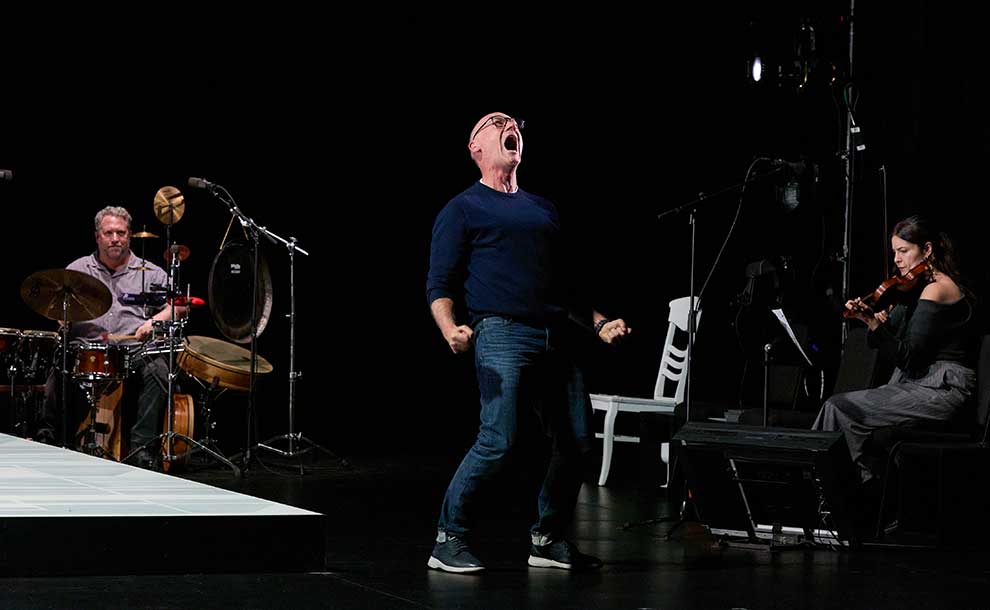
(L-R) Randy Gloss, percussion; Andrew Borba (Robert Adams); Rachel Iba, violin (Photo – Stan Evans)
Despite Unravelled’s impressive commitment to the core “estrangement effect” of Epic Theatre, through its shifting set and redefined patterns of storytelling, the sheer volume of visual and design stimulation often distracted me from forming the key takeaway the narrator seemed to urge the audience toward: a provocative question.
Larry Poindexter’s character first appears as a professor of modern art, lecturing directly on Cubism and Impressionism, before entering the storyline as Anne’s doctor, marveling at her rare ability to communicate through painting. Poindexter held my attention as he argued that provocative questions about art, psychology, and science are what keep humans curious and creative. Yet I couldn’t quite locate an overt provocative question lingering in the subtext. Instead, I found the piece might function more effectively as an example of Theatre in Education, aimed at forty- and fifty-somethings seeking to understand the decline of dementia.
Unravelled, a delightful double entendre, was at its core, a tender play about how beauty can still find you, even when your own brain betrays you.
The world premiere of the play UnRavelled by Jake Broder was shown in conjunction with ‘A brain health festival’ at The Wallis.













Leave a Reply