





GUEST OPINION
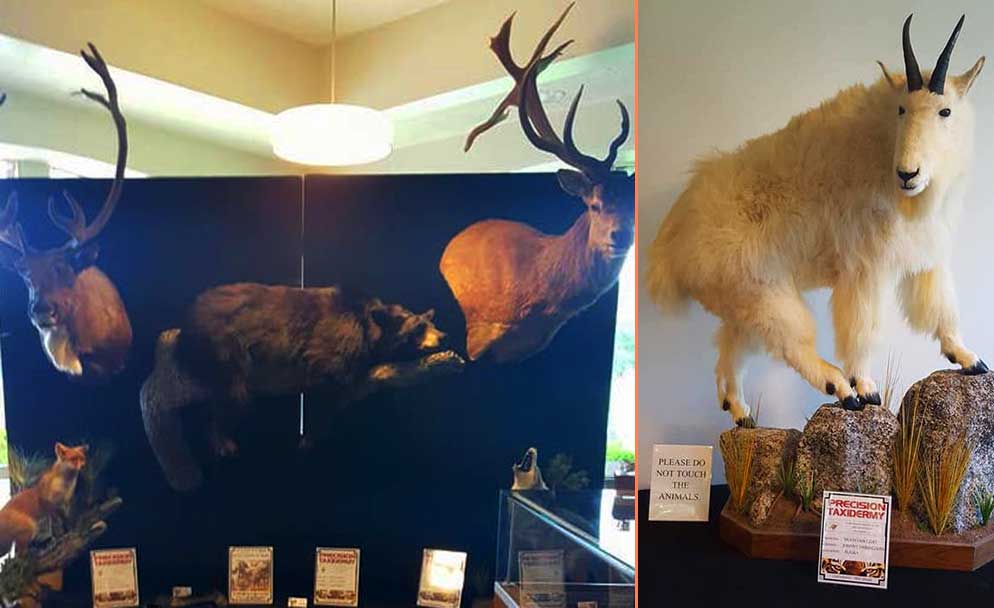
Displays at the “Festival of the Hunt” fundraiser (Photo – An attendee).
On Saturday, April 21, the Safari Club International (SCI) held a fundraiser, “Festival of the Hunt,” at the Brookside Club House.
By Susan Campisi
As a member of the AltaPasa community who cares deeply about saving Earth’s dwindling wildlife, I was shocked to learn that an event revolving around trophy hunting was taking place in a Pasadena-owned establishment.
Safari Club International (SCI) is one of the largest hunting advocacy organizations in the world, wielding enormous influence over domestic and international hunting laws and regulations, helping to keep controversial practices—such as the killing of endangered iconic wildlife, like elephants and lions, and importing of “trophies” into the U.S.—legal.
Most people are disgusted by a viral photo of a young, female hunter posing with a giraffe she’d just killed (such a graceful, gentle creature!), or by the many other photos on social media of hunters with dead elephants, rhinos, lions, bears, etc. Once majestic animals reduced to trophies to be mounted on a wall or stuffed to show off in a display room.
Killing as conservation
Despite the majority of the public finding trophy hunting abhorrent, SCI’s power and wealth enable the “killing as conservation” model to maintain its stronghold around the world. SCI President, Paul Babaz, is one of 16 members on Secretary Zinke’s International Wildlife Conservation Council, a council (stuffed with trophy hunters) whose main purpose is to promote the economic benefits of international hunting. The U.S. imports more “trophies” than any other country in the world, making us the global leader in killing off the planet’s wildlife. This deeply entrenched “sustainable use” model of conservation is a vestige of colonialism, with the U.S. exerting imperial power through trophy hunting.
SCI defends trophy hunting saying the money generated supports wildlife conservation. But an in-depth analysis by CAT* of the practice in Africa challenges that claim, concluding:
“…trophy hunting is an activity that fuels corruption, encourages the unfair redistribution of the wealth generated without adequate involvement of communities, causes the loss of healthy individuals that are still key for reproduction and social cohesion and, most damagingly, contributes to the decline of all five species considered in this report [elephants, rhinos, leopards, cheetahs and lions].”
Elephants, lions, and wolves
Those who support trophy hunting don’t address its inherent cruelty and the destabilization to family structures. Elephants have complex emotional lives and tightly knit social structures, very similar to human beings. Highly intelligent and sensitive, they mourn their dead, returning to the location of a deceased family member, touching the bones with their trunks. Do SCI hunters consider the suffering inflicted on the elephants left behind when one of their family members is “taken” by a hunter?
Cities are like
landlords…they
have the right
to decide who
to rent their
space to
The infamous dentist who killed Cecil the lion in Zimbabwe was an SCI member. Granted, SCI revoked his membership after public outrage and exposure he had broken the law. His Zimbabwean professional hunting guides enabled his crime, luring the majestic lion with bait. Corruption in Zimbabwe has pervaded the hunting industry and law enforcement for years, with Mugabe and his cronies devastating natural resources, including wildlife. The Obama administration instituted a ban on elephant trophy imports from Zimbabwe (and Zambia) in response to rampant corruption. SCI responded to the ban by filing a lawsuit, together with the NRA, challenging it. (They won that lawsuit back in December.)
You can pretty much count on SCI to fight any attempt to restrict hunting. They are lobbying to get wolves off the endangered species list; they are fighting the push in Arizona to ban hunting of bobcats and mountain lions; and they lobbied to keep lions and elephants from getting the strictest protections possible under CITES, an international body that regulates international trade in endangered species, including the import of “trophies.”
SCI lobbying skills
I witnessed SCI lobbying skills firsthand at a United States Fish & Wildlife (USFWS) meeting in Washington, D.C., in 2016 to elicit public comments for U.S. positions at the upcoming CITES conference, CoP17. Attending as a representative of the Global March for Elephants and Rhinos, I urged listing all African elephants and lions on Appendix I, affording both species the strictest protections possible (rather than the confusing, convoluted split-listing where populations from some countries are on Appendix I and other populations on Appendix II). I presented a well-researched case (aligned with positions of the African Elephant Coalition in the case of elephants), explaining why both species desperately needed these strict protections. Nearly all other attendees made similar pleas in their public comments—except for the SCI representative, a slick, articulate lawyer who dispassionately twisted the data to lobby for maintaining the current status. Unfortunately, despite overwhelming evidence to support the case for stricter protections for both species, SCI and their powerful friends managed to maintain the split-listing status. The upshot? It remains legal under CITES to import “trophies” of African elephants and lions (from countries where they are listed on Appendix II) into the U.S.
SCI and lead bullets
SCI even fights efforts to eliminate lead bullets, which the National Park Service states is the biggest threat facing the recovery of the California condor. More than 500 scientific studies have documented that worldwide, 134 species of wildlife are negatively affected by lead ammunition. Instead of working to address this threat to wildlife, SCI fights back against the attempt to restrict lead ammunition, stating “currently one of the biggest threats to hunters and sport shooters around the world is the push to ban or restrict traditional ammunition. SCI is continually working to fight this effort.”

Protesting “Festival of the Hunt” in Pasadena (Photo – Michael Fujimori).
Protesting the fundraiser
I joined a group of about 50 people to protest SCI’s fundraiser event, and then wrote a letter to Mayor Tornek and city councilmembers expressing my disgust. I heard back from Darryl Dunn, CEO and General Manager of the Rose Bowl Operating Company, who said it was a First Amendment issue, claiming “we are limited in our ability to prohibit an individual or group from utilizing the facility if that prohibition is based on their political viewpoint or desire to engage in certain kinds of free speech or association.” But don’t the citizens of Pasadena have some say over who rents their property?
Does the First Amendment compel the city to rent out public property to anybody, regardless of their views? A friend who was involved with a battle to get Glendale to stop renting public property for a gun show said “that would mean that you’d have to rent out the local Civic Auditorium to white supremacist groups, NAMBLA, and other people with abhorrent views. Cities are like landlords and they have the right to decide who to rent their space to, within legal parameters. And the taxpayers of the city are the stewards of public property.”
Shouldn’t the citizens of Pasadena have a say in who rents their public property?
The property was built to serve the community, not just to make money for the city treasury, and their taxes pay for the maintenance and management of that property.
Hamilton Elementary School held a big fundraiser at Brookside on Friday, April 20. I wonder how Hamilton teachers, parents and students would feel when they learn the next day an event on the same property revolved around guns and dead animals. (Check out the list of firearms on the event webpage and the list of animals auctioned off at the 2018 SCI convention.)
Is the killing of endangered species around the world a value that the majority of the Pasadena community upholds? Does Pasadena profit from this SCI event? Does taxpayer money support it? Many of these questions and more should be posed to Pasadena City Councilmembers.
I’m not sure if this was the first SCI event hosted at Brookside or one of many, but I urge Pasadena residents to join me in working to ensure that it be the last.
Susan Campisi is a writer, activist, and UX designer. An animal lover and zero-waste advocate, she is on the core teams of Transition Pasadena and the Global March for Elephants and Rhinos.
*Conservation Action Trust (CAT) – The effects of trophy hunting on five of Africa’s iconic wild animal populations in six countries – Analysis.
[This article has been updated to add a link, May 8, 2018 1:45 p.m.]
The Guest Opinion section reflects the opinions of the responsible contributor(s)/writer(s) only, and do not reflect the viewpoint of ColoradoBoulevard.net. ColoradoBoulevard.net does not endorse or guarantee the accuracy of any posting. ColoradoBoulevard.net accepts no obligation to review every posting, but reserves the right (with no obligation) to delete comments and postings that may be considered offensive, illegal or inappropriate.












If hunters want to argue personal rights: Why does a hunter’s right to kill an animal take precedence over my right to see that animal alive? Why do hunters’ rights take precedence over my right (and the right of others who care about animals) to not have my head filled with bloody images of dead animals? I’ve seen lifeless giraffes, their beautiful heads held up by evil hands for a photo. I’ve seen so many dead animals because of these violent human beings. Where is my right to not have nightmares filled with animal suffering?
Excellent questions, Robyn. Very well said. There is also an economic argument that the money live animals bring to the community over the course of their lives through eco-tourism and photo opportunities outweighs the money paid for killing them.
This Article was mentioned on brid-gy.appspot.com
?
?