






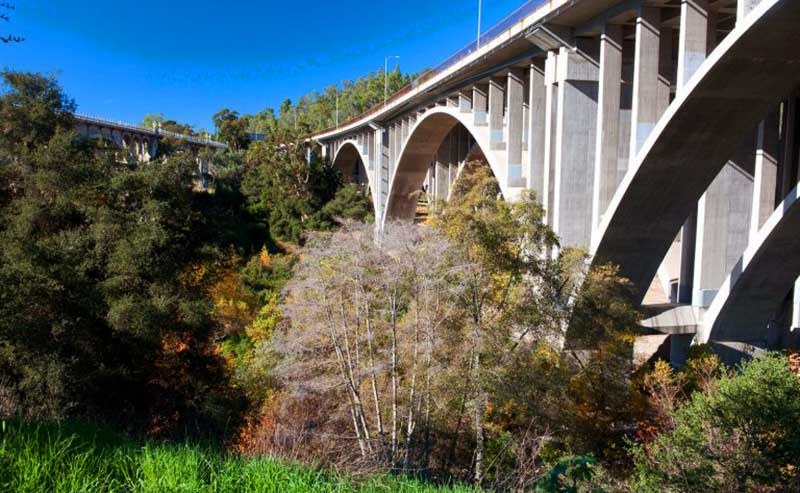
Urban forestry at Arroyo Seco (Photo – cityofpasadena.net)
The cities of Pasadena and South Pasadena have launched the Arroyo Seco Water Reuse Project, the first regional stormwater capture initiative in the historic Arroyo Seco corridor.
By News Desk
The project aims to enhance regional water quality, restore local habitat, improve public access to open space, and significantly recharge groundwater resources in the Raymond Basin—a critical local water source. The main driver of the project is the mandate to remove bacteria per the Total Maximum Daily Load (TMDL) issued by the Los Angeles Regional Water Quality Control Board, ensuring that the water quality improvements align with regulatory requirements.
Spanning 3.7 acres across two coordinated sites, the San Rafael Site in Pasadena and the San Pascual Site in South Pasadena (including a portion of Los Angeles), the project is designed to intercept and naturally treat dry-weather urban runoff, which would otherwise flow directly into the Arroyo Seco channel.
Two Sites, One Vision
At the San Rafael Site, located near San Rafael Avenue, dry-weather flows from San Rafael Creek will be captured before entering the main channel. These flows will be filtered through a pretreatment system and constructed wetlands, allowing a portion of the water to infiltrate into the ground to support local aquifer recharge. Excess flows will be safely returned to the Arroyo Seco channel.
Downstream, at the San Pascual Site, water flows—including those from San Rafael—will be diverted again for further treatment and infiltration. A portion of this cleaned water will be reused for non-potable purposes, such as irrigating the Arroyo Seco Golf Course, helping to reduce reliance on potable supplies.
Together, the system is projected to capture and clean approximately 320 acre-feet of urban runoff annually, with an estimated 258 acre-feet contributing directly to groundwater recharge.
More Than Infrastructure
Beyond water management, the project emphasizes ecological and community benefits:
- San Rafael Site Enhancements:
Native habitat restoration, invasive species removal, wetland creation, interpretive signage, a pedestrian bridge, and trail improvements. - San Pascual Site Enhancements:
Similar restoration efforts, expanded trails, shaded seating areas, and educational signage.
These upgrades will improve ecological function, increase public access, and offer educational opportunities about the Arroyo Seco watershed and sustainable water practices.
Broad Support and Funding
The Arroyo Seco Water Reuse Project is backed by a coalition of community groups, schools, environmental advocates, and government agencies. Major funding sources include Measure W, Proposition 68, and local return funding from both cities. To date, about $13.3 million has been secured for design and construction, with continued advocacy from leaders such as former State Senator Anthony Portantino.
Environmental Review and Public Input
A Notice of Preparation was issued in May 2025, followed by a public scoping meeting on May 28. The public comment period closed on June 30, and a Draft Environmental Impact Report (EIR) is now underway, evaluating potential impacts in areas such as hydrology, biological resources, recreation, and aesthetics. A Final EIR will guide the project’s future approvals and implementation.
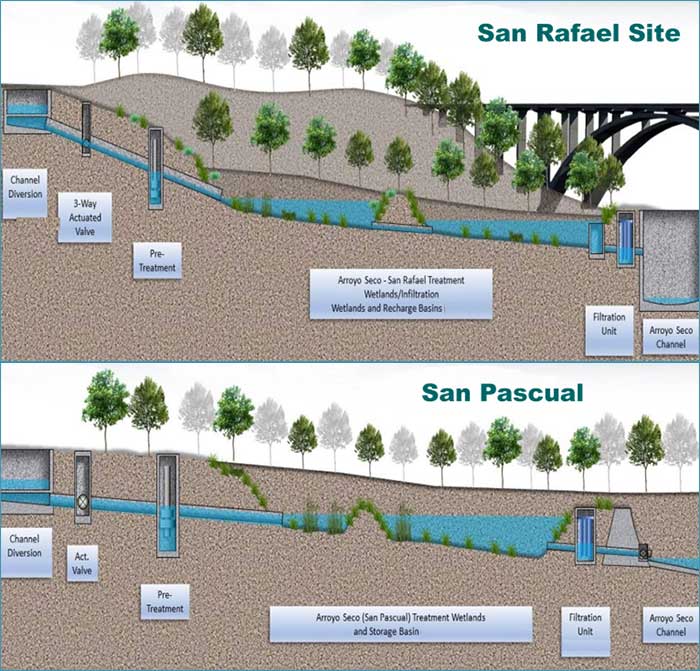
Rendering of San Rafael Site in Pasadena and the San Pascual Site in South Pasadena (Photos – cityofpasadena.net)











Decades ago, when the “storm drains” were constructed the concept was to get all of that water out to sea as quickly as possible, driven by the fear of a couple of disastrous floods. But we failed to adjust our thinking about our decreasing aquifers and our increasing use until now. This is a good start but by no means an end and there is also another project in process in LaManda Park…