

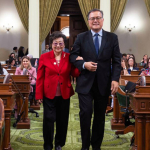




Teresa Mei Chuc on stage with Kathabela and Rick Wilson (Photo – Ben Ben).
Beautiful poet Teresa Mei Chuc came to us on a boat from Vietnam as a small child. She is now a teacher in the Los Angeles area, and a wonderful poet, inspiring all of us with her amazing stories and poems. She recently visited her motherland. Now she is collaborating with Japanese tanka poet Mariko Kitakubo, translating some of each other’s poems. They will give small intimate performances in Pasadena during Mariko’s visit from Tokyo, until October 25. Teresa will also be reading her poetry for the launch of the 2015 Southern California Haiku Anthology at the USC Pacific Asia Museum on November 1, 2015 at 2 p.m., and she will be the featured poet at Tia Chucha’s Central Culturo & Bookstore on January 22, 2016 at 8 p.m.
Teresa Mei Chuc is the author of two full-length collections of poetry, Red Thread (Fithian Press, 2012) and Keeper of the Winds (FootHills Publishing, 2014). Her poetry appears in many journals and anthologies and is forthcoming in the anthology, Inheriting the War: Poetry and Prose by Descendants of Vietnam Veterans and Refugees. Teresa’s third collection of poetry, Lotus Seeds, is forthcoming from Many Voices Press.
Kathabela Wilson
Cockroaches
By Teresa Mei ChucA proposal by someone to my mom
after the Vietnam War: Why don’t
you sell your baby, you don’t have
anything to eat?A response by my four-year-old brother:
No, don’t sell my sister! There are lots
of cockroaches for us to eat!When I returned to the country
eighteen years later, I saw them –
large, brown shiny tanks on the wall,evidence of my brother’s love for me.
~
NHỮNG CON GIÁN
Sau chiến tranh Việt Nam đã có người
đề nghị với má tôi rằng: Sao không bán
đứa bé đi? Các người chẳng còn
cái gì mà ăn.Người anh trai mới bốn tuổi của tôi trả lời:
Không! Không được bán em đi! Chúng ta
còn có rất nhiều gián để ăn!Khi tôi quay trở về nước mười tám năm
sau đó, tôi đã nhìn thấy rõ chúng –
những cỗ xe tăng lớn màu nâu sáng bóng
phi trên tường,Những chứng tích tình yêu của anh trai tôi.
*Translated into Vietnamese by Dang Than
~
Abura-mushi
akanbou wo naze uranunoka kuu tameni hitowa haha ni iu Veiet sen no nochi
“imouto wa uranai yo! taberutame nara boriburi de juubun!” to 4sai no ani
18nen nochini kaereba hei giwani hikaru ookina cha no tank gun
(watashi henno ani no ai no akashi)
*Translated into Japanese by Mariko Kitakubo
________________________________________________________

Teresa Mei Chuc and Kathabela WIlson
An interview with Teresa Mei Chuc, a musical and emotional Poet of ancestral Vietnamese heritage and contemporary lyrical sensibilities.
By Kathabela Wilson
A telescope on the poet
How do you see the performing poet in the world, what can she give and how do you see yourself doing that?
It is incredibly healing for me when an audience listens deeply. When I am reading my poetry about my family’s experiences immigrating to the U.S. from Vietnam, or about the Vietnam War, it is deeply healing for me when I feel the audience listening. I realized this when I began to feel a physical change in my body. I think sharing one’s work can be a healing part of the writing process for both the writer and the reader.
Mapping the Poet

Teresa Mei Chuc @ Moonday East open mic
How does the place where you were born, and the place you grew up, nourish and ignite your work?
My birth country, Vietnam, is full of my ancestral memories, forests, mountains and rivers. Our family came to Pasadena. This is where I grew up and spent almost my whole childhood. I am grateful to be in the belly of a mountain. In times of much needed retreat, I seek sanctuary in the silences of the San Gabriel Mountains. And from this deep solitude and silence, something emerges that becomes poetry.
A microscope on the Poet

Teresa Mei Chuc at Vroman’s poetry reading
What has made you a poet, what propelled you from the beginning and what continues to light the creative fire in you?
It was a relief when I discovered poetry as a child in elementary school. I finally found a way to express myself in a language that I didn’t really feel was mine for a long time. Vietnamese and Cantonese were my first two native languages and English was my third language. The grammar, sounds, pronunciation, and differences from my native languages were hard for me. Writing poetry, I was able to express myself without worrying about punctuation or grammar. Through poetry, I was able to reclaim a part of me that was fragmented and fractured through war, immigration and exile. Poetry empowered me and helped me to transcend language, giving me a way to understand and express myself and my connection with the world.
A metronome on the Poet

Teresa Mei Chuc reading her poetry.
How did music come to you and how does it relate to your poetry?
When I was in third grade, there was a school assembly and a girl played a solo piece on the violin, “The Young Prince and Princess” from Scheherazade composed by Nikolai Rimsky-Korsakov. As I was listening to the girl play the violin solo, I fell in love with the violin and with the song. After I heard her play, I was so moved that I pleaded with my mother to let me play the violin. I had discovered a way to express myself with sounds. I began to feel in the sounds of words and language, their arrangement, like musical notes, the ability to touch the human heart.
Pulse of the Poet
How does your family, your music, and your poetry work together in your life now?
Composing poetry helps me to make sense of the world and helps me to document my family’s history through the Vietnam War, the war itself and the continuing consequences of the war. Poetry allows me to transcend myself in a dance with life and death. Life as well as death lights the creative fire within me. I feel that my work, my family, my poetry community, my travels are all a part of me, my being. So, I do see them as a whole…they are an intricate part of the circulatory system in my body…and my family being the heart.
The Bomb Shelter
by Teresa Mei Chuc
When bombs are exploding outside,
it means that there are implosions.
Vibrations travel through air and liquid.
My amniotic fluid is imprinted with airplanes
dropping bombs and screams and fire.
In the bomb shelter in Saigon,
my father teaches my two-year-old
brother French. “Je m’appelle Chuc Nai Dat.”
“Je m’appelle….”
________________________________________________________
You can learn more about Teresa Mei Chuc on her website.
> Check out more of Teresa’s books: Year of the Hare, Year of the Hare / Nam Cua Tho, and the needle can, Gravity: Poems.








Great feature!
warm regards,
Alan
Microscope, telescope, metronome: I like those changes of pace and perspective. Thank you Kathabela and Teresa