





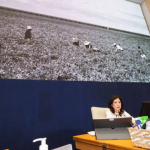


Alex M. Frankel and Kathabela Wilson.
An interview with Alex M. Frankel, a bright, intelligent, sensitive, caring and creative poet and host.
The world Alex uncovers casts light and shadows, as his brave honesty stimulates our hearts and minds to look into our pasts and face the future with insight.
By Kathabela Wilson
A telescope on the poet
Alex, I’ve always loved your originality, and sensed a kinship with your ideas, though we’ve never talked about this before. How do you see yourself as a poet in the world today, and how did your vision develop?
When I was a little boy, I constructed an imaginary society that runs parallel to ours. I noticed even at a young age that most of life is somehow related to conflict, figuring out problems, struggling toward goals. I sought to create an alternative world, in which there was only peace and happiness, sort of like the ideal world that is offered to the old people in the movie Cocoon:
a distant planet where no one has to die, where no disease exists, and yet where people somehow manage to live productive lives. I wrote my own Constitution for my own imaginary world, wrote a History with many Presidents, developed a long catalog of Great Composers. I sang concerts to myself, played with little vintage cars that drove through make-believe streets. I had no brothers and sisters. I had to entertain myself. And I’ve been entertaining myself ever since, even though I’ve given up all notions of peace and happiness. But the creative impulse always has to do with creating a better aesthetic space than what we see around us.

A microscope on the poet
I’ve found your poetry unusual and very personal, with quite a story to tell, how did you find your poetic voice?
When I was much younger I loved telling stories, but as I matured I came to see that I didn’t have much of a grasp of other people’s lives. In my thirties, I began to prefer poetry over prose. I loved the creativity of the enterprise. I could just sing! In poetry I can simply “confess.”
And that’s what I’ve been doing now for nineteen years. However, I’ve once again turned to prose—not fiction but memoir writing. It happens that I do have an unusual personal story to tell that probably needs to be told in prose—poetic prose. You see, I was given up for adoption at birth and later tracked down my birth parents. All four of my parents were intriguing, rich, troubled characters, it turns out.

A compass on the poet
I’ve heard you read, your lines are lyrical, powerful and often surprising, how do you describe this bold tone that has come to be yours?
As a poet, I’ve always felt a bit like a bull in a China shop. I do not refer very often to the moon. I dislike the words “luminous” and “delicate.”
I tend to write from the point of view of a shy, angry outsider.
I have an idea for a poem that would be titled “After Watching the Beheading, a Walk Through the Garden of Peace and Love.” But the poem might take a surprising turn: the garden might be a disappointing place, with a dried-up fountain, a few dull cacti, and a faded photograph of Pope John Paul II; the beheading video, on the other hand, might have its own singular fascination: strange how the victim seems totally unafraid, amazing the precision and strength of the executioner, and even more amazing and terrible the crowd of adults and kids, standing there as if watching a juggler or a mime on the Third Street Promenade!

Mapping the poet
Where are you now and where have you come, how would you map your poetic world?
In everything I’ve written there’s always been a strong sense of place. I was born in San Francisco, went to college in New York, lived in Spain for ten years, then settled in Southern California. All four places have their own smells, their own sounds, lights, atmospheres. In San Francisco there is the ubiquitous fog, and a strong scent of eucalyptus. What I remember most about New York is the hellish subway and the dingy roach-infested little apartments.
Barcelona had bright lights, ambulance sirens, coffee, cognac, bad breath, monotonous TV newscasters that came on at three p.m. followed by exciting Venezuelan soap operas. And LA? It has possums that creep across streets as quiet as the bottom of the sea; it has sky and more sky, taco trucks and the music of Mexican and Central American Spanish. I’m fifty-four, excited about giving up my day job, though I’ve loved teaching English as a second language. I love using cuisenaire rods to link verbal and visual worlds. Someone stole them out of my car the other day, but I’m replacing them. I’ll be writing more poetry and memoir, and continue building my own imaginary world out of colorful wooden blocks and words.

Harbor Swell
By Alex M. Frankel
Yachts are struggling,
gulls fight fiercely.
I write to Ann in England:
Fog has settled in, everything’s
the way it was when I was twelve.
San Francisco
in the fog: the color of a funeral.
I walk from room to room,
the foghorns
never stop, and my father
without his teeth!—
I fed him soup and mashed potatoes,
his mouth so eager and obscene
snatching up the spoon,
a hungry fish mouth from the deep—
and then I put my hand
on his hand,
how he looked at me,
how much he wants to live!
Write me, Ann, please,
about the birds of Wimbledon, write me
about your garden chairs. . .
________________________________________________________
Alex M. Frankel hosts the Second Sunday Poetry Series, check out his book “Birth Mother Mercy“, and learn more about him on his website.












What a fascinating story. Having read two poetry books and attended some readings I formed an idea about who Alex is, now I see it was false and I’m glad to see more. The imaginary world of a lonely child is particularly touching as I had lived on one, too, though mine was largely wordless and consisted of wondering around meadows picking flowers and making bouquets, watching the clouds shifting in the sky and generally daydreaming about the beauty of the world around us that is infinitely fascinating and unknown… Kathabela has the ability to bring out the secrets and hidden selves of poets to the surface with kindness and affirmation.
The story is so moving it got my throat throbbing! As a matter of fact I was so emotional much my teeth clicked and clacked that I decided to put them on my night table… haha!
The tale so insightful I say how cocky we are when in good spirits and when downtrodden we call for mommy. Even when she’s long gone.
Alex M. Frankel’s philosophy on LIFE and ART is rich, imaginative and FASCINATING.
Thank you Kathabela for finding unique intellectual , talented , honest people, and giving them an opportunity to share their vision .