



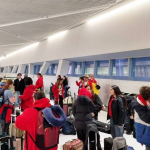


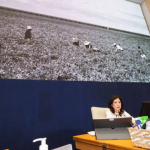


Bike Repair @ Repair Cafe
In his poem “Harlem,” poet Langston Hughes asks:
What happens to a dream deferred?
Does it dry up
like a raisin in the sun?
Or fester like a sore—
And then run?
Does it stink like rotten meat?
Or crust and sugar over—
like a syrupy sweet?Maybe it just sags
like a heavy load.Or does it explode?
Many of you know what it feels like to have that dream deferred. You’ve been laid off. Or ended up underwater on your home. Or have been underemployed.
By Tera Landers
Maybe that’s not you, but most of us know someone who has been negatively impacted by an economy that doesn’t work for everyone.
The truth is, when a community experiences huge gaps in income between the lowest wage workers and the highest wage earners – everyone feels it.
Larger income gaps lead to more pronounced gaps in almost everything, for every person on the income spectrum, rich or poor.
According to Richard Wilkinson, a retired professor who focuses on patterns of health in society, these disparities show up in all aspects of our lives.
More income inequality – in the same country and even within the same state in the United States – leads to:
- Less trust
- More mental illness
- More homicides – the rate goes from 15 per million to 150 per million as the income gap increases
- More people in prison – this is not driven by more crime – but mostly it’s about more punitive, harsher sentencing.
- Death penalty is more accepted the higher the income gap
- Lower possibility of social mobility
- Higher obesity rates
These are just a few examples.
 The more pronounced the wage disparity, the more desperately we try to hold on to what is ours. There is little sense of abundance, and those with more than enough operate out of a scarcity mentality.
This matters to those of us who work to heal and bring peace to the world we care so much about. In order to repair our living earth, we must create the more beautiful world we dream about, and it must be created on multiple levels, including economics.
Those of us who feel called to heal Creation must shift current practices to allow the flourishing of human potential, to put the dream back on track for every person.
Lucky for us, we do not have to start this from scratch. Wise people are already pointing the way toward an economy based on abundance, not scarcity.
Grounded in Love, not greed.
In Pasadena, there are specific ways that we can actively practice a new economy of Love out in the greater community:
- Get involved with the Arroyo SECO Time Bank – the Time Bank philosophy states that an hour of my time is worth an hour of your time. My hour could be weeding your garden and your hour could be cooking me a meal.
- Become more active with Transition Pasadena. They are moving us away from an economy based on oil, and one toward local resilience – locally grown food, community-focused transportation, repairing what we already own rather than throwing things away and buying new. They also focus on the needed inner transition – letting go of our attachment to things and the belief that what we buy equals who we are as people.
- Take action locally on just wage issues. Get involved with Pasadenans for a Livable Wage or with CLUE-Pasadena (Clergy and Laity United for Economic Justice). These groups are working to make Pasadena not just a “fair-trade” city, but also a “fair worker” city.
The dream has been deferred for much too long. It’s up to each of us to take our love for humanity and all of Creation, and put it to work in the world, creating a Love Economy based on abundance and the worth and dignity of each person.












Leave a Reply