







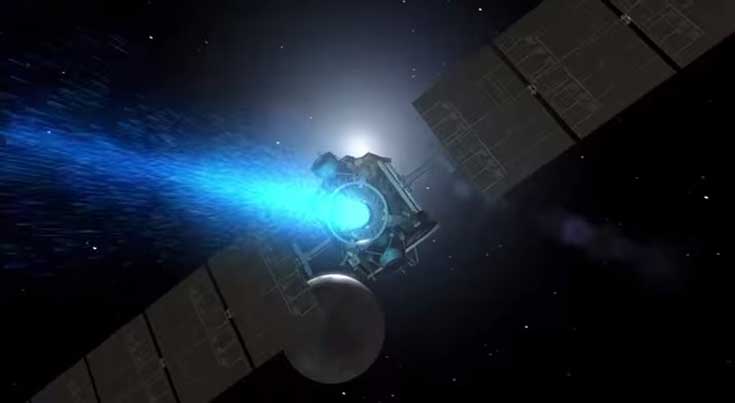
Dawn (Photo – YouTube).
Four years ago, VIR’s computer reset when Dawn was approaching Vesta, and the most likely cause was deemed to be a cosmic ray strike. That’s life in deep space! It also reset twice in the survey orbit phase at Vesta. The camera reset three times in the first three months of the low altitude mapping orbit at Vesta.
By Dr. Marc D. Rayman
Even with the glitches in this second mapping orbit, Dawn’s outstanding accomplishments represent well more than was originally envisioned or written into the mission’s scientific requirements for this phase of the mission. For those of you who have not been to Ceres or aren’t going soon (and even those of you who want to plan a trip there of your own), you can see what Dawn sees by going to the image gallery.
Although Dawn already has revealed far, far more about Ceres in the last six months than had been seen in the preceding two centuries of telescopic studies, the explorer is not ready to rest on its laurels. It is now preparing to undertake another complex spiral descent, using its sophisticated ion propulsion system to maneuver to a circular orbit three times as close to the dwarf planet as it is now. It will take five weeks to perform the intricate choreography needed to reach the third mapping altitude, starting tomorrow night. You can keep track of the spaceship’s flight as it propels itself to a new vantage point for observing Ceres by visiting the mission status page or following it on Twitter @NASA_Dawn.
As Dawn moves closer to Ceres, Earth will be moving closer as well. Earth and Ceres travel on independent orbits around the sun, the former completing one revolution per year (indeed, that’s what defines a year) and the latter completing one revolution in 4.6 years (which is one Cerean year). (We have discussed before why Earth revolves faster in its solar orbit, but in brief it is because being closer to the sun, it needs to move faster to counterbalance the stronger gravitational pull.) Of course, now that Dawn is in a permanent gravitational embrace with Ceres, where Ceres goes, so goes Dawn. And they are now and forever more so close together that the distance between Earth and Ceres is essentially equivalent to the distance between Earth and Dawn.
Earth laps Ceres
On July 22, Earth and Dawn will be at their closest since June 2014. As Earth laps Ceres, they will be 1.94 AU (180 million miles, or 290 million kilometers) apart. Earth will race ahead on its tight orbit around the sun, and they will be more than twice as far apart early next year.
On July 22,
Earth and Dawn
will be at their closest
since June 2014
Although Dawn communicates regularly with Earth, it left that planet behind nearly eight years ago and will keep its focus now on its new residence. With two very successful mapping campaigns complete, its next priority is to work its way down through Ceres’ gravitational field to an altitude of about 900 miles (less than 1,500 kilometers). With sharper views and new kinds of observations (including stereo photography), the treasure trove obtained by this intrepid extraterrestrial prospector will only be more valuable. Everyone who longs for new understandings and new perspectives on the cosmos will grow richer as Dawn continues to pioneer at a mysterious and distant dwarf planet.
Dawn is 2,700 miles (4,400 kilometers) from Ceres. It is also 2.01 AU (187 million miles, or 301 million kilometers) from Earth, or 785 times as far as the moon and 1.98 times as far as the sun today. Radio signals, traveling at the universal limit of the speed of light, take 33 minutes to make the round trip.
Dr. Marc D. Rayman is the Dawn Mission Director and Chief Engineer at JPL. Marc greatly enjoys sharing the thrill of interplanetary adventures with the public.












Leave a Reply