







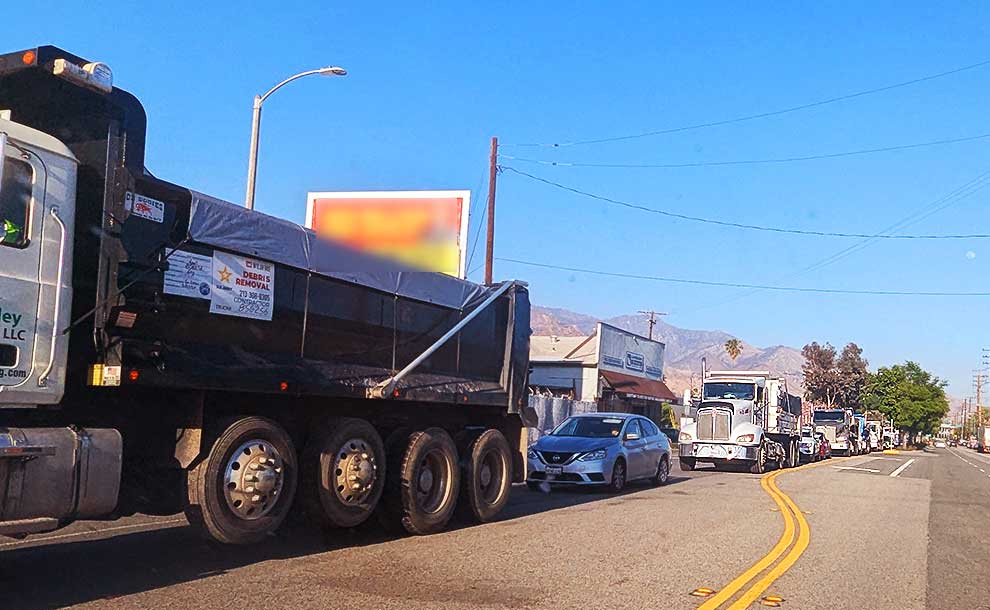
Trucks hauling debris in Altadena (Photo – W.K.)
The Los Angeles County Department of Public Health has released preliminary findings from recent soil testing conducted in areas impacted by the Eaton and Palisades wildfires.
By News Desk
The testing, which aimed to assess potential environmental and health risks posed by wildfire-related debris, revealed concerning levels of harmful substances, particularly lead, in the soil.
Eaton Fire Area Shows Elevated Lead Levels
The most significant finding came from the Eaton Fire area, where soil samples collected from properties downwind of the fire site—particularly those with intact homes—showed lead levels exceeding health-based screening thresholds. This discovery aligns with earlier reports indicating elevated lead levels in air samples taken immediately after the fire.
The presence of lead is likely linked to the burning of homes painted with lead-based paints, which were commonly used before 1979. In Altadena, where the fire occurred, Caltech reports that over 90% of homes were built before 1975, increasing the likelihood of lead exposure from deteriorating paint.
While the lead levels found in the soil exceed recommended safety thresholds, these findings do not automatically mandate cleanup. Instead, they underscore the need for further investigation to fully understand the extent of the contamination. The lead levels may be influenced by a variety of sources, including both wildfire-related and pre-existing environmental factors. Additional assessments are planned to determine the precise origin of the contamination.
Localized Chemical Impact in the Palisades Fire Area
In the Palisades fire area, soil testing revealed isolated instances of heavy metals and polyaromatic hydrocarbons (PAHs) exceeding health-based screening levels. However, these findings were not widespread and did not indicate a community-wide impact from the fire. The source of these contaminants remains undetermined, though the results suggest localized chemical fallout rather than large-scale contamination from fire smoke.
Testing Methodology and Health Implications
Between mid-February and mid-March, the County’s soil testing team, under the direction of Roux Inc., collected samples from various property conditions—damaged, destroyed, and intact properties—within and surrounding the burn zones. The analysis focused on substances commonly found in post-wildfire debris, such as heavy metals, PAHs, and dioxins. These substances can pose health risks, particularly to vulnerable populations, if exposure occurs over extended periods.
Levels of contaminants below the screening thresholds are generally considered safe for long-term exposure. However, when levels exceed these thresholds, they do not automatically trigger a requirement for immediate cleanup but signal the need for further evaluation to assess potential health risks.
Protective Measures and Testing Resources
The Department of Public Health has advised residents in affected areas to take precautionary steps to limit exposure to ash, soot, and fire debris. Personal protective equipment (PPE) is recommended, especially in areas where fire debris remains. For individuals concerned about potential contamination on their properties, the department suggests consulting with an environmental professional to conduct a more specific evaluation.
Residents worried about lead exposure from the fire are also encouraged to take advantage of free blood lead testing, available through various channels, including visits to medical providers, appointments at Quest Labs, or walk-in testing at select community events. Lead exposure—especially for children and pregnant individuals—can have serious health implications, making early detection crucial.
Ongoing Assessment and Future Reports
This report is based on preliminary findings, with a more comprehensive analysis expected in May. The Department of Public Health has committed to ongoing monitoring and further investigations to ensure the health and safety of residents in the aftermath of the wildfires.
For those interested in residential soil testing, a list of recommended laboratories and environmental consultants is available on the Los Angeles County Department of Public Health’s website. These resources can assist residents in evaluating the safety of their homes and properties.
For more information about soil sampling, health risks, and lead testing, visit the Los Angeles County Department of Public Health’s wildfire response page or call 1-800-LA-4-LEAD (1-800-524-5323).
Editor's Note: This developing story highlights the need for ongoing vigilance and professional guidance to assess and mitigate the potential environmental hazards caused by wildfires.













Leave a Reply