






SCIENCE CORNER
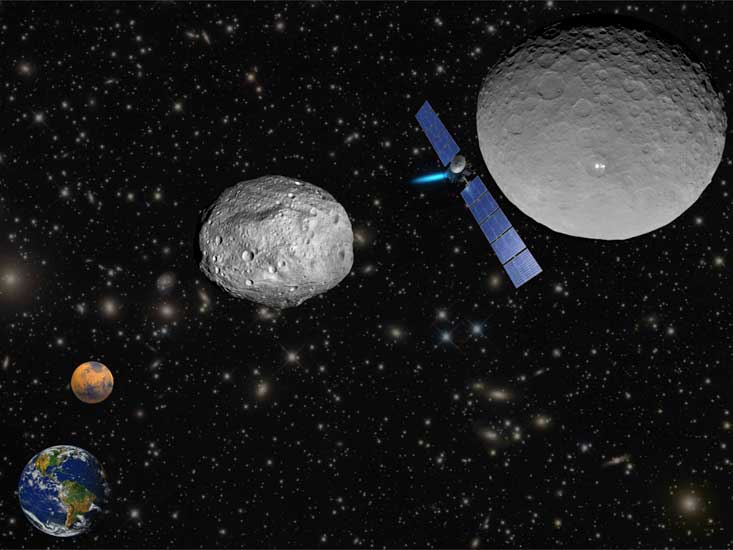
The Dawn spacecraft left Earth in 2007 and flew past Mars in 2009. It orbited the giant protoplanet Vesta in 2011-2012. After a journey of 7.5 years and 3.1 billion miles, it arrived in orbit around dwarf planet Ceres (upper right) in March 2015 (Photo – dawn.jpl.nasa.gov).
The NASA/JPL Dawn spacecraft is now returning spectacular pictures and other information from a distant, mysterious world named Ceres.
By Dr. Marc D. Rayman
Discovered in 1801, Ceres was named for the Roman goddess of agriculture and grain. If you had cereal this morning, you established a connection with the goddess, because our word “cereal” is derived from Ceres.
Ceres used to be called a planet, later an asteroid and now a dwarf planet in the same category as Pluto. Indeed, first glimpsed 129 years before its more famous planetary sibling, Ceres is the first dwarf planet discovered and, thanks to Dawn, the first to be explored.
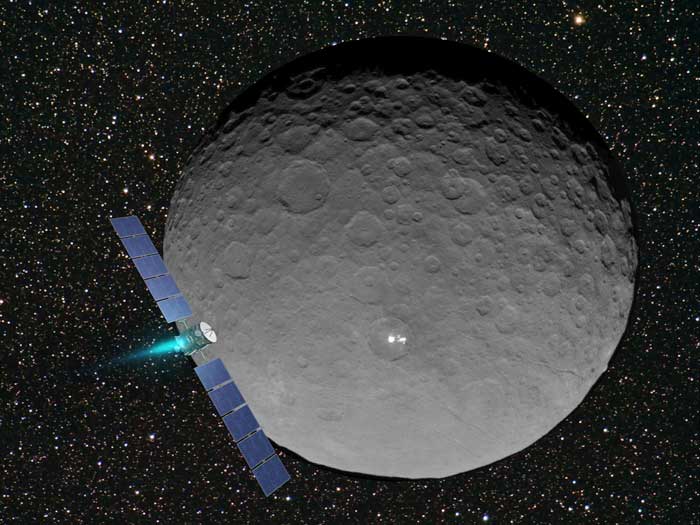
The Dawn spacecraft orbiting dwarf planet Ceres. Dawn has discovered mysterious regions that reflect more sunlight than most of the surface (Photo – dawn.jpl.nasa.gov).
Unlike your cereal (or, at least, mine), Ceres is composed of rock and ice, and it might even have liquid water deep underground. Dawn’s exploration may shed more light on this intriguing possibility, as the sophisticated spacecraft focus on this exotic orb sharpens during the rest of this year and next.
Let’s bring into perspective the cosmic landscape on which this extraordinary extraterrestrial expedition is now taking place. Imagine Earth reduced to the size of a soccer ball. On this scale, the International Space Station would orbit at an altitude of a bit more than a quarter of an inch. The moon would be a billiard ball almost 21 feet away. The sun, the conductor of the solar system orchestra, would be a fiery ball 79 feet across at a distance of 1.6 miles.
A grape
has a higher
water content
than Ceres
But even more remote, Dawn would be nearly four miles away. Tremendously far now from its erstwhile home, it would be only four inches from its new residence. (By the end of this year, Dawn will be slightly closer to it than the space station is to Earth, a quarter of an inch. And yet Dawn and Ceres together would be more than six miles from our soccer-ball-sized Earth.) That distant world, Ceres, the largest object between Mars and Jupiter, would be five-eighths of an inch across, about the size of a grape. Of course a grape has an even higher water content than Ceres, but I am confident that exploring this fascinating world will be much sweeter!
! Visit dawn.jpl.nasa.gov to follow Dawn’s remarkable deep space adventure.
Dr. Marc D. Rayman is the Dawn Mission Director and Chief Engineer at JPL. He greatly enjoys sharing the thrill of interplanetary adventures with the public. Marc writes a feature once a month called the Dawn Journal.












Leave a Reply