







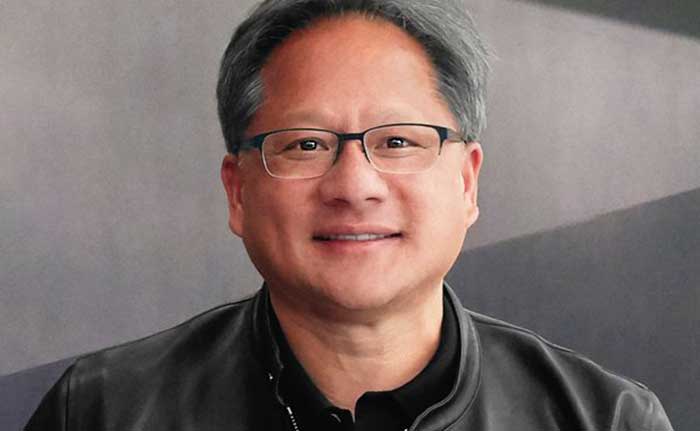
Jensen Huang (Photo – caltech.edu)
Jensen (Jen-Hsun) Huang, Founder and CEO of technology company NVIDIA will deliver the keynote address at Caltech’s 130th Annual Commencement Ceremony on June 14, 2024.
By Caltech
Huang led NVIDIA to become a pioneer in accelerated computing and the fourth most valuable company in the world.
“As NVIDIA’s CEO, Jensen Huang has led a revolution in computation and artificial intelligence,” said Caltech President Thomas F. Rosenbaum. “His personal story underlies these accomplishments and provides a touchpoint for our students as they embark on the next stages of their careers.”
Huang translated a childhood passion for computer gaming into a career of innovation, business development, and entrepreneurship, and, in doing so, is at the cutting edge of a technological revolution that is leading profound societal change.
He was born in Taipei, Taiwan, in 1963 and lived in Thailand for part of his childhood. When he was nine, he and his brother moved to Tacoma, Washington, to live with their uncle. After Huang’s parents were able to immigrate to the U.S., Huang and his brother reunited with them in Oregon. He completed his undergraduate degree in electrical engineering from Oregon State University and worked at LSI Logic, and Advanced Micro Devices during the early part of his career. In 1992, he received his master’s degree in electrical engineering from Stanford University.
Huang co-founded NVIDIA in 1993 with Chris Malachowsky and Curtis Priem to take advantage of the growing demand for 3D graphics and visualization technology that accompanied the rapidly expanding PC and gaming industries.
The company initially focused on the development of microprocessors capable of providing high-quality 3D graphics. It is credited for inventing the graphics processing unit or GPU leading to the company’s widespread recognition.
Due to their enormous computing potential, the company’s GPUs have since catalyzed the advancement of applications other than graphics, most notably in the area of artificial intelligence (AI). Coupled with the company’s supercomputing software package, CUDA, NVIDIA technology enabled programmers to create AlexNet, a powerful neural network used for image recognition and classification that won the 2012 ImageNet Large Scale Visual Recognition Challenge. NVIDIA’s dedicated AI supercomputers also were responsible for training models used by ChatGPT.
Huang’s sights are now set on combining NVIDIA’s computer graphics research with its generative AI research to create the “Omniverse,” a platform capable of simulating the real world to create “digital twins” that could be used for safely training robots and self-driving cars, among other applications.
Named the world’s best CEO by Fortune, The Economist, and Brand Finance, Huang is listed as one of Time magazine’s 100 most influential people and has been elected to the National Academy of Engineering. Huang and his wife, Lori—also an alum of Oregon State University—donated $50 million to help establish the Jen-Hsun and Lori Huang Collaborative Innovation Complex at OSU. They also donated $30 million to Stanford University.
This article has been edited for clarity and brevity.












Leave a Reply