
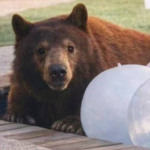







Deer in Sierra Madre (Photo – Jean Sudbury).
In these current times of water shortage, water conservation is nothing new to me. When I bought my house in Sierra Madre some years ago, my first activities included planting a water- wise, yet colorful garden.
By Jean Sudbury
The house is on a North-West corner. It has a few shrubs around the house, a tree in the back yard, and many clumps of dead grass. I saw it as an artist’s palate. I had many potted succulents and cacti, which finally had permanent places to set their roots. At that time, I began observing the garden area and developing microclimates according to natural moisture accumulation in specific places in my corner lot. It’s very opportune to be in a climate area similar to the Mediterranean, where many varieties of plants thrive.
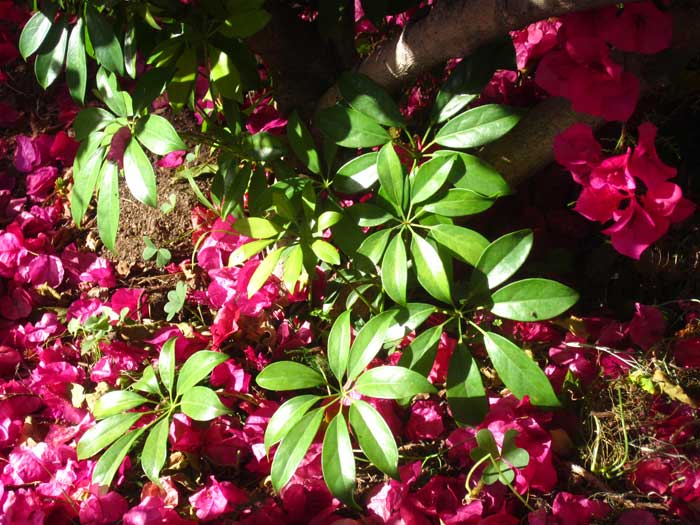
(Photo – Jean Sudbury).
Fast forward to the present; my little cactus and succulent cuttings had turned into a massive forest. My house was surrounded by a prickly battalion. Within the forest were rose gardens, day lilies, irises, orchids, and subtropical plants. It was a true cacophony of color, texture and greenery. When we received the information from the City of Sierra Madre that our once plentiful well had run dry, we were asked to conserve water. I decided to stop watering the front yard and see what would survive. The large cacti and succulents grew stronger, the aloe vera suffered but held on, and some of the roses and other subtropicals made it through the crisis. My citrus trees even pulled through. However, I needed to make a change. I had a massive trim done to my large plants. I hired some friends to help me further develop my water- wise project.

Spring (Photo – Jean Sudbury).
In this venture, I am using techniques I’ve learned from Leigh Adams, Artist-in-Residence at the Los Angeles County Arboretum. We’re working together on her undertaking, The Crescent Farm at the Arboretum. You can find more information about The Crescent Farm at the Arboretum online. You can also find it on Facebook under the same heading.
In my garden, I’ve also added Hugelkultur, a berm, and a canyon, which could be defined as a swale. (If it would ever really rain, I could see how it works.) These water- harvesting techniques have been developed and used in other areas of the world, where water is regarded as a precious resource. It’s very exciting to see the progress of my waterwise garden project, to watch what’s coming into to fruition with all my TLC. Today, I noticed two lavender plants in my garden springing back to life. Is that why they call it “springtime”?
Gardening is good for the soul, especially during a drought.
Jean Sudbury is a long time resident of California. She shares her love of nature through gardening, making music, and creating natural art forms in her garden.












Thank you!