







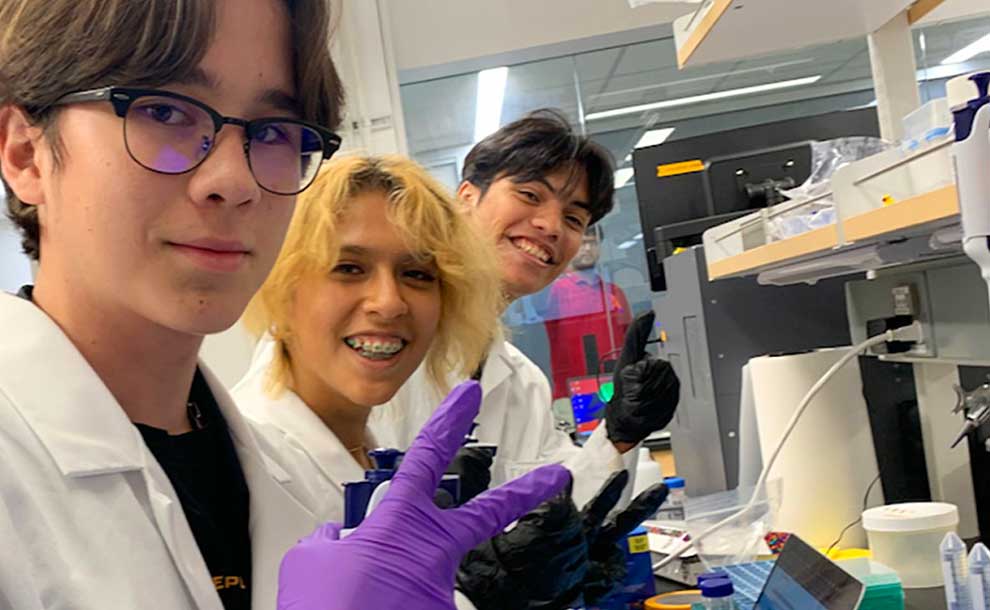
High School students at the lab of Matt Thomson (Photo – Monica Barsever)
In the summer of 2023, the PFAS Annihilators came to Caltech to play! Housed in the lab of Matt Thomson, an assistant professor of computational biology, seven local high school students took on an ambitious project in synthetic biology: Finding proteins that may be able to degrade per- and polyfluoroalkyl substances (PFAS), the so-called forever chemicals commonly used to create water-resistant, stain-resistant, and grease-resistant cookware, furniture, clothing, and food packaging.
By Cynthia Eller, Caltech
PFAS can accumulate in soil, water, and the human body, and are extremely toxic to humans and the environment, even in amounts too tiny to be accurately measured.
PFAS can be filtered out of water, but the chemicals themselves remain. So, how do we get rid of them?
It is this dilemma that inspired the PFAS Annihilators. These students met through Monica Barsever, a former laser and fiber-optics engineer who now works as a STEM specialist at the nonprofit Institute for Educational Advancement. The students spent the 2023–2024 academic year working with Caltech graduate students and postdocs.
They formed the PFAS Annihilators team during the spring semester to enter the 2024 iGEM (International Genetically Engineered Machine) competition. Alec Lourenço, a graduate student in biochemistry and molecular biophysics worked with the students during summer 2024 as they prepared for the iGEM competition.
According to Lourenço, who participated in the iGEM competition himself as a high school student at La Cañada High School, iGEM is a wonderful opportunity for students “to do independent work and learn firsthand what scientific research looks like.”
Once the team came together, the students began brainstorming to settle on a project idea for their summer research. “Whatever problem the students take on, they have to pursue a synthetic biology-based solution to participate in the iGEM competition,” Lourenço explains, “So, we went through a few iterations of problems in the world that might be solved through genetic engineering.”
In order to help frame the project, the students spoke with those who are directly affected by the PFAS problem or who will be responsible for implementing solutions. Conversations with experts in water treatment led the team “to change our entire goal from the filtration of PFAS to the degradation of them.”
As their summer research got underway, the hunt was on to find—and eventually design—enzymes that could break the robust carbon–fluorine bonds found in PFAS substances. Barsever was on site to supervise student work, ensure safety compliance, and connect the PFAS Annihilators with additional resources.
The team began its work by training a large language model on the structure of naturally occurring proteins that have some ability to degrade PFAS. They then asked this AI model to generate new protein sequences similar to these naturally occurring proteins, with the hope that one or more of the AI-designed proteins might degrade PFAS more quickly and efficiently.
The next step, trying to express these proteins, was especially tricky. The team built a machine learning model that can predict whether a given protein sequence will be expressible or not. “In our lab and in other labs on campus, it’s a huge pain point to not know which protein sequences will be easy or difficult to express,” Lourenço says. “So, this expression classifier has the potential to be very useful, even apart from the PFAS degradation project.”
With the help of their expression classifier, the team set out to express the most promising proteins. The students analyzed the novel proteins using mass spectrometry and then sent them to a lab at MIT where Lourenço’s collaborator, Ariel Furst (PhD ’15), tested the proteins to see how well they degraded PFAS. The team arrived at three main families of protein sequences that are possible candidates for the job.
“I am so proud of this lovely, hilarious, smart, hard-working group of students for their amazing achievements this summer,” Barsever says.
The work of the PFAS Annihilators is ongoing, but now they are gearing up for the 2024 iGEM Grand Jamboree in late October in Paris. If they successfully raise the funds, they will travel to Paris. If not, they will attend virtually. In addition, on October 12th, they will host a local IGEM team meetup on the Caltech campus.











Great article and a shout out for the scientists and students and journalists I am a mini scientist and exploring at home how to breakdown pfs and chemicals..a complicated problem allways has a simple solution.mom said hugs to all light sophos