




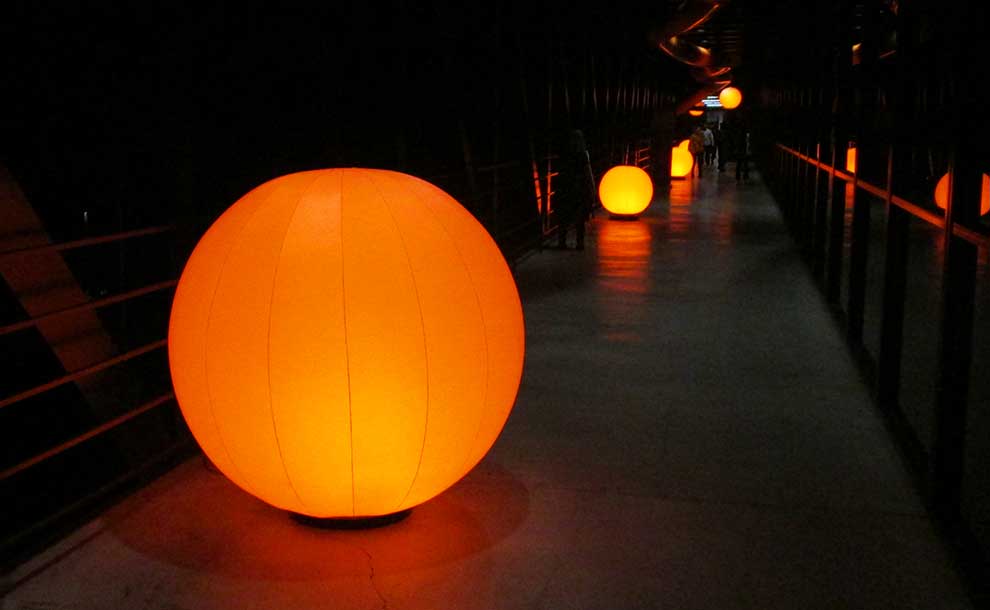
Fall 2017 Graduation Show Preview at ArtCenter (Photo – Garrett Rowlan).
“The past is a foreign country,” H.E. Bates wrote at the beginning of his novel, The Go-Between, “they do things differently there.”
By Garrett Rowlan
And while the environs of the Design School of Pasadena is hardly a foreign country—though the panoramic of Pasadena, by night, is out of this world—one felt the almost-overwhelming presence of the onrushing future when attending the Grad Show. The event, hosted Thursday night, showed students on the cusp of entering the workforce, with their calling cards and resumes printed on high-quality paper, displaying their efforts across a spectrum of design arts.
Projects for interactive, environment, entertainment, and just about sort of art with a commercial uplink—from pens to palaces—presented an impressive array, a forward leap of creativity so impressive that one thought of an updated Sistine Chapel, Michelangelo’s Adam wearing a lab coat, jeans, and tennis shoes and holding a laptop while receiving the divine tag. The many displays, spread throughout the campus, suggested the results of creativity joined with the catalyst of hard work.
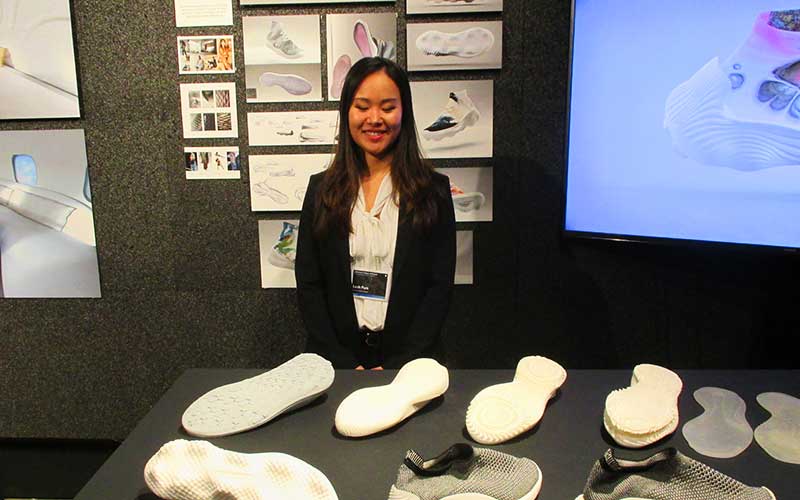
Leah Park (Photo – Garrett Rowlan).
This metaphorical, laptop-bearing human also carried pencils, brushes—as in the impressive student artwork that hung in the halls—and even used a 3D printer, as in the case of Experience Designer Cooper Dai, whose architectural modeling of West Coat hotels and restaurants suggested a miniaturized world, or envisioning the foot shod in a colorful array of custom sneakers, as in the case of Leah Park.
Footwear, indeed, was the calling card of notable Art Center grad Jacques Perrault, a computational designer for Adidas Futures. In a discussion with two other grads—Kit Hinrichs and Julian Ryder—Perrault was quoted in the introduction by Lorne Buchman, President of the college. “We have the opportunity,” Buchman said, “to question fundamentally what’s been done and respond to it with things that haven’t imagined.”
Perrault’s words rang both as a challenge and a comfort , for one could not be so caught up in thoughts about the future that the present world problems leave one wondering just how creative people will respond. The post-apocalyptic, mythic-futuristic landscapes of Julia Oh and Joachim Hoekx, in Entertainment Design, suggest both the threat of a bleak future, as did the shadowy interiors in the film work of Jeff Su, some scenes filmed in the abandoned desert shacks of southern California. These works hint at a future of privation, magnificent desolation, yet at the same time suggest the scenery of a Hollywood blockbuster. And for viewers of a certain age, the conceptions even had the hint of posters in a 60’s headshop.
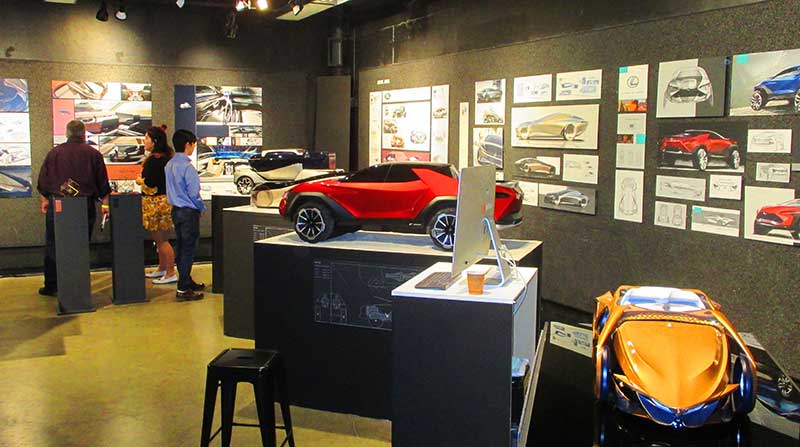
Preview of Fall 2017 Graduation Show at ArtCenter in Pasadena (Photo – Garrett Rowlan).
Indeed, the other two participants in the Full Circle discussion, to the side of the much-younger Perrault, gave balm to observers of a certain age. Julian Ryder, Outstanding Service recipient, spoke of reinventing himself against the inevitable backdrop of mortality. After burnout, he consulted a career coach and developed a “Right-Brain Project” to bring creativity to the corporate world. His project gave him an enthusiasm for work, for each waking day that was inspiring to the roomful of listeners. Kit Hinrichs, gifted with the Lifetime Achievement award, spoke of an ongoing need for curious observing, eclectic learning, and Vexillology, that is, the collection of flags—American flags are his interest—of which he has some 5,000 flags, beginning with a family heirloom weaved at the end of the Civil War. The observations of these two made it clear that creativity, and on-going interest in the world, can be a lifetime accomplishment.
“It’s all about telling stories,” Hinrichs said during the Q-and-A session, and leaving the exhibit, one is impressed by the thought that the many Art Center grads are building a story that will extend far into the future.








Leave a Reply