





GUEST OPINION

PUSD Budget (Logo – PUSD)
PUSD issued layoffs last March, and in a February 2024 editorial, the leadership explained that the layoffs were necessary “because of the lapsing of one-time COVID-19 funding, a decline in enrollment, and the need to allocate our resources responsibly.” A more recent editorial from PUSD leadership reiterated that the district needs to lay off more employees due to “declining enrollment, rising costs, and the expiration of one-time COVID relief funds.”
By Dr. Adrienne Ann Mullen
Declining enrollment has been occurring since the early 2000s, following a decline in birth rates and a rise in housing costs. PUSD contracts with a firm that annually projects this decline, adjusting plans and budgets each year accordingly. Typically, these required reductions due to an annual 2% decline can be managed through retirements, which means layoffs are usually not necessary. The special COVID-19 relief funding from the federal government was always intended to be one-time funding, not ongoing, so PUSD had an opportunity to plan for its expiration—but did not do so. The second editorial’s vague reference to “rising costs” hints at the true reason for the layoffs: increases in the salaries of its employees.
Ongoing Salary Increases
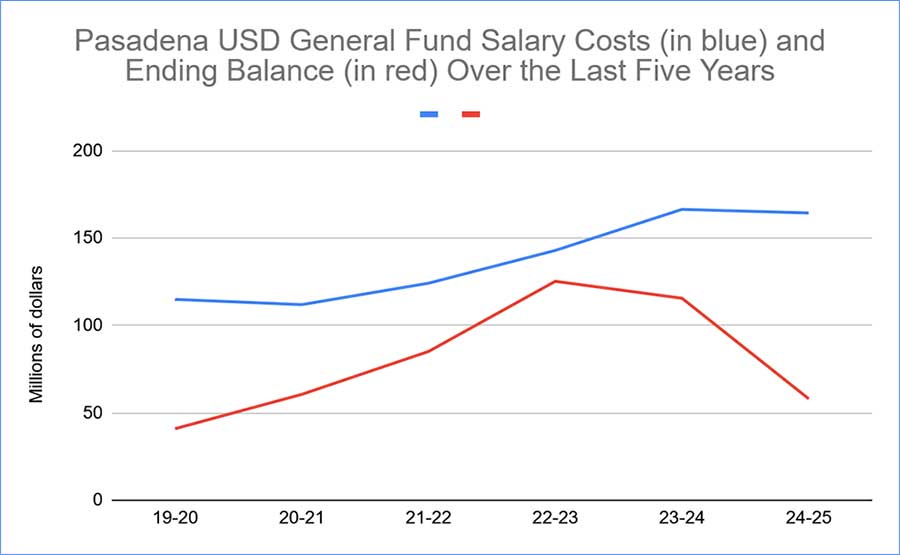
In 2021-22, most teachers received an ongoing salary increase of nearly 8%, while other staff received a 5% raise. In 2022-23, all staff saw a 10% raise, followed by another 10% increase in 2023-24. Since 2019-20, the cost of PUSD’s general fund employee salaries has risen by 43%, from $114.9 million to $164.36 million in 2024-25. This roughly $50 million increase in salary costs is nearly equivalent to the ongoing budget shortfall PUSD faced at the start of the 2024-25 fiscal year. This figure doesn’t even account for the additional increases in special education staffing costs, meaning the overall impact of the raises is likely greater than $50 million.
The Necessity of Raises
These raises were essential to ensure PUSD staff salaries remain competitive with those in other districts. Parents and residents deeply appreciate the contributions of the district’s staff, and the raises were widely supported. As a parent of four children who attended and graduated from PUSD, I too believe that staff deserve salaries that reflect their value. However, these raises have contributed to the rapid depletion of PUSD’s reserves, which were bolstered by the one-time COVID-19 relief funding
A Cardinal Tenet of School District Finance
One of the cardinal tenets of school district finance is not to use one-time funding to cover ongoing costs, but PUSD did exactly that; it used the one-time nature of its reserves to fund these ongoing higher salary increases. As these higher costs roll into future years, PUSD will face significant budget deficits once the reserves are exhausted.
If a household had $85,000 in savings but took on a new ongoing annual cost, like a new mortgage or college enrollment, of $30,000, those savings would be depleted in less than three years unless the household found new sources of income. The household would need to cut back on expenses in order to afford new ongoing costs.
PUSD now faces a similar dilemma. In order to manage these ongoing salary costs, the district will need to make cuts, including further layoffs.
Meeting Budget Obligations
California school districts must demonstrate that they will meet their budget obligations, maintaining a 3% reserve for the current fiscal year (2024-25) as well as the following two years (2025-26 and 2026-27). After PUSD granted a second consecutive year of 10% raises, the county required the district to adopt a Fiscal Stabilization Plan. As part of this plan, PUSD issued layoffs for about 100 staff members by March 15, 2024, as required by state law. To reduce costs further and meet its fiscal obligations, PUSD has approved an additional 75 layoffs.
Cumulative Effect of Salary Increases
Below is a graph illustrating the cumulative effect of salary increases on general fund employee costs (shown in blue) and the corresponding changes in PUSD’s general fund reserves (shown in red). The graph highlights the significant COVID-19 relief funding bump from 2019-2020 to 2023-2024, followed by a steep decline as ongoing salary costs drain the district’s reserves:
Dr. Adrienne Ann Mullen is a former PUSD trustee and mother of four PUSD graduates.











Leave a Reply