







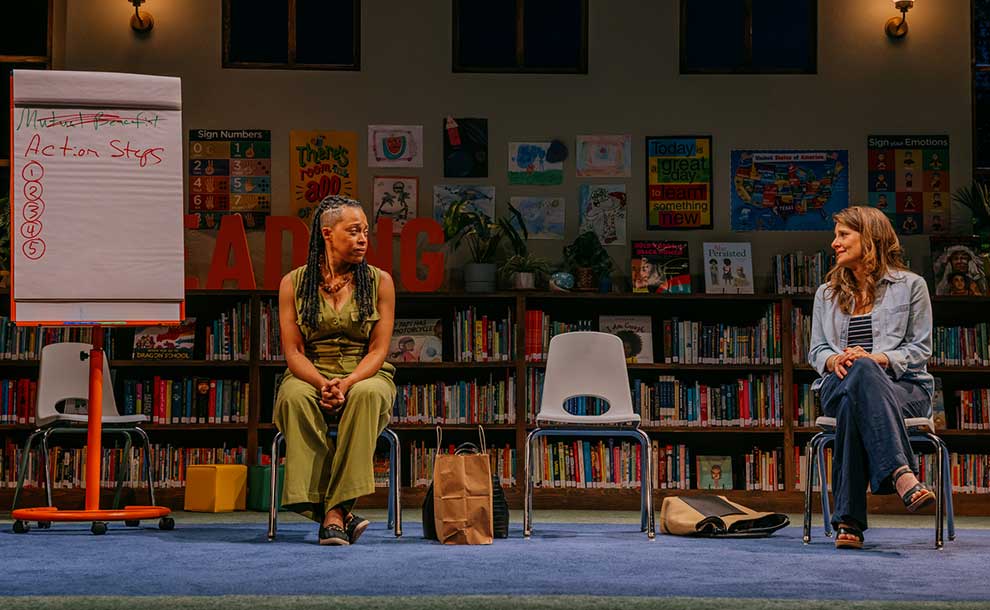
Cherise Boothe and Mia Barron in Eureka Day at Pasadena Playhouse (Photo – Jeff Lorch)
It’s theatre so vivid that we recognize ourselves immediately.”
~ Teddy Bergman (Director, “Eureka Day”)
Theatre survives because it forces us to confront ourselves, and few plays do it as brilliantly, or as painfully, as Eureka Day by Jonathan Spector. This two-hour, uninterrupted catalyst revitalizes the art of debate, empathy, and collective effort, while hopefully skewering dogmatism for good.
By Natalia Rose
In the opening scene of Eureka Day, the playwright weaves in nearly every contemporary buzzword, such as “ignorance,” “privilege,” “triggered,” and “canceled,” in a relatable and comical discourse, immediately signaling to the audience that this is the zeitgeist play they’ve been waiting for. The play follows five private school teachers in pre-Covid Berkeley, California, as they struggle to figure out how to handle vaccination status during a mumps outbreak. The drama intensifies when the teachers decide to turn the vaccine discussion over to the students’ parents in a Zoom chat. A giant projection screen mounted on the back wall displays a stream of parents’ direct messages, with conversations veering off into tangential, and at times violent and impatient, remarks, while the teachers try to calm the storm. I guarantee that every audience member will see a glimpse of an acquaintance, themselves, or even their theatre-going neighbor on that stage , challenged, yes, but united by a common thread: we all want to do the ‘right thing.’
Despite each teacher or parent holding a different stance on the vaccine, like Suzanna (Mia Barron), who embodies resistance to public health measures, or Carina (Cherise Boothe), who supports the vaccine as a means of protecting the community, Eureka Day allows for an extended debate on the subject. The play spends an equal amount of stage time on the characters’ responses to the problem, rather than just the arguments themselves.
The set design would fool any elementary teacher into believing they’d wandered into a playhouse portal and ended up back in a classroom. The shelves were stocked with nonfiction children’s books, and the colorful carpets were complemented by toddler-sized geometric foam furniture. The room made you feel as open as a child, yet burdened by the responsibility of the teachers. A gentle soundscape of birdsong, paired with the satirical pacing of scene changes, soothed my attentive ears and eyes for the full 100 minutes.
Each performer defied easy categorization of their characters into “good” or “bad.” Mia Barron (Suzanne) deepened her character’s chaos-adjacent tendencies with an undercurrent of genuine pain. Camille Chen (Meiko) navigated the fine line of independent thought so brilliantly, taking the audience on a backseat journey of those of us who don’t wish to follow the standard deviations of thought.
“I believe in human fallibility,” Meiko (Camille Chen) shouted, putting an end to the straw man arguments of her fellow teachers. She’s speaking to the audience too, perhaps reinstating the idea that choices always have consequences, and sometimes the views we support are more nuanced than black and white. Achieving social peace isn’t going to be easy, but as long as we continue to talk to each other and offer grace, we will be rejuvenated.
Eureka Day
September 10 — October 5
By Jonathan Spector
Directed by Teddy Bergman
Location
Pasadena Playhouse
39 South El Molino Avenue, Pasadena
Tickets: PasadenaPlayhouse.org
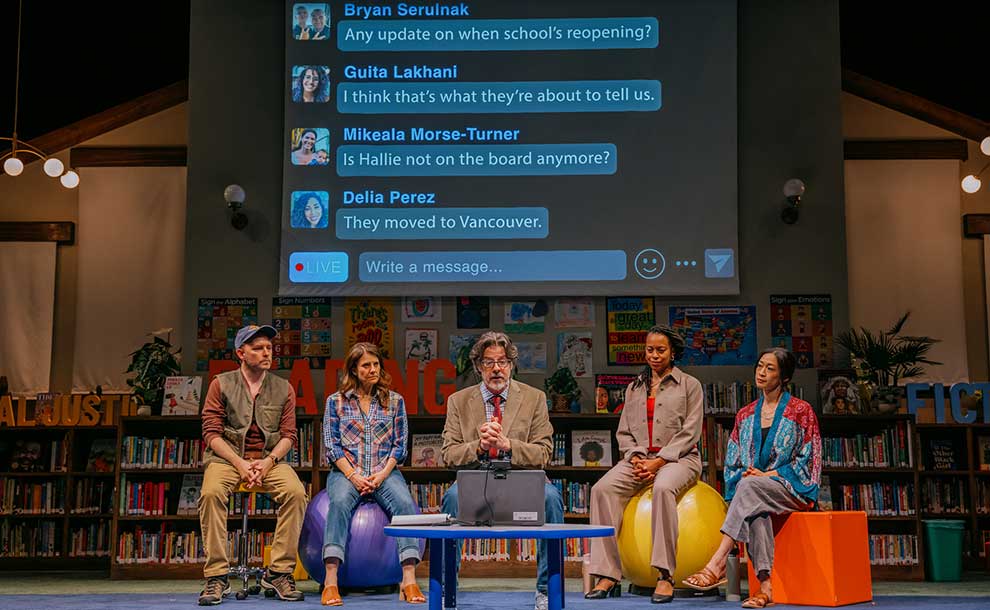
Nate Corddry, Mia Barron, Rick Holmes, Cherise Boothe, and Camille Chen in Eureka Day (Photo – Jeff Lorch)













Leave a Reply