







THEATRE REVIEW

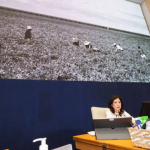
“Disinherit the Wind” with Circus-Szalewski, Caroline Simone O’Brien,
Matt Chait and Ken Stirbl (Photo – Ed Krieger).
Did Darwin skip a link?
Here’s a line we don’t often hear: “I’m going to make you feel great about your body.” Now place it in the mouth of a tenured microbiology professor, and you have the essence of what makes playwright Matt Chait’s Disinherit the Wind so unique.
By Melanie Hooks
Just opened at the Complex Theatre in Hollywood, Chait’s courtroom drama debates evolution theory, specifically Darwin’s, and its lionization among scientists. Chait himself plays the lead, Dr. Bertram Cates, a professor stripped of his position and reputation by the University of California when his unusual take on consciousness brings unwanted media attention. As we learn through the courtroom proceedings, however, Chait’s real beef is with Darwin’s Origin of Species conclusions. The institution’s, and indeed the field’s, knee-jerk reaction is to label him a creationist (which he assuredly is not) and laugh him out of his profession. Cates has his day of reckoning to clear his name, and we the audience go along for the intellectual, spiritual, and occasionally emotional ride.
The biggest draw is Chait himself, nimbly managing the lion’s share of dialogue, over the 2 hour, 40 minute run-time. He immediately establishes credibility as a professor in the opening scene’s sample Molecular Biology lecture. His topic – the delicacy and intricacy of DNA replication – fascinates and awes him, and his energy, like any great university lecturer’s, spreads throughout the room. Audience members nod in understanding as he breaks down the topic and leans into the best bits. The Complex is a small, black box space, so there is little hiding even in the darkened seats, adding to the feel of a classroom. “Life is a million times older than the pyramids;” “One hundred trillion hemoglobins/second are produced by ribosomes;” “Your body has 37.2 trillion cells.” These could be delivered as dry facts, but Cates practically sings them. The body’s complexity enthralls him, and the character, even later when beaten down by humiliation and exhaustion, stays true to that pure love. This love is the basis of his spirituality, which he’s not shy about sharing. It’s refreshing to see such a duality in an academic character.

Ken Stirbl and G. Smokey Campbell (Photo – Ed Krieger).
More common in drama is the representation of Cates’s rival, Dr. Robert Hawkins, played by Circus Szalewski with exactly the sort of sneer one expects from a Cambridge don. Unfortunately his dissertation-style dialogue doesn’t allow for much comedy, but when it does, Szalewski shines.
Cates’s protégé, Howard Blair, is closer to tears than laughter, as his fellowship and engagement to the Dean’s daughter are both on the line. Actor Stephen Tyler Howell shakes with all the nervous energy one can well imagine having on the biggest day of a young life. He arguably has more to lose as Cates’s only character witness. Blair is gambling a future career yet to happen versus Cates’s defense of a long-established one. Howell and Rehany Aulani, who plays his fiancé Melinda Brown, share a nice, believable chemistry amongst the biologists, and Aulani strikes a grounding daughter-father presence with G. Smokey Campbell, who plays the pro-Darwin crusading UC department head, Dr. Jared Brown. Neither Brown nor Hawkins can imagine an explanation of life’s origin outside Darwin’s theory, and both struggle to understand Cates’s thoughts about consciousness versus physical existence. Where does the mind fit in?
Brown’s character has the potential to be the most morally complex and conflicted, torn between his desire to defend the university’s reputation and his own love for new ideas, something his bureaucratic tenure has denied him. Campbell is afforded little opportunity to express this middle ground position, as most of the play’s real estate concentrates on the ideas themselves as expressed by their real believers, Cates and Hawkins. Playgoers however are treated to Brown’s forceful academic animosity in contrast with his real tenderness toward daughter Mel, a tease at a deeper emotional journey that would have been enjoyable to experience more often. Campbell’s stillness when holding daughter Mel’s hand might be the show’s most deeply felt moment – quiet, brief, jealously guarded.
As it stands, grad student Blair takes the prize for Act One’s most transformative personal choice, and Cates’s highs and lows take the audience along the whole of Act Two. The writing makes good use of the Judge (Christina Hart)’s reminders to both sides that they should be sticking to the evidence instead of their desire to win small, personal points. Even lauded academics are human, perhaps more painfully so, as their daily goals often knock on the door of eternal questions. The visuals, projected on scrims, of microscopic and galactic images also harken back to the real topic – the mystery and wonder of life.

Renahy Aulani and Stephen Tyler Howell
(Photo – Ed Kriege).
Including intermission, the entire experience runs around three hours, which starts to feel it at about Hour 2.25. But as a summary of his own life’s writings and insights into spiritual-scientific links, it likely feels short to Chait, who remains just as invested emotionally by the end of the play as in its opening. His drive powers along the last section, and we experience Cates’s personal resolution as genuine and profound.
In an interview with Dan Berkowitz, Chait dismisses cautious and ‘good enough’ attitudes about theater: “If you are not trying to deliver an experience to an audience that is life-changing, or attempting to affect people in a way that they will never forget, then what is the point?” Whatever one’s own conclusions about the origin or meaning of life, it’s unlikely that Disinherit the Wind will leave the mind unchallenged or unaffected.
Well worth your time – enjoy!









I directed this piece and while I was not mentioned in a peep of it I believe it to be a perfect review. Thank you Melanie for being open to the possibility of being awed, experiencing wonder.
Thank you, Gary. Your comment is especially gracious considering my oversight. Clearly the direction of the piece made welcome space for the bravura performances and engaging ideas.
As you say, awe and wonder should always have a place in our artistic lives.
–Melanie Hooks