






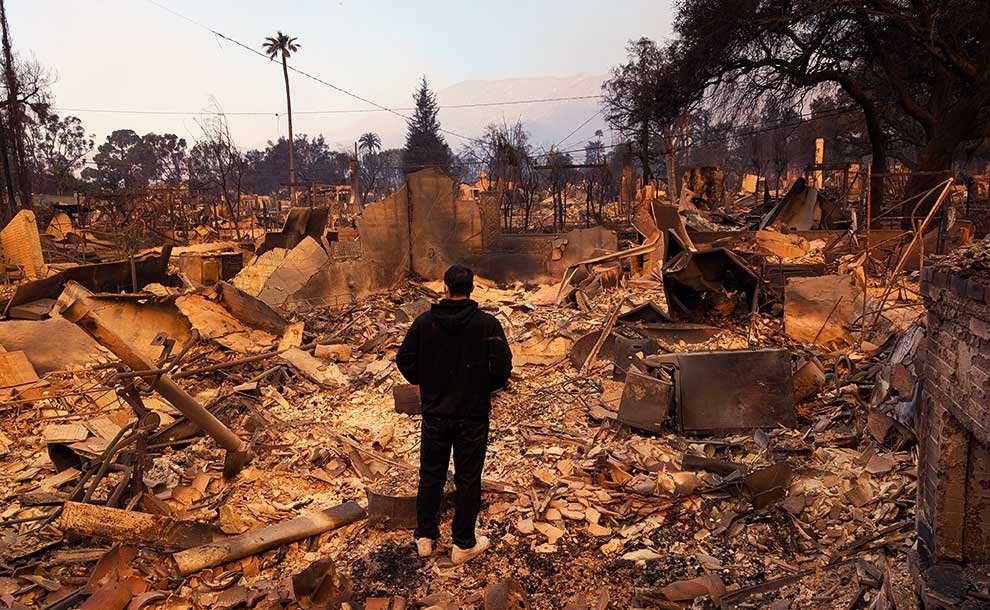
Devin Peries standing on the grounds where his house once stood (Photo – Chris MIller)
Before any rebuilding can begin, debris must be cleared. What does that mean, and what are our choices?
By Mala Arthur
In general, this information only pertains to properties whose homes were destroyed or mostly destroyed. None of the services or processes below pertain to homes still standing with smoke or slight burn damage. Those of us with homes with some damage should call Department of Public Works debris removal, (844) 347-3332, have FEMA visit to assess or go to the Disaster Recovery Center, 540 W Woodbury Rd, so an official can take a look at the property and make an informed decision about whether the property qualifies for the official debris removal process. It’s unclear whether properties with the garage or other outbuilding destroyed and the home still standing qualify. If there are any questions about qualification, call, email or go talk to someone.
Phase 0 of debris removal (unofficially) is the assessment of burned trees by licensed Tree Risk Assessment Qualified Arborists. If any trees are in danger of falling or injuring someone on the property, they will be removed quickly by the Department of Public Works. In general, this is not a choice and we are not allowed to be present for any removal. No notice will be given and no permission is required. If damaged trees are not marked already with paint, we may be able to hire our own qualified arborist to assess our trees, if they can do the work quickly and are able to communicate with the DPW and EPA.
Phase 1 of debris removal is the removal of hazardous waste. We have no choices to make this is required, automatic and must happen before any further work can be done. Hazardous waste removal is being done by Environmental Protection Agency (EPA) and CalEPA teams of up to 8 people. Fully protected EPA employees or contractors go onto each property as a team and carefully search properties for batteries, electronics, propane, paint, chemicals, oil, pesticides, ammunition, compressed gas tanks such as used for welding, anything with asbestos and so on. The team will carefully sift through ashes and other remaining items on properties, wetting the material as they go to avoid kicking up dust, ash and soot. They also are checking for radiation. Found items that are not hazardous will be set aside, along with safe items such as compressed gas canisters that are empty. The removed items will include the batteries from any burned or damaged vehicles. All hazardous materials will be carefully packaged to prevent spilling or other damage and transported to a sorting facility before being taken to a disposal site.
Important things to know: we will not be sent a notice that they will be working on our property, we may not be present on the property while the EPA team is working, and we will be notified with a posted sign on the property when they are finished. In addition, the EPA has a new map which shows the properties that have been completed at https://www.epa.gov/ca/2025-california-wildfires#Storymap. This process originally was projected to take up to 6 months but officials are attempting to complete most properties in 30 days. This work is provided free of charge and our insurance companies will not be charged for the service.
Phase 2 of debris removal is the removal of burned debris from our properties. We do not have a choice about this being done, but we can decide whether we want to hire our own contractor (if they are licensed and approved) or allow the Army Corps of Engineers and their contractors to do the work. Step 1 is to decide whether to opt-in or opt-out. We do this by filling out an online form at https://recovery.lacounty.gov/debris-removal/ and submitting it online, by email, fax or filling it out in person at the Disaster Recovery Center.
Opt-in: If we opt-in, we can then opt-out later if desired, but once we opt-out that is final. The opt-in means that we grant permission for the Army Corps of Engineers or their official contractors to go onto our property as a team, sift through carefully while wetting the ash and soot to avoid spreading it into the air, save any personal items or keepsakes found, and remove burned and damaged debris. Opt-in must happen before March 31, 2025.
Opt-out: If we opt-out, we must hire our own licensed and approved contractor to remove the burned and damaged debris. We must choose from the contractors registered with DPW and/or FEMA. If we file no form, it is assumed that we are hiring our own contractor.
Important things to know: Phase 1 EPA work must be fully completed on a property before Phase 2 can begin. We are not allowed to complete this clearance on our own under any circumstances. Licensed and approved contractors or the Army Corps of Engineers must be used in all cases. This is to protect everyone’s safety. If we opt-in, the ACoE will notify us 3-5 days before work will start on our property, and then again the day before. We are welcome to be present, but not required. Their team members will carefully and respectfully preserve any items that they find which may have emotional or tangible value whether we are there or not. Team members will be wearing air quality monitors and there will be at least one portable monitor setup at each property to ensure safety.
Choosing opt-in versus opt-out can be complicated. Those of us with insurance usually have a line item in our policy that specifies how much will be paid for debris removal when the home is significantly damaged or destroyed. The amount of money up to the limit or the cost for our specific property will either be paid by the insurance company directly to the contractor we hire (opt-out), or to an LA County fund (opt-in). If we don’t have insurance or it does not include debris removal and we opt-in for the Army Corps of Engineers to do the work, there will be no charge. If we hire a contractor and our insurance does not provide enough to pay them, we will be personally responsible for paying the balance.
What’s included in the opt-in: The Army Corps of Engineers and/or their contractors will remove ash, all parts of our homes and the contents that were inside including chimneys, furniture, appliances etc. They also will take fire damaged or destroyed vehicles from our properties. We can choose whether they should remove the foundation, but it’s recommended that we speak with an architect or engineer before deciding this part because high heat often compromises concrete, making it too weak to hold up a new structure. In addition, the ACoE will remove 6” of soil within the “ash footprint” of our home. To understand what an “ash footprint” is, imagine a bright light directly over our intact homes, such as noon on a summer day. The shadow cast by the roofline, usually some inches or feet from the foundation, is the outline of the “ash footprint”. Finally, although the ACoE may use our swimming pool or pond water to help wet the ash and debris, they will not drain or clean our pools. They will only pull house parts out for disposal. They will then fence any pool so no one falls into it. Finally, they will install erosion control as appropriate.
What’s not included: The Army Corps of Engineers will not remove perimeter fences or fences that were not part of our homes. They will not remove walls that are not part of our homes. They also do not remove hardscape such as patio flooring, sidewalks, driveways etc. If there are standing structures on our properties such as a garage, it appears that they will leave those alone unless FEMA/DPW has determined that the standing structure is dangerous or too damaged to remain. The ACoE also will not provide soil testing, air test results or any list of materials removed.
More important things: The Phase 2 process prioritizes groups of our properties, so getting neighbors to complete the opt-in will raise the priority of our properties. The teams work most effectively if they can bring equipment to a neighborhood and work in parallel on several of our properties at the same time. There are several documents which we are required to provide in order for the forms to be processed. See the above website for more info about the requirements. You will need your parcel ID# to complete the opt-in or opt-out form. You can get this from the County Assessor’s office or by going to the Disaster Recovery Center. If you are missing other required documents, the Disaster Recovery Center can help you get copies of them. Save every receipt for all fire-related things, digitally if you can’t carry around paper. The Phase 2 process was originally expected to take 18-24 months but extra staff has been added in order to speed the timeline. There is no firm end date.
Changes and Updates: As the process goes on, things will inevitably change or morph. The LA County’s recovery page has mostly accurate and up-to-date information. Check the LA County Recovery page at https://recovery.lacounty.gov/debris-removal; if you have questions go to the Disaster Recovery Center to ask. The US Army Corps of Engineers has established a Debris Call Center to help answer questions regarding Private Property Debris Removal. Hours of operation are from 6:00 am to 6:30 pm; call (213) 308-8305 for assistance.
Mala Arthur lives in a high fire danger canyon that did not burn down thanks to brave neighbors, and manages the neighborhood association and a mostly-inactive Fire Safe Council. She has lived in the area for 37 years.













Leave a Reply