






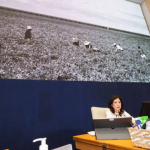


Shri Kulkarni (Photo – caltech.edu)
Shri Kulkarni, the George Ellery Hale Professor of Astronomy and Planetary Science at Caltech, has been awarded the prestigious 2024 Shaw Prize in Astronomy “for his ground-breaking discoveries about millisecond pulsars, gamma-ray bursts, supernovae, and other variable or transient astronomical objects,” according to the Shaw Prize Foundation, which has been granting the honor since 2004.
By Whitney Clavin
The award citation further states that Kulkarni’s “contributions to time-domain astronomy culminated in the conception, construction and leadership of the Palomar Transient Factory [PTF] and its successor, the Zwicky Transient Facility [ZTF], which have revolutionized our understanding of the time-variable optical sky.”
The Shaw Prize consists of three annual awards: the Prize in Astronomy, the Prize in Life Science and Medicine, and the Prize in Mathematical Sciences. Each prize comes with a $1.2 million award.
Kulkarni said:
I was pleasantly surprised to hear that I was the winner of the 2024 Shaw astronomy prize last evening. My wife did not believe me at first having suffered many of my pranks in the past! ZTF is possible because of a knowledgeable and dedicated crew at Palomar Observatory, the sophistication of the instrumentation program of the Caltech Optical Observatories, and finally, exceptional students and postdoctoral fellows at Caltech. ZTF is only possible at Caltech, which values exceptionalism.”
Kulkarni has made a wide variety of discoveries over his career. In his recent Watson Lecture at Caltech titled “Illuminating the Dynamic Night Sky: Discoveries from the Zwicky Transient Facility,” he discussed his passion for building instruments to explore uncharted areas in astronomy. He has built a total of 10 instruments in his career. “My motto has been to build a big enough gizmo and things will happen,” he said.
Some of Kulkarni’s earlier discoveries include the first millisecond pulsar, a rapidly rotating neutron star that emitted more than 600 precisely spaced pulses per second; and the first brown dwarf, or “failed” star, uncovered in 1995 using a then-novel instrument at the Palomar Observatory’s 60-inch telescope. In 1997, Kulkarni and his colleagues were the first to measure the distance to a gamma-ray burst—a brief intense burst of gamma rays from the cosmos—showing the energetic event originated far outside our galaxy, billions of light-years away.
Working with a graduate student, Kulkarni later developed the STARE2 (Survey for Transient Astronomical Radio Emission 2) instrument for studying fast-radio bursts, mysterious bursts of radio waves whose origins were unknown. STARE2, which consisted of three bucket-sized radio antennae spread across the southwestern United States, caught a massive fast-radio burst in our own galaxy, and helped pinpoint its origins to a type of dead magnetic star called a magnetar.
Shri Kulkarni
Kulkarni was born in Maharashtra, India. He received his master’s degree from the Indian Institute of Technology Delhi in 1978 and his PhD from UC Berkeley in 1983. He arrived at Caltech on a Millikan Fellowship in 1985 and joined the faculty in 1987, serving as an assistant professor of astronomy (1987–90), associate professor (1990–92), professor (1992–96), professor of astronomy and planetary science (1996–2001), MacArthur Professor (2001–17), and George Ellery Hale Professor of Astronomy and Planetary Science (2017–present). He was also executive officer for astronomy (1997–2000) and director of Caltech Optical Observatories (2006–18). He is a member of the Royal Society of London, the Indian Academy of Sciences, the Royal Netherlands Academy of Arts and Sciences, and the U.S. National Academy of Sciences.
Kulkarni has received many awards, including the National Science Foundation’s Alan T. Waterman Award and the Dan David Prize. He authored or co-authored more than 60 papers in the journal Nature by the age of 60, one of his lifetime goals.
This article has been edited for length and clarity. Read the full story at caltech.edu.













Leave a Reply