







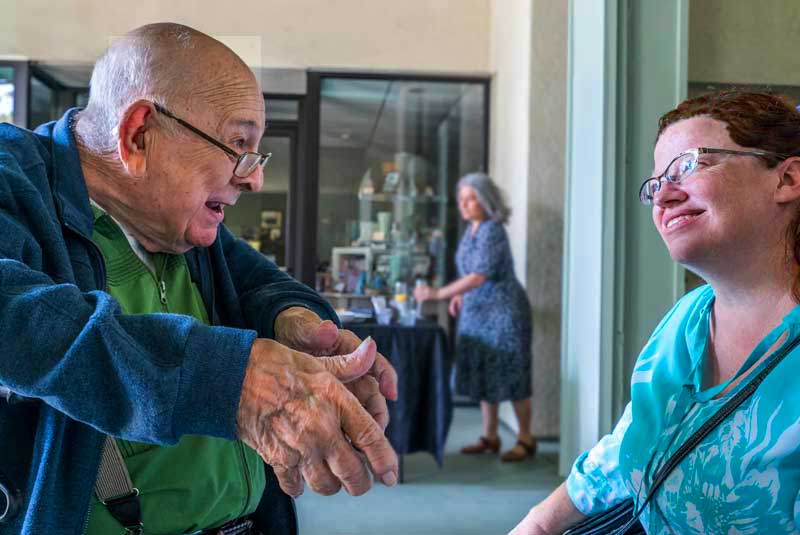
Dr. Robert Winter (Photos – Marlyn Woo, Joanne Wilborn).
For Dr. Robert Winter, it all began with a beautiful house he couldn’t afford and two old women who dug in the dirt.
By Melanie Hooks
In 1972, Winter was a young history academic who’d managed to win a coveted faculty spot at Occidental College despite most of the department’s disapproval. The now-heralded, 91-year old retired professor admits, “They didn’t like me very much.” His boss took him under his wing and gave him his title, Associate Professor of the History of Ideas.
Meanwhile, Winter “fell in with a group of Arts and Crafts addicts” and ended up leading a local USC history tour – the first time he encountered master craftsman Ernest Batchelder’s home. “When I first saw the tie fireplace, I did one of my phony fainting acts.” Owner Francis Dean remembered his enthusiasm a few years later when she wanted to sell the house and approached him. At first, he had to decline until the price dropped to a figure the modest professor could manage. It was after he moved in that the women started coming around.

A custom marked Batchelder tile. Salve translates from Italian and Latin to “welcome” or “hail”. (Photos – Marlyn Woo, Joanne Wilborn).
Two elderly ladies had been scouring the long-closed Batchelder tile factory yard for lost treasures. They found them: Aztec gods, fountain fish, pastel fairy tales. Lots of them. So many that when the women started bringing the tiles round to Winter, he had little choice but to store them in his garage, hallways, any spare space he could find. “Some of these still have the factory dirt on them,” he said of the tile on exhibit. “The museum was afraid to scrub them clean.”
Now a respected expert on Batchelder and his life’s work, Winter lent the rescued tiles and curated the Pasadena Museum of History exhibit from his and other private collections. But if you’re curious about the house that started it all, you can visit it too at the exhibit – via a Virtual Reality 3D headset. Dr. Winter will greet you by the cozy fireplace, exactly where one feels Batchelder himself felt such warm domestic art should be enjoyed.

A large panel from LA’s Dutch Chocolate Shop (Photos – Marlyn Woo, Joanne Wilborn).
The most stunning frieze comes from downtown L.A.’s Dutch Chocolate Shop, a privately owned site still being negotiated for preservation and only on view for occasional high-dollar small tours.
In addition to those stunning muted-browns, one can also view bright reds, blues and greens from the Hershey, Pennsylvania, resort hotel lobby. Clearly chocolatiers appreciated fellow artisan Batchelder. (Willy Wonka springs immediately to mind.)
Pasadena’s Mid-Century Ceramics

Cast & Fired Pasadena’s Mid-Century Ceramics Industry exhibit (Photos – Marlyn Woo, Joanne Wilborn).
The companion piece to well-known Arts & Crafts artisan Ernest Batchelder’s exhibit might not strike all viewers immediately as high art, but it should make them smile. Bright colors, whimsical figures and above all, the familiarity of the domestic art light the space. Grins of recognition filled the faces of early gallery-goers as they wandered through the Mid-Century Ceramics displays.
“Did you get that from my grandmother’s house?” “I shouldn’t have thrown those knick-knacks away.” “Wait. This was made on my street!”
In fact, mid-century Pasadena saw hundreds of ceramics producers hard at work, says PMH Executive Director Jeannette O’Malley, due to the distinctive and highly workable native clay. Many of those were one or two-person shops, run out of private homes and garages. A quick look around the room shows how female-led the industry was as well. O’Malley believes that the Mad Men-era push of women out of businesses inevitably led to a need for women’s creative and intellectual output.

Bright colors and whimsical figures at the Pasadena Museum of History exhibit (Photos – Marlyn Woo, Joanne Wilborn).
Many posted histories of the microproducers show that brightly colored fawns, flowers and genies weren’t short of buyers either. Quite a few developed into factory-sized productions, with some lasting well into the late 1970s.
O’Malley says that the Museum’s volunteer staff single-handedly uncovered the tremendous local treasure trove of both artifacts and histories – a full two-year effort led by Dr. Elizabeth Smalley, exhibit curator, based on passion and generous sharing of time. You might never look at Pasadena garages the same way again.

(Photos – Marlyn Woo, Joanne Wilborn).
A Members’ Opening Reception celebrates both exhibits this Friday, September 30, 6-8p.m. onsite.
Tie-in lecture
“Out of the Blue, Creating Beauty from the Earth: Decorative Tiles of Southern California, 1910-1930”
By Joseph A. Taylor of the Tile Heritage Foundation.
Pasadena Playhouse Courtyard & library
Tues, October 4, 2016
$35-40.
> Batchelder: Tilemaker &
> Cast & Fired: Pasadena’s Mid-Century Ceramics Exhibit
Pasadena Museum of History galleries
Wednesdays-Sundays, 12-5 p.m.
Through Feb 12, 2017.
Tickets: $7 General/ $6 Students & Seniors
Free for Members & Children 12 and under.









Leave a Reply