



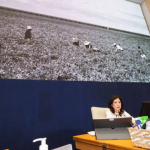


” Storm Cloud: Picturing the Origins of Our Climate Crisis” (Photo – Elon Schoenholz)
This fall at The Huntington, two exhibitions focus on the practice of observing and documenting natural phenomena in ways that lead to profound insights.
By Andrew Kersey
Both exhibits open on September 14, 2024 and will be available through January 6, 2025. They are part of PST ART: Art & Science Collide, Getty’s regional collaboration involving more than 70 cultural institutions across Southern California.
- “Storm Cloud: Picturing the Origins of Our Climate Crisis” examines the ways in which British and American scientists and artists documented the environmental impact of industrialization from the late 18th through the early 20th centuries.
- “奪天工 Growing and Knowing in the Gardens of China” focuses on how scholars and artists of the Ming and Qing dynasties (1368–1912) carefully studied plants to gain insight into the wider world and themselves.
Each exhibit traces a history of the relationship between humans and the environment. And both share an emphasis on close observation of the natural world and the important role that observation played in art, science, and ethics.
“Storm Cloud”
“Storm Cloud” takes its name from “The Storm-Cloud of the Nineteenth Century,” a series of impassioned lectures given by the British essayist and art critic John Ruskin in 1884.
Ruskin was one of the first people to home in on industrialization’s impact on the atmosphere: dark, polluted skies. In the summer of 1871, he began to write about what he had been observing. Some in the modern U.S. West came to a similar realization, though only when faced with the early signs of an impending crisis.
“Growing and Knowing”
Centuries earlier, careful observation of the natural world, and the ethical insights that followed from it, defined the work of Chinese scholars. Chinese gardens provided opportunities not only for contemplation but physical engagement. Gardening was seen as a necessary complement to intellectual pursuits and a more complete way of knowing what nature had to teach. Working directly with plants, even actively interfering in natural processes, led to more advanced horticultural practices.
Did these new horticultural practices “usurp the works of Heaven” (duo Tian gong 奪天工), as some Chinese scholars of the era contended, or were such interferences respectful augmentations of nature?
When viewed together, The Huntington’s two PST exhibitions elicit these and other provocative questions about how close observation—of changes over time, of our connections to other living things, and of the ethical implications those connections entail—can be a powerful catalyst for re-envisioning one’s place in the world.










Leave a Reply