







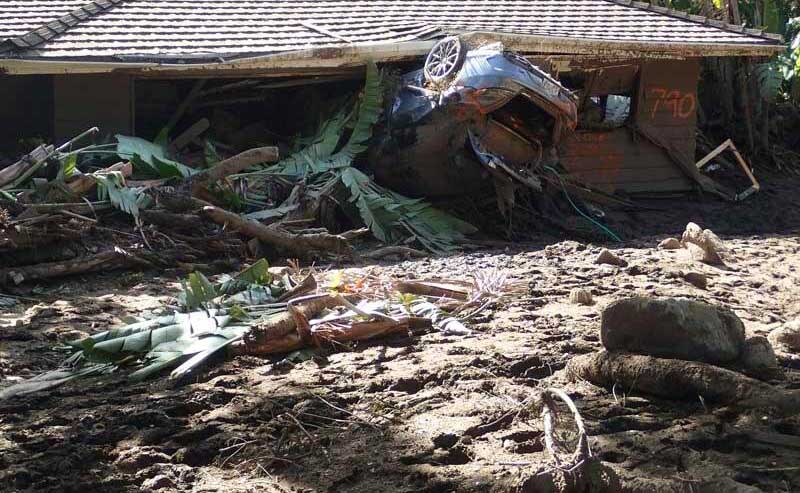
Debris flows in Montecito (Photo – U.S. Geological Survey)
A few days after the Thomas Fire of December 2017, half an inch of rain fell on the mountains above Santa Barbara—and it fell in a very short period of time.
By Sharon Hawley
Mud and boulders the size of cars tumbled through Montecito, killing 23 people and destroying much of what the fire had spared. Given the similarity of terrain between the Thomas Fire and the Eaton Fire, it is a harsh reminder.
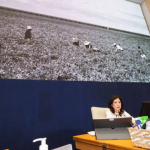
Michael Lamb, geologist at Caltech, became concerned about the possibility of debris flows in Altadena after the Eaton Fire. On January 29, he presented a quickly prepared lecture at Beckman Auditorium to share his professional opinion. This article summarizes his evaluation of what might happen.
The San Gabriel Mountains above Altadena have been rising along a fault line at the rate of about one inch every fifty years for a long time, and they have been eroding at about the same rate due mostly to rainfall. But erosion doesn’t happen gradually—it happens in bursts after heavy rains. Debris flows have been a regular occurrence for thousands of years.
Altadena is built on a fan of eroded debris—sand, rocks, and boulders deposited over millennia. Debris flows carry not just water, but trees, rocks, and boulders. Engineers have recognized over the past hundred years the need to protect Altadena and neighboring communities by building debris basins to catch the rocks before they reach human settlements.
Debris basins have been highly effective in preventing major debris flows from devastating Altadena. On average, it takes 20,000 dump truck loads per year to keep them clear and ready for the next storm. A good example is the large debris basin in Eaton Canyon, just below where the Eaton Fire started. Taxpayers have largely accepted the high cost of maintaining these basins, recognizing their importance.
But after a fire, the burden on these basins increases dramatically—erosion is about twenty times greater after a fire, than normal. The San Gabriel Mountains burn, on average, every thirty years—not all at once, but every part burns about that often. Before the Eaton Fire, the chaparral above Altadena had survived longer than usual, reaching full maturity. Now, it is almost completely gone, all the way up to Mt. Wilson.
Mature chaparral holds soil and rocks in place far better than young chaparral. What remains now is bare, deep soil, stripped of the stabilizing power of vegetation. Some of it has already sloughed off the steep hillsides and is resting in canyons. If heavy rain falls, even briefly, the potential for significant debris flows increases.
Michael Lamb and his colleagues have studied the capacity of the debris basins, and have found that they are likely to contain most the debris from what he estimates will be an average or slightly above-average rainfall season. However, it is not the total amount of rain that matters—it is the intensity of short bursts of rain that triggers debris flows. His conclusions are based on historical rainfall records.
If rainfall turns out to be more extreme than historical data suggests, then destruction like the Montecito debris flow is possible. The connection between Altadena’s weather and global temperature rise has become speculative and unpredictable. Historical averages may soon be ineffective in predicting future weather patterns. The Eaton Fire was driven by winds stronger than any on record. Future Rainfall patterns might soon be unpredictable from historical rainfall records.
Much remains uncertain about Altadena’s future. Unfortunately, destructive debris flows are among the risks that cannot be predicted with certainty. If rainfall proves to be more conducive to debris flows than historical trends suggest, destruction similar to the Montecito debris flow is possible. It’s likely that, in the lifetimes of the young, historical averages will no longer be reliable for predicting future weather patterns. As a result, we can expect significant uncertainty in future weather predictions for Altadena, including the likelihood of destructive debris flows.












Leave a Reply