








THEATRE REVIEW

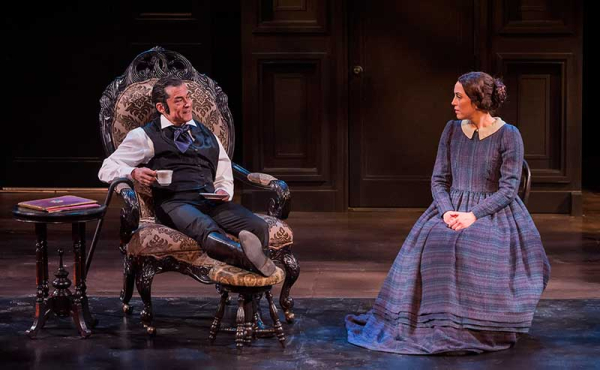
A Picture of Dorian Gray at A Noise Within (Photo – Craig Schwartz).
First, notice the slight change of title for this classic tale by Oscar Wilde of a Victorian era socially and physically flamboyant young man who makes the ultimate “deal with the devil,” acquiring the gift of eternal youth while only a painting of himself ages and displays the various stages and results of his decaying soul.
By Carol Edger Germain
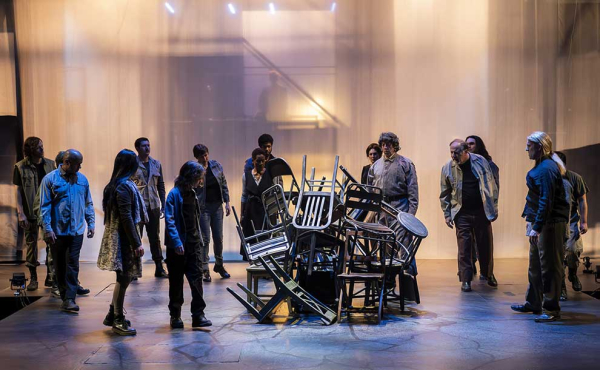
This production is titled “A Picture…” instead of “The Picture…” That’s the first clue that this play will veer from the usual take we’ve seen in movies and theater previously. This production adheres more closely to the original story as published in 1890 in Lippincott’s Monthly Magazine. It received criticism for its unabashed homoerotic aura, with comments such as “decadent,” “unclean,” and “poisonous.” The revised version published a year later as a novella focused more on a Gothic horror atmosphere, although the sexual undertones were undeniable. Michael Michetti’s adaption and direction of this piece at A Noise Within take it a step further, adding powerful and graphic dance sequences, and more overt interaction among the characters. The part of the “picture” is played by an empty frame, which also serves very effectively to keep the attention on the people in the story more than the aging picture.
Michetti’s distinctly stylized and modernized vision is enhanced with excellent casting, including Colin Bates as Dorian Gray (who perfectly fulfills Wilde’s description of a young man with a “face like ivory and rose leaves”), Frederick Stuart as Lord Henry Wotton, and Amin El Gamal as Basil Hallward. Although Dorian is primarily attracted to women, his attraction to being adored is a stronger driving force, and he basks in adulation regardless of where it comes from, and he leaves a string of emotional devastation among many acquaintances.
The vision, staging, and casting are in alignment and intriguing visually as well as auditorily, and although the manifestations of Dorian’s decay were all there, from jilting his fiancee to murder, there was more direction toward the psychological aspects of his descent into hedonism than the horror aspects. The only place the technique didn’t play quite as well was the sequence where the forceful ballet was accompanied by Basil and Henry in the background attempting to disguise the effects of their aging while Dorian remains unchanged (and nude, as he is through much of the play), overlaid by philosophical readings. The three elements of the scenario need to be more intertwined, with the audio levels more balanced (believe it or not, the sounds made by the dancers made it difficult to hear the readings, and I wanted to hear more without straining). But that’s a minor flaw that can be easily corrected. I also think nothing would be lost by shortening it by 20 minutes or so, which could also easily be done. Overall, quite unique and recommended.

(L-R) Frederick Stuart, Amin El Gamal, and Colin Bates (Photo – Craig Schwartz).











Dear Carol Edger, greetings! In my undergraduate days, “Importance of being earnest” was prescribed and now to view “Dorian Gray here,what a contrast ! the review of production, the picture, the details into it, how hedonism brings down fall and ruins one’s prospects – all in the picture and narration, so beautifully drawn.