









The “No 710 Tunnel” march at the Festival of Balloons in South Pasadena. (Photo – Sylvia Plummer)
A lot of residents are falling prey for misinformation about the construction of the 710 tunnel. It’s time to set the record straight.
Here are 9 reasons to why the SR-710 connector tunnel should not be built.
1- Trucks corridor

Trucks on 710 corridor (Photo – Metro.net)
The SR-710 North Extension is not being built for commuters. It’s intended as part of a goods-movement system that ties into the Expansion of the I-710 Freeway and the High Desert Corridor.1
2- More ports traffic

Long Beach and Los Angeles ports are the busiest in the nation (Photo – Trucks in Long Beach, greenbiz.com).
These 4.9 mile tunnels will not have exits or on-ramps, further demonstrating that it is not designed for local commuters, but pass-through traffic from the Ports.
3- More congestion

Traffic on 210 (Photo – Steve Hymon, thesource.Metro.net).
The SR-710 North Extension tunnel(s) would connect the lower I-710 Freeway with the already heavily congested I-210 Freeway which will lead to gridlock conditions for everyone.2
4- Cost
Government sources have quoted project cost ranges between $1 – $14 billion to build the tunnel. The current figures being used by LACMTA is $5.425 billion and SCAG is $5.636 billion. The smaller “Big Dig” tunnel, (only 3.5-mile long) was estimated to cost $2.8 billion in 1982 dollars. However, the Boston Globe has estimated that the project will ultimately cost $24 billion, including interest, and that it will not be paid off until 2038.3
5- Toll aversion

Commuters will try to avoid toll fees by going through surface streets. (Photo – Alhambra traffic, transportation.gov).
To pay for the huge construction and upkeep costs (lacking in current estimates), a public-private partnership must be forged. These investors need to make a profit from this deal and tolls will be charged. Tolls create diversion traffic.4 Drivers unwilling to pay the “average” fees of $5.64 for cars and $15.23 for cargo trucks5 will likely take the “short cut” through local neighborhood streets.
6- Wasted money
InfraConsult, a financial consultant, provided a forecast volume of 190,000 annual average daily traffic in the SR-710 North Tunnel for the year 2030 to which a diversion rate of 35% has been applied.5 It is possible that a public-private partnership for the 710 tunnel(s) will fail like other toll roads because the forecasts were based on FLAWED traffic projections6 and traffic volumes may be much lower than expected.7
7- Death trap

Fatal traffic accident in tunnel. (Photo – thelocal.ch).
The risk of being killed in a traffic accident occurring in a tunnel is twice as high as on open stretches of motorways.8
8- No easy way out (watch short video)
Roadway tunnels are inherently dangerous. If a fire occurs, there is no easy way out of a tunnel, especially for those with limited mobility.9
9- Concentrated Air Pollution
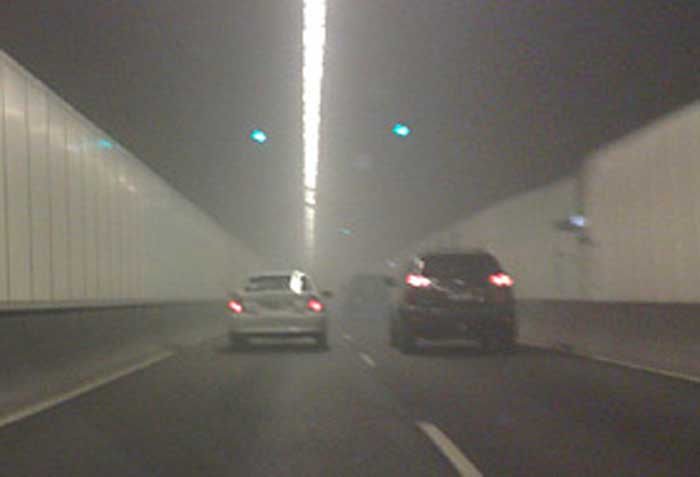
New research suggests that ultrafine particles are lurking inside road tunnels in concentration levels so high they have the potential to harm drivers and passengers.
Vehicle exhaust cannot be properly filtered and will lead to health issues not only for the drivers who use the tunnel10 but also for the surrounding communities where the exhaust is vented.11
Source: no710.com. Check Data footnotes here.










Will,
In your stated interests of saving time and fuel, why not continue the development of the Alameda Corridor? Rail to move goods east to well-established rail lines east and north…
That would get trucks off the main freeways all over the LA area. The cost would be
much less than that of a tunnel, using rail lines already constructed.
Or—would that destroy your (obvious) interest(s) in the Upper Desert Corridor and the
trucking industry.
Please come into the 21st century!
Concerned LA Area Citizen
Connecting the 710 and 210 will reduce traffic volume Nowhere. It will reduce travel times Nowhere.
The proof: The recently completed $1 billion I-405 widening between the West Side and Valley reduced traffic Nowhere. It reduced travel times Nowhere.
(laweekly.com/news/11-billion-and-five-years-later-the-405-congestion-relief-project-is-a-fail-5415772)
The missing link between the 710 – 210 does seem dumb. As for a connecting tunnel, why not? It would be “out-of-sight and out-of-mind”, except for the cost. And except when you consider that the end result will simply be to increase freight traffic on the 210, and no traffic will be reduced anywhere.
You’ve just given the main reasons why the tunnel SHOULD be built. The 710 was deliberately intended to provide a direct route for freight traffic from our ports to the main routes north. The arguments against the tunnel we’ve heard concentrate on people-carriers, which are pretty much irrelevant to the 710’s designed mission. The commuters are already coming off the current end of the 710 and onto Valley and Fremont (as somewhat caricatured at Point #5), and we should expect them to keep doing so. I certainly will. The important aim here is to correct the waste of fuel, time and money imposed upon commercial traffic by that very real gap. The surface freeway originally proposed was an awful idea that was properly killed off; the tunnel does present its own problems, but in my view it solves more than it creates
They all sound like valid points. BUT can you have someone give 9 reasons it should be built for an offset to this list?
Will Owen and Mr Krafton you sound like you have something to gain from turning the 210 into a heavily congested trucking freeway. Are you connected to goods-movement in some way or storage warehouses along the route?
I’m a retired graphic artist, writer and editor; my only connection with the movement of goods is the one I share with everyone: the costs and benefits of commerce. As a consumer of goods and a sharer in our common economy I understand that the easier and more economical it is to move goods from seaports to distribution centers, the greater the benefits to the commonwealth. Saving time and saving fuel benefit the truckers, wholesalers and everyone else in the supply chain.
Nobody is going to “turn the 210 into a heavily congested trucking freeway” – it’s that already. Goods headed to the inland north have only the 210 or the 5; as it is now, trucks bound for the 210 have to dogleg through town on the 5, very much increasing and often immobilizing traffic. Closing the gap would alleviate much of this.
As a car driver I have a lot of options. My ghastly two-hour crawl last week from Downey to Highland Park, as I realized too late, could have been cut by almost half if I’d taken a surface route, Lakewood/Rosemead etcetera. An over-the-road hauler doesn’t have those options, as I understood while waiting on a long on-ramp among a whole herd of them.