





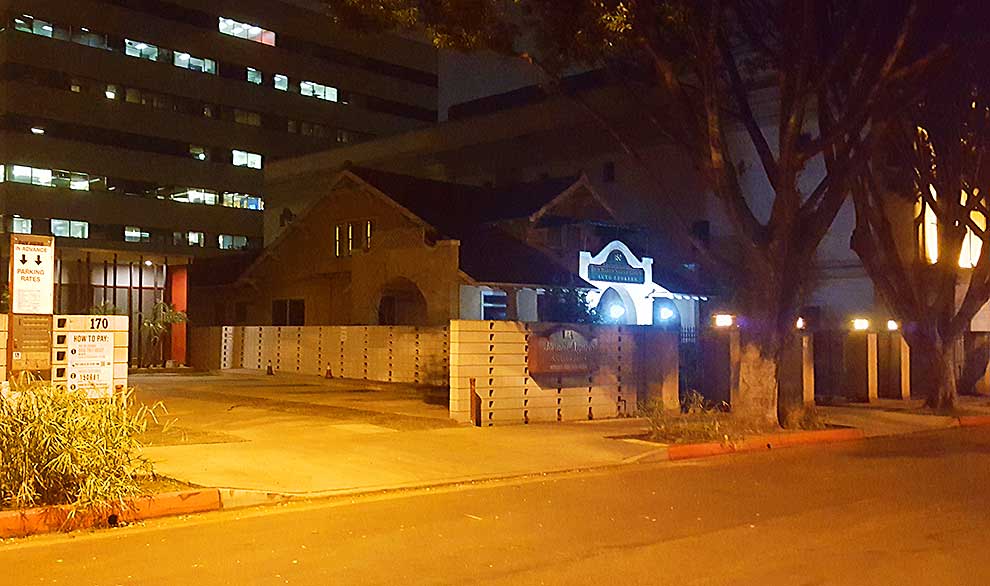
The Pinney House on 180 S Euclid Ave., with 170 S. Euclid property to the left and the Masonic Temple to the right (Photo – Emmanuel Kraletz).
As the New Year approaches, Monday night’s meeting of the Pasadena Design Commission shows clearly how Pasadena is a Janus-headed city, both looking toward the past and future.
By Garrett Rowlan
This bifurcated sense of direction was evident in the proposal by Onyx Architects for the space at 170-180 S. Euclid Ave., an area just south of the Paseo and nestled between Green Street and Cordova. The site is an eclectic one, now occupied by the Pinney House, Miss Orton’s Classical School for Girls, and the muscular dimensions of the Masonic Temple, just south of the proposed site, where Onyx proposes the building of a 5-story, mixed-use building.
The decision, on May 19, to move the Pinney House to a location on North Fair Oaks and the planned razing of an office building that—as Senior Planner Kevin Johnson said in his introduction—has elements of the new formalism style though falling short of preservation status, clears the way for construction, and while those historic and quasi-historic elements are removed, the path ahead is hardly one of clear sailing.
Listening to the presentation, and the give-and-take with the Design commission, one can appreciate the difficulty of Onyx or any other firm building in Pasadena, where increasingly collective hackles are raised with the proliferation of modern structures that are nudging the “small town” character of Pasadena toward the past, and the folkloric Little Old Lady to her final resting place.
In addition, the site itself presents issues as the Pinney House, Orton’s School, and the Masonic Temple offer a variety of heights and styles that challenges any building in 2018 to walk a conceptual tightrope, a dilemma evident in the commission’s comments where terms like integrate and contextual had the presenters nodding, blinking, and smiling though with a strained aspect as the evening had passed the four-hour mark. After considerable sniffing about the proposal, the commission didn’t exactly raise its collective leg but presented the architects with a plateful of objections and recommendations that they carried into the night.
Oak Grove Park
The evening also featured a detailed presentation for the restoration of the Oak Grove Park Area, a multi-use place that again shows how Pasadena needs to blend collective interests, as in hikers, habitat enthusiasts, bikers, and even disc golfers. Concerning the latter, the Oak Grove site is the world’s first disc golf course, and the Oak Grove Disc Golf club is some 200 members strong. Flood control, parking, and restroom facilities are other concerns. It is hoped that full implementation of the plan can be realized by 2020.
Removal of poor performing trees in Pasadena
Greenery was also the subject of the evening’s second issue, the need to remove poor performing tree species in Pasadena. Even here diversity is an issue, as no one species can claim more than 20% of the Pasadena area, as an ecological mix is the best defense against insect deprivation. Other issues are the ongoing drought, breakage, and costly maintenance issues. Because of this, species such as the silver maple, purple leaf plum, and tulip (a tree, not a flower in this case), are headed for the hit list, while the fern pine, crepe myrtle, and others are seen more favorably. Even Pasadena’s beloved camphor trees and the canopy they provide are looked at with a jaundiced eye, as they are not drought tolerant, either.
Kidspace Museum bike racks
The evening began with a presentation of an inverted U design for the bike racks around the Kidspace Museum, an issue of such relative triviality that one commissioner suggested it didn’t need two months’ worth of hearing to be resolved, but exhaustive inspection seemed to be the evening’s theme.













Leave a Reply