








Writing (Photo – Toshiyuki IMAI, flickr).
One of the many benefits of being a filmmaker in Hollywood is the opportunity to work with a diverse and talented group of people on a daily basis in order to complete a film.
By Kent Matsuoka
By diversity, I’m not necessarily speaking about race, gender, or orientation, as that’s another article entirely. What I’m talking about here is the diversity in job qualifications, skill set, and social class. I can’t think of another industry where accountants, armorers, car mechanics, carpenters, graphic artists, hair stylists, and writers all routinely work hand in hand on a daily basis.
They all lend their individual skills and abilities to ensure the successful completion of the project, but sometimes, individual groups are responsible for doing what they normally rely on others to accomplish.
One of these tasks are the periodic contract negotiations of the various guilds and crafts with the studios. As a member of one of the groups that are responsible for negotiating on a daily basis, as well as being a member of my own group’s contract negotiating committee, I can tell you that negotiating with the studios is tough. They have the resources to make things very difficult if they want to, but by and large, they’re not necessarily evil. The biggest problem usually isn’t the studios themselves, but vocal members of our own guilds and unions that don’t understand the complexities of negotiating with studios and always want to strike over terms that anyone who has ever sat in on a negotiation can tell you would never fly, and will never have the support of the other groups.
For all the writers out there, and especially those on the Writers Guild negotiating team, let me start out by saying that my hat is off to you. I can’t say that we’ve ever had a 67% return on eligible votes cast or 96% approval. Perhaps dissatisfaction on the national front has created more sense of urgency on political matters.
That being said, as someone who does negotiate on a daily basis and has learned to take a more pragmatic expectation of potential contract negotiation outcomes, I also don’t envy your position representing a guild of idealistic creative types emboldened by the political climate and unwilling to back down from the big bad studios.
So in the interest of greater peace and prosperity in Hollywood, I’d like to take a moment to offer a little background on studio negotiations, potential outcomes, and the big picture to the writers out there outside of what you might be hearing from the MPAA and the WGA.
You’re not in this alone
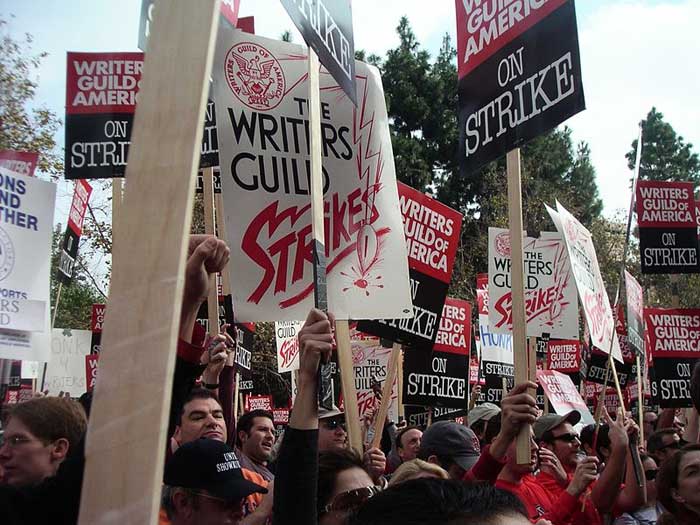
Writers raise signs at WGA rally in 2007 (Photo – Replysixty, commons.wikimedia.org).
The first thing to remember is that you’re not in this alone. That means that if you want our support, you also have to remember that not being alone means you’re not the only group that has to negotiate with the studios, but that we all have our own negotiations to deal with. You’re only one of a dozen separate bargaining units that the studios have to deal with in order to conduct their business. That can be used as leverage for or against, depending on what you’re asking for.
This means that if the studios come back with an offer that reduces your pay or isn’t on par with what the rest of us get, we’ll back you 100%. Otherwise, we know they’ll come back to us and say, “The writers accepted this reduction; why can’t you?”
The WGA leadership quotes potential studio cost numbers that are significantly lower than those the studios themselves are quoting. The studios know that if they give writers a substantial raise in any of the negotiated terms, we’ll all demand the same increases in our own agreements. The WGA makes its projections based on its own raise without taking any other guilds’ similar raises into account. The studios’ projections do, thus the cost difference.
Therefore, WGA negotiators, if you decide to strike on an offer that is on par with what the rest of the industry gets in the hopes of getting a raise that might be unsustainable when given to everyone across the board, you’ll find yourself hard pressed to gain any sympathy from the rest of the industry.
As chaotic as studio negotiations might seem, the studios are ultimately in the business to make money and have developed a formula for the equitable distribution of profits to the hundreds of thousands of below the line crew members represented by collective bargaining agreements. The formula roughly boils down to a 3% raise annually in pay and in health & pension contributions. If it looks like changes in the economy or a rise in health care costs are negatively affecting our plans, we might ask for a 3.5% increase in health & pension contributions in exchange for only a 2.5% raise in pay. Conversely, if our health & pension plans are strong and we think that we could push through something else that our membership wants, we might waive half a point for the contract term so we can ask for the new benefit. The point being that while we obviously want to get the most we can for our members, we also understand that we can’t ask for something more than what another group gets and need to give something back to the studios if we do.
For the idealists that had a good year, have a little money saved, and want to use a strike to send the message to the man that you’re sick and tired and not going to take it anymore, please take a moment to think about the ramifications all the way up and down the production ladder.
Have you met and spoken with the young Production Assistant that just got their foot in the door and is still working paycheck to paycheck? The grip who just had a baby or the driver trying to figure out how to pay for her daughter’s college tuition next fall? How about your favorite restaurant down street that is dependent on industry customers? The average production employee only makes about $1000 a week and there’s about 50~100 cast and crew members on set and behind the scenes for every writer on a television series that will be affected by a strike as well.
Have you taken the time to thank the crew at the wrap party or after they finished shooting your episode? Were you still on set at midnight as they wrapped on a Fraturday that wasn’t your episode? While many of you do, including many personal friends whom I greatly respect and support for your creative genius, there’s a great many writers out there haven’t and don’t, and that’s a disadvantage for those of you hoping for a complete shutdown. There’s also the issue of writers who are also producers and showrunners, and when we see them cross the picket line while asking us to honor it as some did in 2007, it makes the difference between a successful strike or one that ends in failure with no winners except for the studios, who have the capital to hold out and will use the strike as an excuse to execute force majeure clauses on unproductive development deals before they decide to come back to the table as they did in 2007.
So…if you find yourself at an impasse this weekend, and it’s a choice of extending the current contract for a week to take a breath and iron out the details, reaching out to Netflix/Amazon/Hulu for a side-deal and leverage, or actually execute the nuclear option of a strike, please take the former and not the latter option. We don’t need to give the administration in D.C. another excuse to push through federal right-to-work legislation that will cripple labor unions across the country and give the studios the leverage they need to bankrupt the unions here.
Kent Matsuoka is a Line Producer and Location Manager working in Hollywood serving on the Teamster Location Manager Steering Committee and consults with studios and film commissions on filming in developing production areas.

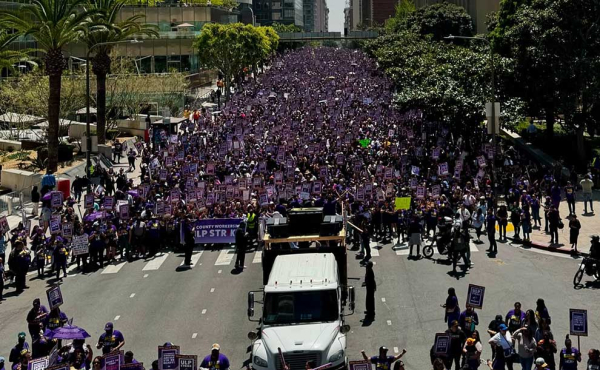











The biggest contention held by the WGA is that the studios are attempting to cut the amount they contribute to the guild’s health and pension accounts… in a time when studios are making record profits.
A few of the points made in this article are patently untrue:
“This means that if the studios come back with an offer that reduces your pay or isn’t on par with what the rest of us get, we’ll back you 100%.”
Studios haven’t attempted to gut their contributions to the DGA, but they are to the WGA.
“As chaotic as studio negotiations might seem, the studios are ultimately in the business to make money and have developed a formula for the equitable distribution of profits to the hundreds of thousands of below the line crew members represented by collective bargaining agreements.”
HA! “Equitable distribution of profits”? If that had even a whisper of being true, Hollywood accounting wouldn’t exist.
“we also understand that we can’t ask for something more than what another group gets and need to give something back to the studios if we do. You absolutely can. That’s why each guild negotiates separately and not all of them have the same deal. Or have you forgotten that PAs don’t make the same as script supervisors?”
“The average production employee only makes about $1000 a week”
That’s a falsehood. The majority of crew are in unions. Check out the schedule of weekly minimums here (Section B)
It’s unfortunate that this writer, while crying a position of neutrality, has a vested stake in the game: “[Author] consults with studios and film commissions on filming in developing production areas.”