


Editor’s note: This article appears in our February 2026 print edition. We are publishing it online ahead of schedule to include updated information about the sale of the Highland Theatre.
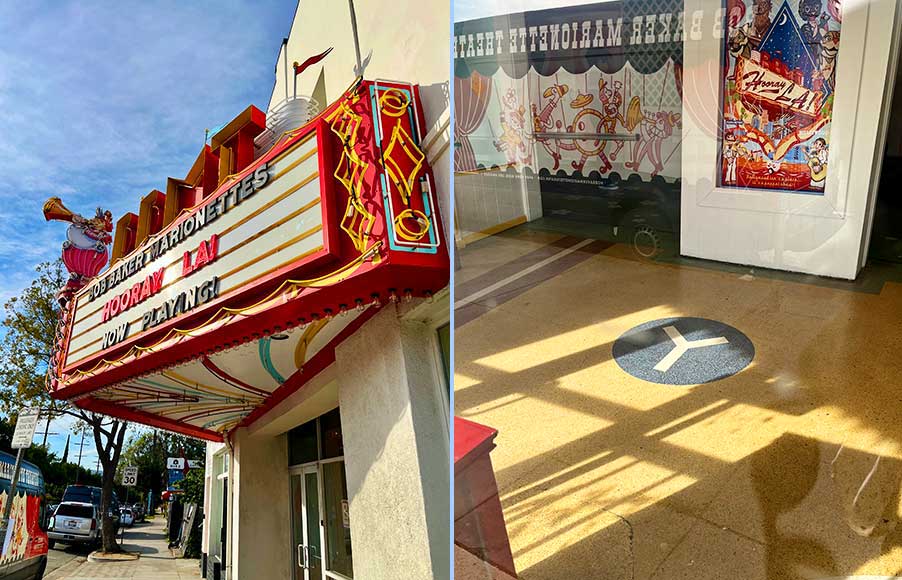
The Bob Baker Marionette Theater (Photos – Matt Hormann)
“Passing of a movie house,” read the 1963 headline in the Highland Park News-Herald & Journal. “Like the demise of the trolley car and the corner cigar store, another famous Highland Park landmark faded from the scene last May with the closing of the Park Theatre.”
By Matt Hormann
The theater, which stood at 5817 N. Figueroa, was one of seven that entertained the moviegoing public in Highland Park between 1911 and 2024. Today, only the Highland Theatre and the Bob Baker Marionette Theater remain intact, though neither shows movies anymore.
Highland Park’s first movie theater was the York Theater, which opened in February 1911. “The first moving pictures at the York Theatre on York Blvd. and West [Ave.] 57 were operated last Saturday night,” wrote the News-Herald & Journal. “On account of the absence of electricity, an engine was installed to manufacture and furnish electricity.”
The theater, about which little is known, didn’t last long. In January 1912, the paper noted: “The York Theatre, which has been open every night for nearly a year, has been temporarily closed. The proprietor has offered it for sale.”
The Highland Park Theatre, which opened on October 10, 1912, at 5630 N. Figueroa Street (then called Pasadena Avenue), became Highland Park’s second theater. It closed several years later.
The Sunbeam Theatre, also on Figueroa, opened in April 1914 at the intersection of Avenue 58. Its opening ceremony was accompanied by the giveaway of a cow from the Cy Perkins Country Store. “Highland Park’s new and palatial picture theatre, the “Sunbeam,” will be thrown open tonight in a blaze of electric glory,” wrote the News-Herald & Journal. “The building, inside and out, represents the last word in picture theatre construction in this country.”
A May 1914 newspaper ad touted “photo plays and fine music; refined vaudeville specialties. Admission range from 5 to 15 cents.”
Notably, the theater management assured the Herald that, “nothing but elevating shows will be given. Aside from pictures, the so-called vaudeville will consist exclusively of songs and musical specialties, and clean comedy. No suggestive or immoral features will be permitted upon this stage.”
The theater’s run was short-lived; by 1933 it had closed. A live theatre company briefly leased the space in the 1980s and ‘90s. Today, its current tenant Sunbeam Vintage pays tribute to its history.
Adding to the roster of neighborhood picture houses, the York Theatre opened in 1923, with a single screen and 700 seats. It was later renamed the York Lyceum Theater. By 1959, it had closed and became Electronic Organ Arts.
In 1961, it became a branch of the Church of Religious Science, then the Glad Tidings Tabernacle, then the People’s Church, before finally becoming the Pyong Kang Korean Church from 1985 until 2017, when the Bob Baker Marionette Theater moved in. A visible “Y” for York still appears on the terrazzo entrance threshold, and the original theater marquee has been restored with eye-popping neon.
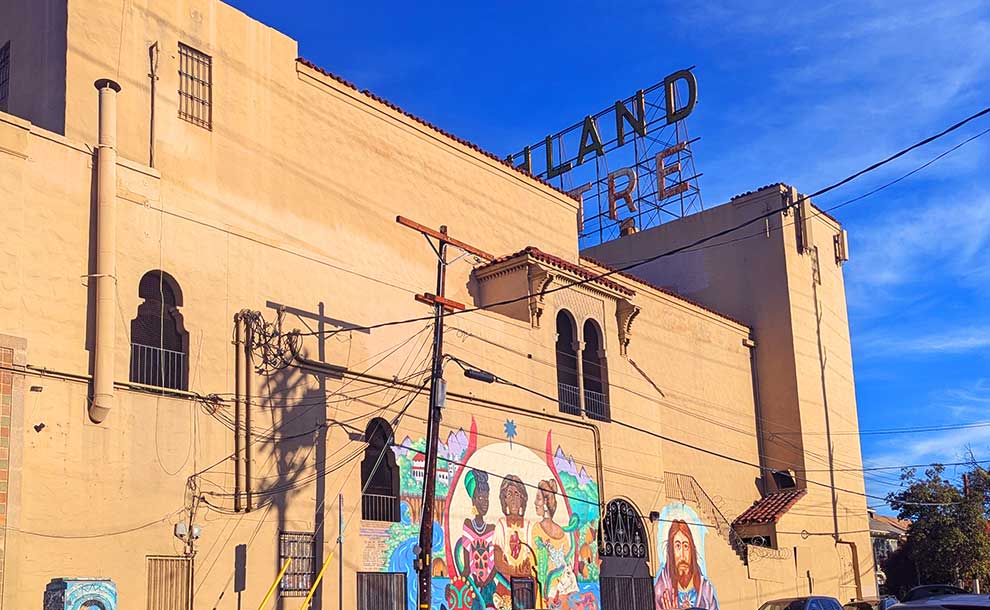
A mural on the side of the Highland Theatre (Photo – Matt Hormann)
Highland Park’s most famous and longest running movie house, the Highland Theatre, opened two years after the York, in 1925. Highland Park local Martin Carman recalled the theater being built, in a 1963 interview. “The construction of the Highland Theatre began to capture my attention and I would stop each day on the way home and check the progress,” he said. “I became greatly impressed with an artist who spent considerable time in the foyer painting a magnificent picture depicting a knight in armor, with a trumpet pressed to his lips, while mounted on a horse. […] I had the privilege of witnessing [silent star] Norma Shearer christen the theatre.”
Despite its glamorous beginning, by 1974, the Highland Theatre was showing adult fare — including Deep Throat (1972) and The Devil in Miss Jones (1973) — which drew strong rebukes from the local PTA, religious groups, youth groups, and a city councilman, for being “a threat to the future of the community.” The complaints shut the theater down a year later but it reopened in late 1975 showing “only family type films,” according to news accounts.
In 1983 it was divided into three auditoriums before closing for good in 2024. The theater’s future remains uncertain, but most recently it was featured in the upcoming The Adventures of Cliff Booth — a film sequel to Quentin Tarantino’s Once Upon a Time in Hollywood (2019) — starring Brad Pitt.
In 1983 it was divided into three auditoriums before closing in 2024. The theater will appear in the upcoming The Adventures of Cliff Booth — a film sequel to Quentin Tarantino’s Once Upon a Time in Hollywood (2019) — which was shot at the Highland last July/August. In early February Architectural Digest announced that actress Kristen Stewart, star of the Twilight franchise, had purchased the theater. “I’m fascinated by broken-down old theaters,” she told the magazine. “I always want to see what mysteries they hold.” Stewart intends to “recapture the glamour of Hollywood’s Golden Age while positing a new kind of social cinema experience.”
“It’s not just for pretentious Hollywood cinephiles,” she said.
The last theater constructed in Highland Park was the Park Theater, which opened in 1936. Garrett Rowlan, art and film critic for Colorado Boulevard, recalled it fondly. “Walking to school on Figueroa, I would see that marquee everyday,” he said. “I remember the Park, first, in association with monster movies, those I saw in the late 1950s and early 1960s, a list that included but was hardly limited to movies like Gorgo, Rodan, Blood of Dracula, House on Haunted Hill, and Frankenstein 1970.”
Later, Rowlan remembered, the theater branched out to foreign fare — films like Last Year at Marienbad (1961) and Shoot the Piano Player (1960) — which titillated and intrigued him.
“I think much of my interest in foreign films [came] from the Park Theater,” he said. “The monster and actions movies of my childhood were replaced by titles that seemed strange and intriguing to me. Viewing these titles and posters represented a kind of implanting, an interest that would find its fulfillment years later.”
The Park closed in 1963 and became the People’s Department Store. Today the space is occupied by Bridge Thrift.
“The Park lives on in my memory,” said Rowlan. “Those marquees with their mysterious fare that I felt unable to enter whether by lack of initiative, money, age, or the censoring of peer pressure remained at the periphery of my thoughts, waiting for the time when I had the age, money, and mobility to explore them.”
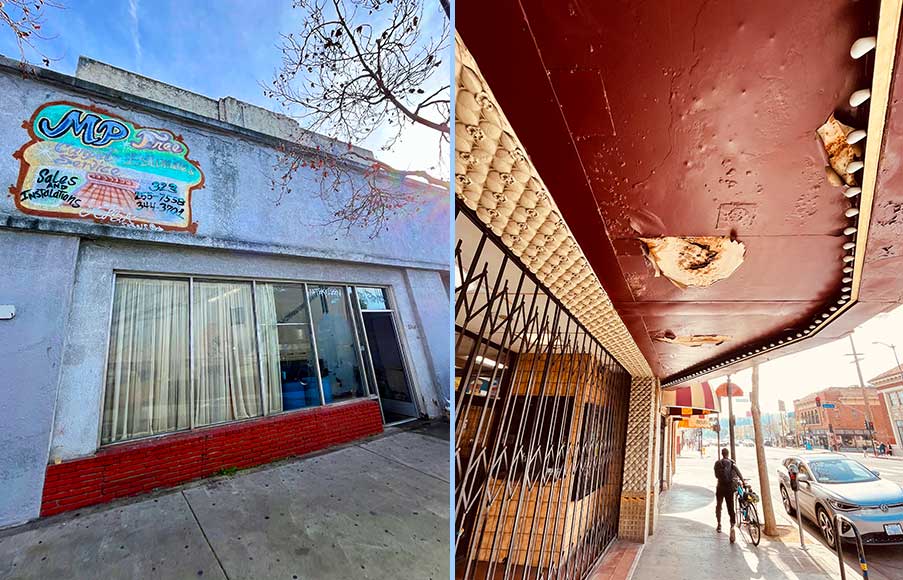
(L) Former Franklin Theatre. (R) Highland Theatre entrance and marquee (Photos – Matt Hormann)








Great article. Thanks for keeping the past present.