







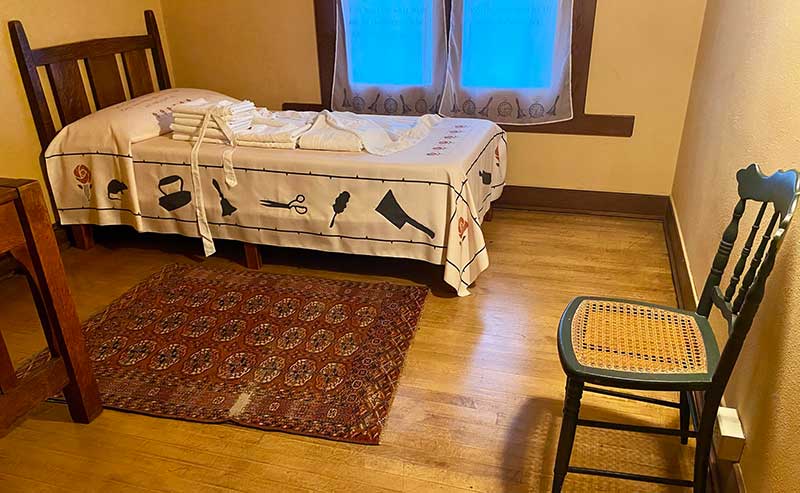
Servants bedroom at the Gamble House. Note the artists bed coverlet and designs on the bed spread (Photo – Brian Biery)
“I have no one to talk to. There is nothing in my life but dirty dishes to wash and a kitchen to clean up.” ~ Mary Anderson
By Brian Biery
During the first two decades of the 20th Century Pasadena became the home of millionaires (who probably would be billionaires in today’s dollars). Chewing gum magnate William Wrigley Jr., David B. Gamble, son of James Gamble, founder of Proctor and Gamble, and Adolphus Busch of Budweiser fame, were some of the wealthiest families in the country. Many of these upper-class residents lived on Orange Grove Blvd. which, due to this extreme affluence, was nicknamed ‘Millionaire’s Row’.
As ‘Millionaire’s Row’ grew, with dozens of opulent mansions of eight or ten bedrooms lining the street, the need for hired help increased dramatically. Mary Gamble and Ada Wrigley were not going to wash dishes and clothes, nor prepare meals for their families. Those laborious tasks were given to domestic workers who lived in the residences of the rich in modest servants’ quarters. And they were paid low wages for the difficult and arduous work required to maintain these enormous estates.
How were these servants treated? What were the conditions not only for carrying out the labors of the household, but also for their own accommodations? What was compensation for ensuring that the house was spotless, the laundry clean and folded, and food stored and prepared each day to the demanding tastes of the owners? How many hours a day were required to accomplish these tasks? And what happened if a servant became ill or requested a vacation?
In order to learn about the lives of these unseen and largely forgotten workers, local artists Lisa Mann and Karen Schwenkmeyer partnered with Pasadena’s Gamble House to investigate and bring to life the often-tragic lives of domestics throughout the country. Their curiosity about the lives of ‘servants’ of the wealthy was sparked after a tour of the Gamble House and the observation that architects Greene and Greene actually designed spaces for live-in help to sleep and bathe. According to Karen Schwenkmeyer, “We became interested in these less visible inhabitants of the Gamble House: the live-in maid and cook who were allotted living spaces above the kitchen.”
The result of their investigation is the site-specific art installation project titled ‘Dirty Laundry,’ which is being presented in collaboration with the Gamble House’s ‘Upstairs, Downstairs’ tours that are running from July 25 to August 17. This unique endeavor provides the public with the opportunity to see what it was like to live in the home of and work for millionaires in Pasadena at the beginning of the 20th century.
For anyone who faces the challenge of maintaining a household, the scale of the mansions on ‘Millionaire’s Row’ daunted even the most hard-working servants. Endless hours of cleaning, polishing, preparing, folding, and organizing filled the days of women who were hired to ensure that the owners had clean clothes and full stomachs every day. Often domestic workers had few, if any, days off and were separated from family and friends both by the demands of the job and by overbearing matrons. “What I did mind was that from the time I entered the house till I left it there was never a word for me beyond an order, any more than if I hadn’t been a human being. . . .That house shone from top to bottom; but a dog would have gotten far more kindness than they gave me.” (Almira)
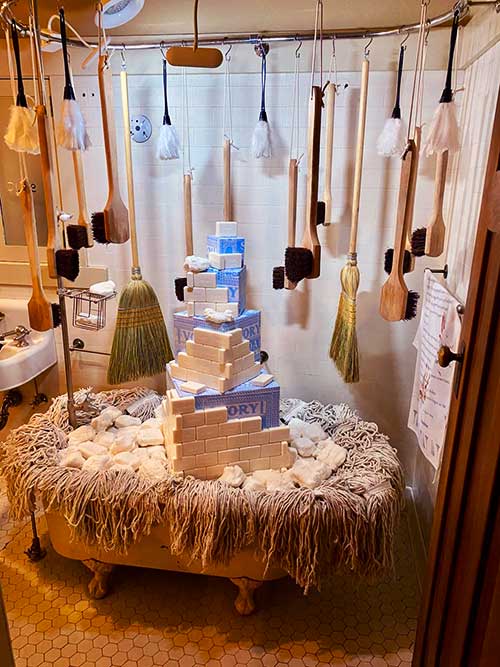
Servants bathroom with artists ivory soap exhibit (Photo – Brian BIery)
As with many menial jobs, the nonstop pace of cleaning, cooking, washing, etc. took its toll on these women, and those who could left the field. This meant that heads of households had to identify and recruit replacements, often resulting in international efforts to find their next servant. Several European countries that had limited employment opportunities for young adults at the time served as resources for millionaire families to find help, particularly Ireland and England. Ironically, according to research found in the exhibit, many of the immigrant laborers were hoping to “find new social freedom and opportunity here in America.”
Unfortunately they were constantly stifled by the rigid confines of class and wealth that demanded fealty and constant attention. What they found in this new land was the opposite of what they hoped for: “She followed me about constantly. She looked into the cupboard when I was by to see if I had washed the dishes clean. She addressed me with emphasis for having scraped the wooden potato-masher with a knife, whereas I had used the side of a fork . . . .She nagged me continually about opening and shutting, the locking and unlocking of doors, windows, and gates; about the lights, and the animals. She was forever at my heels.” (Lillian Pettengill)
For Mann and Schwenkmeyer, a critical piece of the project was to uncover the voices of servants whose stories, until now, have been ignored. Significant historical research has been conducted about the architects, the Greene brothers, as well as the Gamble family. However, little attention had been paid to the people who enabled the rich and famous to live lives of comfort and leisure. Mann and Schwenkmeyer present the thoughts of domestic workers in their art pieces. For example, the sheets and tea towels on the clothesline drying just outside the kitchen are filled with the heartbreaking statements of domestic servants working in the United States in the early 20th Century. More of these quotes are found on the coverlet and the curtains in one of the servant’s bedrooms.
Commenting on the clothesline portion of the exhibit, Schwenkmeyer shared, “The intent is for the viewer to move through the clotheslines feeling enclosed and immersed in the world of the servants. We wanted to consider class issues in a democratic society before entering the house for the tour.”
Another key site for the installation is in the servants’ bathroom, where Mann observed, “…Procter & Gamble constantly promoted Ivory soap in their ads as being 99.44% pure, we focused on the question of who is pure and who is dirty… So, the bathroom is a place of resistance and empowerment. In the bathtub, we created an Ivory Soap monument to these women who do the domestic work.”
The number of domestic workers needed to provide these invaluable services was immense. According to Jennifer Trotoux, Director of Collections and Interpretation at the Gamble House, “In the case of the Gamble family, there were seven or eight family members who lived here over the course of more than fifty years. But there were easily four times that number who worked here.”
Trotoux observes that the design of these areas shows how Greene and Greene “…provided for their clients’ needs as they thought out both the daily tasks performed in the working spaces and the needs for the living spaces of those who worked in service for the family.”
While the special tour is sold out, the grounds of the Gamble House are open to visitors to explore the outdoor art installation and watch a video of Schwenkmeyer and Mann’s piece “The Servants.”
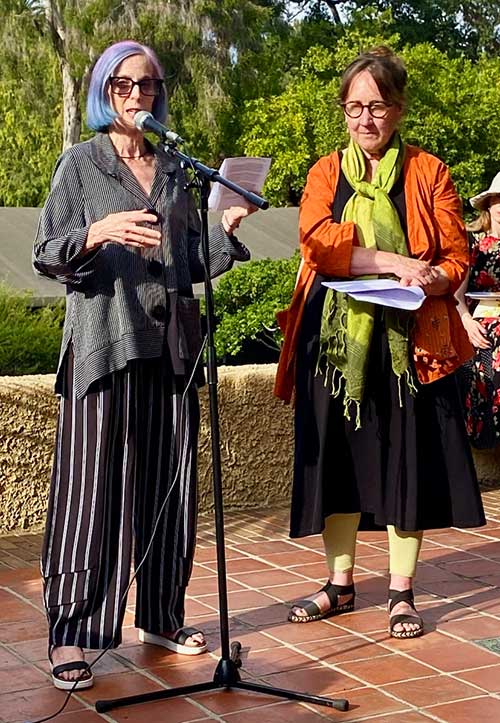
Lisa Mann and Karen Schwenkmeyer (Photo – Brian Biery)
Note: Quotes in this article were provided by Lisa Mann and Karen Schwenkmeyer, as well as the Gamble House and its archives.













Leave a Reply