




REWIND
“Fire at Sea,” a 2016 award-winning documentary by Gianfranco Rosi, is downloadable starting at $3,99.
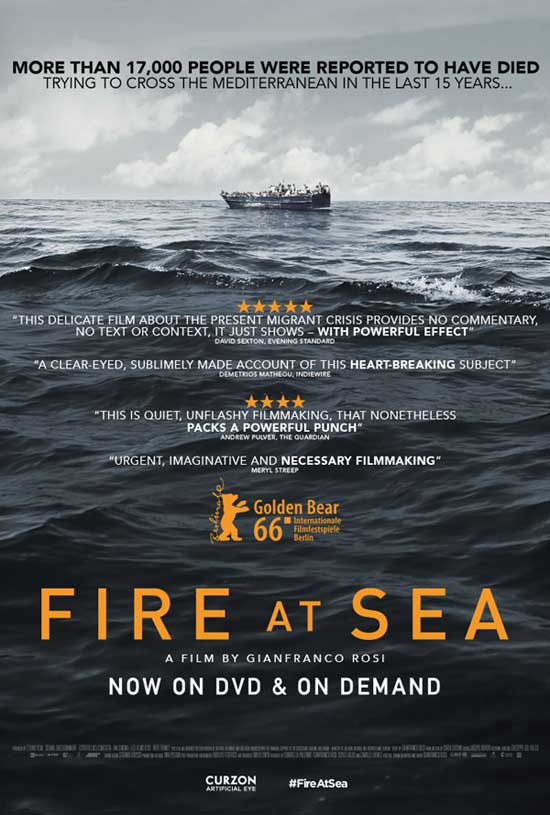
fire-Fire at Sea Poster (Photo – fireatsea.com).at-sea-poster
Almost two hours long, slow paced, meditative, the documentary Fire at Sea necessarily calls for a change of state, a switch in attention quality, a moment of suspension and rest. Dialogue is minimal, commentary inexistent. A few written data caption the beginning photograms, giving the viewers all the information they need.
By Toti O’Brien
Four hundred thousands migrants have arrived on the island of Lampedusa (hanging like a teardrop at the far-south of Sicily) in the last twenty years. They are mostly refugees from West African countries, persecuted and ejected throughout their northbound travel on land, lastly attempting to cross the Mediterranean towards Europe. Fifteen thousands were found dead at sea. This said, the director keeps quiet. He lets us enjoy the landscape, observe scenes simply shot with a fixed machine, listen to sounds of nature, music from the radio, sparse verbal interaction. Make our own reflections—for those plenty of room, plenty of time are left.
Lampedusa’s entire surface amounts to twenty square miles. Of course, the four hundred-minus-fifteen thousands who arrived wouldn’t fit. Not even a sample. The island is just a station—the extreme rung of a rope ladder hanging from above, grasped in despair while trying to climb off the abysm. After all even Columbus—when he imagined having reached Asia from the opposite side—alighted on a small island he took for a continent. Just a crumb, but it must have looked like a loaf to the delirious sailors of the Pinta, Nina, and Santa Maria, persuaded they’d never see shore again.
Talk about those caravels. Fragile vessels—wood, wax, fabric, tar—irresponsibly allowed to cross oceans. They were heavenly strong, if compared to the boats routinely falling apart in Lampedusa’s waters. No, they never make it. They come close. In the night, radio towers always get the same message: “Help! Please! Help! For god’s sake! We are sinking. There are women and children. Many children. Please, help us!”
The language is invariably English. How surreal are those English words, spat wearily in the very middle of nowhere—week after week, night on night off, under pitch-black skies, as if dawn had decided never to break again? Listen to these almost undecipherable phrases—are they real? The message from afar is fragmented, crushed, constantly breaking up, wailing, desperate—yet singing with accents unheard, mysteriously beautiful. The response is elementary, thick with Southern Italian slur, almost comical in its rhythmic staccato: “Stay calm. Please. Where are you? South/North? Yes! East/West? Repeat. East/West? How many? How? Many? Stay calm. We are arriving. Stay. Calm.”
Many children. Would you be surprised. There’s a doctor, only one—enough for a local crowd of six thousands. Early in the movie, we see him performing an ultrasound on a woman pregnant with twins. All is fine, though it is hard to determine the gender of the second baby. Limbs are intertwined. Maybe finding this out isn’t crucial. It certainly isn’t. Yet the doctor insists, starting over and over while he describes what he observes, reassuring the woman with a sort of lullaby. This scene fragment highlights the doctor’s main quality—patience—an almost superhuman capacity of endurance and bearing. He is the one constantly called to receive the migrants/refuges/castaways, one by one, responsible for triage, urgent as well as protracted care, emergency deliveries, and what he dreads the most—cadaver examination.

Director Gianfranco Rosi (Photo – Paul Katzenberger, commons.wikimedia).
The ultrasound scene also introduces an underlying theme of the movie—birth, as it mingles and coincides with death. Sea like primal waters, boats like matrixes, long perilous journeys like pregnancies bringing to deliverance, yet more often ‘miscarrying’ in a most literal sense. Many pregnant women need help on arrival. Alas, many are found dead. Dead babies are also found, or mothers and babies attached by the ombilical cord—passed during labor. Before handing these aborted beginnings to burial, local laws require a fragment of flesh—a finger, perhaps—to be cut and sent to the lab for epidemic screening. The physician resents this procedure—yet another offense to already butchered humanity.
Passengers on those wrecked vessels pay a thousand and five hundred euros for “first class” (the top part of the deck, where they stand for an average week—no room for sitting down). A thousand for the lowest part of the deck. Eight hundred and fifty for the cargo hold, where they are amassed without air, stifled by humidity and heat. The boat belly packs in most women and youth. There, most corpses are found. People die of hunger and dehydration—the paradox of their journey through water is their shrinking body, weathering because of fluids deprivation. They are horribly burned by fuel spilled from tanks, impregnating their clothes, mixing with salt water, corroding their flesh. They often die of those burns.
Of course when they embark, usually from the northern coast of Libya (when lucky enough to escape Libyan prisons) they don’t expect a cruise (though the ticket price would justify such illusion). They know traveling will imply risks. But, “it is risky not to take risks in life— says one of the happily arrived—because life itself is a risk”. He is not answering a journalist or talking to the camera. He is talking out loud to himself, chanting in a Nigerian language with interjections in English. Relating the adventure, celebrating survival, mourning the irreparable losses, summoning courage, making history.
“The sea is not a road,” he adds, glossing about the unnatural quality of the exodus forced upon his community. No, the sea is not a road, certainly not when crossed in inhumane conditions. Or it is a road leading to hell, only threaded when fleeing from another hell—despair driving to despair.
“My friends tell me”—the doctor whispers a quiet, subdued litany to himself—“I’m lucky. They tell me I have rescued the wounded, gathered corpses, autopsied cadavers so much, now I am used to it. They assume all of this no more affects me. They believe I’m anesthetized. But it is completely false. I will never get used. I can’t.”
Half a way through the documentary, a long shot lingers on a woman’s face. First two women. They wearily hug, comforting one another in silence. The camera then zooms-in on the younger woman—ageless would be a more appropriate description. She is mutely crying. We don’t know what happened. Is she hurt or sick? Did she lose someone? Did she witness the loss or just realized on arrival, when at last rescue operations were completed? Maybe all of the above happened at once. We aren’t told. We are left with her face, the look in her eyes, silent tears—spectators of what can only be defined as unbearable pain, allowing no commentary.
Underwater shots are interspersed through the movie—a lone diver surreptitiously explores the sea bottom. He is engaged in unclear activities—he salvages something, piles his findings in a cave. Maybe he is profiting from the human trafficking in some secondary manner, just as those who sell tickets for the crossing. It probably doesn’t matter. Yet those scenes make us think of what the Mediterranean has become in the last decades—an immense burial site for unknown travelers. Future archeologists will find uncounted human remains, of all size, bones leaning the bottom as a prayer carpet. Gravel for future humans to kneel upon, meditate, wonder.
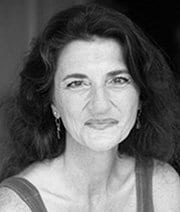
Toti O’Brien was born in Italy and lives in Pasadena. She’s a published poet and writer. She is also a folk musician and a coloratura soprano, singing opera and choral music, as well as a visual artist.













Leave a Reply