





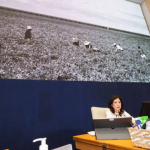


Opening panel at ArtCenter (Photo – Garrett Rowlan)
Science met art at the ArtCenter College of Design Saturday under the banner of “Free Radicals: On the Provocations of Awe.”
By Garrett Rowlan
The keynote address by Stephen Nowlin, director and curator of ArtCenter’s Williamson Gallery, addressed art and science not as opposites but as a fusion of disciplines on an “Alchemy we are going to explore this weekend.” (The symposium lasts through Saturday and Sunday.) An exploration, Nowlin added, rooted in awe, a “transcendent feeling of deep joy.”
He was followed by cosmologist Jenna Levin, a professor at Barnard and the author of Black Holes Blues (among other books), whose lecture on the “empty space” of black holes was mind expanding and ego shrinking, evoking vast cosmic spaces. Levin went on to recount the project that resulted in the recording of the collision of gravitational waves, a sound that had traveled some 13 billion light years to Earth. (Levin’s relating of this story was reminiscent of certain scenes in the movie Contact.) She also noted the “picture” of a black star—actually, a shadow backdropped by an explosion of cosmic light—that was viewed around the world earlier this year. “It’s like the image of a species,” she said.

Cosmologist Janna Levin addresses the crowd (Photo – Garrett Rowlan)
Next, artist IR Bach began by citing art and science as “black holes in reverse,” meaning that as art turns certainty into uncertainty, science turns uncertainty into certainty. His lecture revolved around his viewing of “unexplained lights” in Mexico which he didn’t call UFO’s or any buzzwords that cast doubt on his sanity, but instead used his exploration of this mystery as a way of exploring the unknown. No doubt, Bach brought a sense of wonder—different from Levin’s, but equally compelling—into the lecture hall.
Jana Winderen, next on the bill, is a sound artist who explores sub-frequency sounds from nature. The audience heard crickets, underwater beetles, bats, and fish sounds played to the audience, who eavesdropped on a world below the sonic capabilities of humans.
Kyle McDonald, the last artist on the program before a panel discussion, creates visual sculptures using 3D scanner technology. He showed pictures made using computer programs, ingenuity, and fifty disco balls (the kind that hang from ceilings), to create a luminous atmosphere beyond anything nature could ever create.
All in all, an exhausting compendium of art and science that seemed to say we are living in the best and the worst times of human history.











Leave a Reply