





Jacqueline “Jackie” Amézquita, a Latin American artist, and a student at the ArtCenter in Pasadena, embarked on an eight day performance art walk from the border of Tijuana, Mexico to a gallery in Chinatown, DTLA. The walk kicked off April 5th and is part of Decentralized, a group show of 16 artists focused on the theme of displacement.
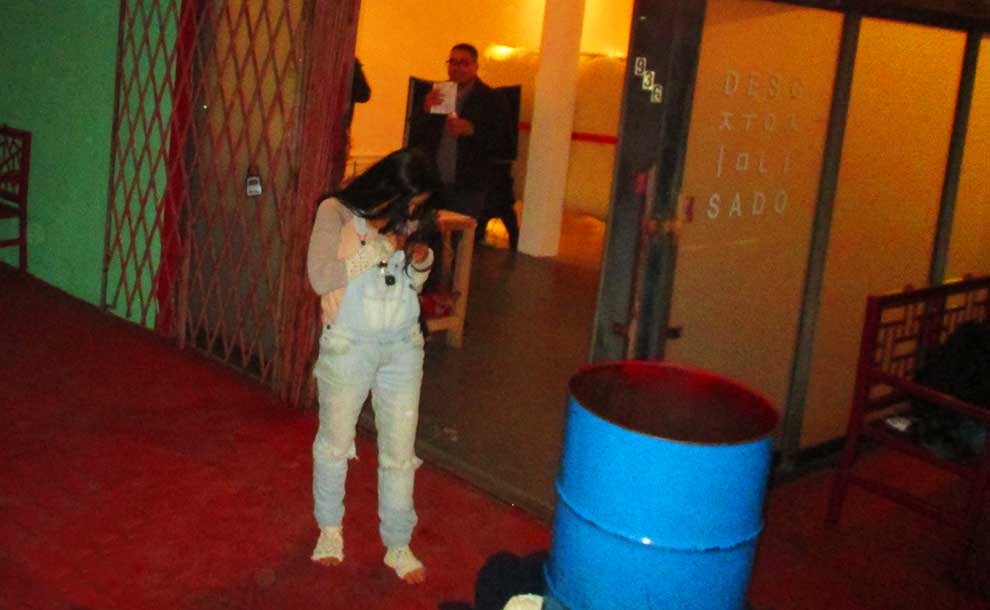
Artist Jackie Amézquita as she arrived to Chinatown (Photo – Garrett Rowlan).
As day turned to night and as the time for the arrival of ArtCenter student Jackie Amézquita at the Decentralized Gallery, or Space, in Chinatown drew near, a crowd of 70 or so people gathered in a semi-circle around a water-filled barrel. Lit from above and wearing, at its bottom, a gasket of discarded clothes—to symbolize discarded lives, memories, mores?—the barrel would serve as the spot where Jackie would immerse herself after walking from the US-Mexico border.
By Garrett Rowlan
Amézquita’s trek of eight days, a journey historical awareness, cultural engagement, and perhaps a nod to a previous ancestral hegira (Ms. Amézquita was born and raised in Guatemala before coming to the United States) was the conclusion of a project called Huellas que Germinan (germinating footprints), part of ArtCenter’s Socially Engaged Art class sponsored by the Mary Pickford Foundation in conjunction with Designmatters.
As Jackie’s ETA missed the original 7 PM mark, missed 7:30, and missed 8 PM, and as the cold night wind blew, the scene in front of the Space took on the aspect of a stage production of Waiting for Godot. The crowd waited, the barrel of water waited, and some in the crowd wished they had dressed more warmly.
At 8:10, attendants carried the realia of Jackie’s journey—backpack with water bottle, shoes, and hat. They were laid on a chair, like the chrysalis a of a discarded life.
Soon thereafter, in a crocheted, angelic-white body suit, Jackie rounded the corner and approached the applauding crowd. Her name was shouted. Flashcubes bursts as if illuminating the 99 names of God.
However, as she approached the water-filled barrel, the crowd grew hushed, as if they had been transferred from bleachers to pews, and Jackie, after a partial disrobing, climbed atop the barrel, hovering momentarily as if about to ride a wobbly unicycle, and descended.
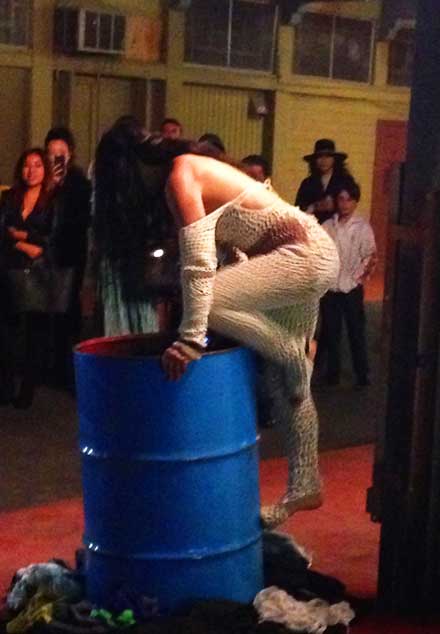
Performance artist Jackie Amézquita (Photo – Joan Morris).
As Jackie deep-sixed to the point where only her black hair bobbed on the water’s surface, the baptismal ceremony entered the realm of art. “Performance” became contemplation. Were we witnessing a symbolic drowning, cleansing, or a distilled recreation of waters crossed (or not, tragically) to reach the United States? Or was Jackie’s willingness to discomfort herself by immersing into cold water on a chilly, windy night, after trekking for days from the border, a metaphor, a dunking that called to mind the debasement of those who have come to the United States, seeking a better life, only to find themselves forever at the bottom of the barrel?
Questions that flashed by in the few seconds—it seemed longer—that Jackie stayed underwater.
Finally, she emerged. People applauded. She thanked the crowd and swaddled in a blanket, retreated to the inside of the space.
The performance had ended, but her other work, and those of her fellow student-artists*, can be seen until April 15 at 936 Mei Ling Way in Chinatown.
Garrett Rowlan’s first novel, “To Die, To Sleep” is newly published and available on Amazon.










Leave a Reply