




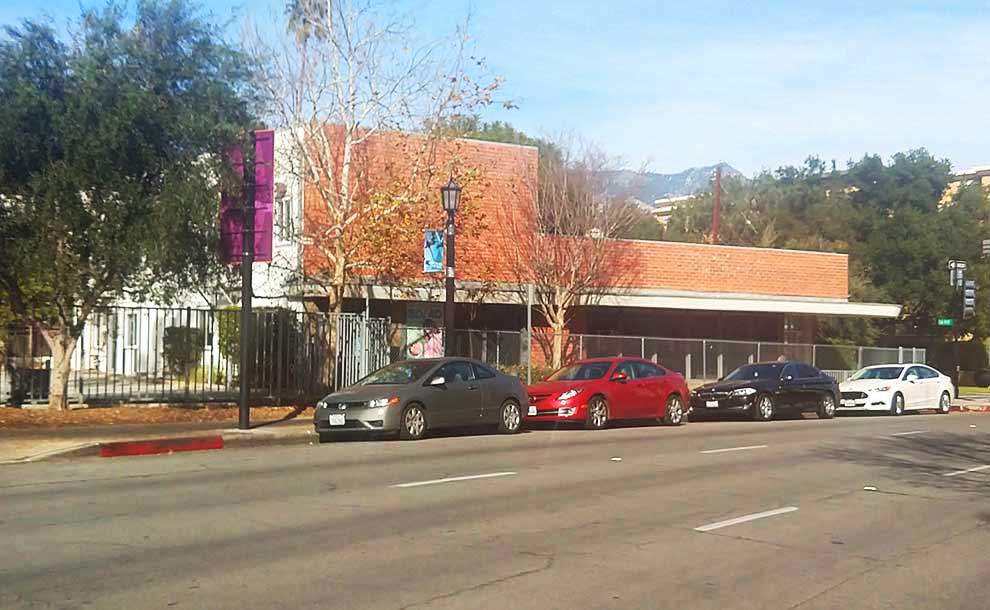
Former site of Banner Bank at 721 Union St. in Pasadena (Photo – ColoradoBlvd.net)
At its regular monthly meeting on Tuesday, February 4, 2020, the Pasadena Recreation and Parks Commission voted unanimously to recommend that City Council approve and fund the creation of a public park to serve the residents of Pasadena’s downtown and Playhouse District.
By News Desk
The vote was hailed by park advocates as a milestone in what has been a decades-long effort to establish Pasadena’s first urban neighborhood park.
In 1993, local residents and business interests began searching for land and funding for a public park to serve what has become the most densely populated area of Pasadena.
Noting a critical lack of open space in the area, in 2017 the City Council directed city staff to identify a location for a park. Residential density has increased dramatically in the area during the past decade.
Developers of multi-family housing in the Playhouse District have paid millions of dollars in “residential impact fees” to the City; state law requires that the fees be used to provide parks, open space and recreational facilities for residents. Despite increased density from new residential construction in the Playhouse District, much of that money has paid for parks and recreational programs in other areas of the City.
Residents, local business interests, homeowner groups and the Downtown Pasadena Neighborhood Association sent representatives to the Commission meeting to hear Public Works staff present its proposed design concept for the new park. The design reflected input from a City-designated Stakeholder Committee, as well as public comments received at multiple well-attended community meetings in 2019.
Playhouse District Association executive director Brian Wallace reminded the Commission that businesses and residents first began advocating for a park in 1993.
Resident, Stakeholder Committee member, and vice chair of the city’s Environmental Advisory Commission, Deborah Dentler described life on her block, where her 53-unit building houses about 20 children under age 12 and at least that many dogs:
We are surrounded by multi-family buildings, none of which have any place for kids to play safely, so parents and grandparents spend countless hours and lots of dollars at nearby Target and Vroman’s, where kids run up and down the aisles that serve as our neighborhood’s recreation facilities.
In 2019, Dentler organized a group of local homeowner associations from the condo complexes adjacent to the Banner bank site, and she runs PlayhouseParkPeople, a Facebook site for park advocates.
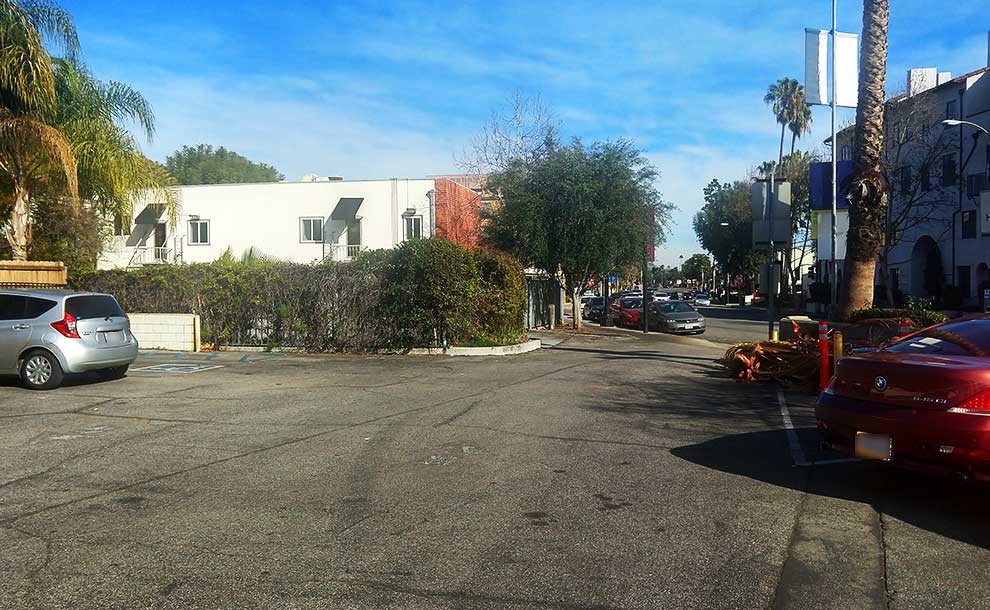
Future site of Playhouse Park (Photo – ColoradoBlvd.net)
The proposed plan, which calls for permeable-paved parking area that also will be utilized for events such as a farmer’s market, elicited some pointed questions from some commissioners. Commissioner John Furhman asked, “what’s the logic for retaining 48 car parking spaces?”
Commissioner Mastromatteo urged the City to plant mature trees, not baby trees, so park users will be able to enjoy shade sooner rather than later.
Commission chair Aaron Milam cautioned that the inclusion of a public restroom in the plan may raise eyebrows with some, and said he hoped staff would carefully consider the need for lighting and security measures.
Commissioner Tim Martinez lauded the “diversity of uses” depicted in the design plans, and said he especially liked the proposed permeable “flex” parking area that can be used for events.
Commissioner Sheppard–who abstained from the final vote because she rents an apartment near the proposed park–liked the way the event spaces planned for the park will “connect well” with surrounding theaters.
The Commission called the design “beautiful” and commended staff for listening to residents and coming up with a design that is responsive to a multiplicity of competing views.
The Commission’s recommendation now proceeds to the City Council for action in March 2020, on a date not yet announced. In addition to approval of the design concept, the City Council will decide on awarding a contract for the demolition of the former Banner Bank building at the corner of Union Avenue and Oak Knoll. Public Works engineer Kris Markarian told the Commission that in March 2020 the City Council will consider appropriation of the funding needed to create the park by allocation of funds in the City’s 2021 Community Improvement (CIP) budget.








Leave a Reply