








Arev Markarian, center, and four of the Trout Scouts of the Arroyo Seco Foundation, during their field research in the upper Arroyo Seco recently (Photo – ArroyoSecoFoundation)
There’s a small population of native Rainbow Trout in the waters of Pasadena, and a local nonprofit organization has released comprehensive data about those trout and their habitat.
By Arroyo Seco Foundation
The Rainbow Trout live in the waters of the Arroyo Seco, and have been the subject of a years-long study by the Arroyo Seco Foundation, which is a local Pasadena-based nonprofit organization.
Their survey details the size and health of the trout population, the quality of their habitat, and data about the waters in which the trout live. The information is the result of more than four years of research by the Arroyo Seco Foundation, and can be found on a public dashboard on their website, ArroyoSecoFoundation.org.
The data collection is ongoing and is conducted by groups of researchers and citizen scientists, who the Arroyo Seco Foundation refers to as their Trout Scouts, because they hike the Arroyo Seco and search, or scout, for the trout.
The scouts do their field work two or three times each month, usually on Saturday or Sunday mornings. They sometimes enter the waters of the Arroyo Seco with snorkeling gear, to help them locate the trout. When they observe trout, the scouts often document their findings with a submersible camera.
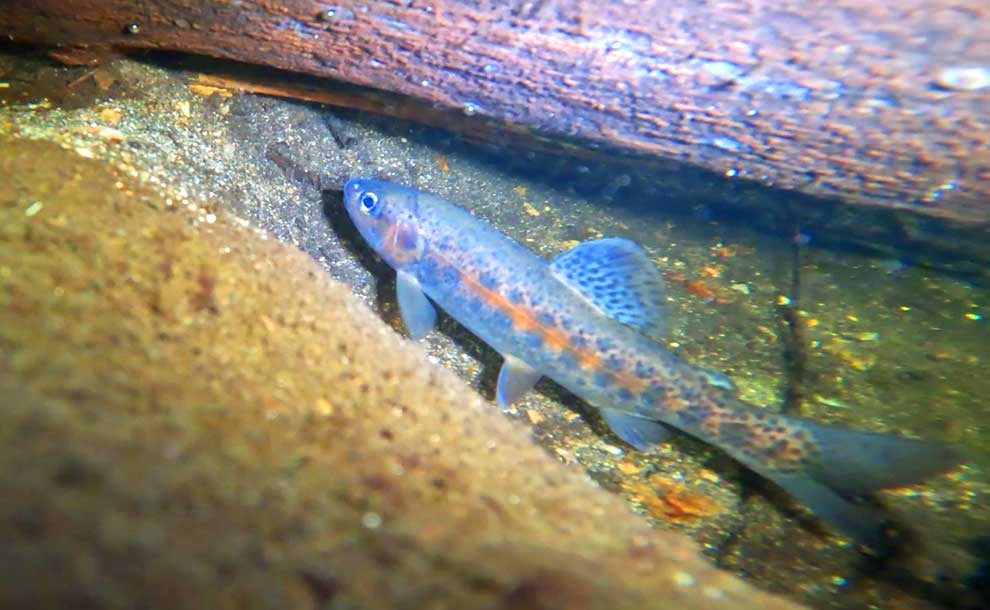
A Rainbow Trout observed in the waters of the upper Arroyo Seco this past summer (Photo – Arev Markarian)
Arev Markarian, a research scientist for the Arroyo Seco Foundation, has been leading the scouts, and she developed the dashboard of information that is on the organization’s website. The dashboard features maps that show locations where trout have been observed, and provides information about the water quality, with a Geographic Information System. The dashboard is a dynamic feature of the website; it is regularly updated with new data.
“The trout are an important indicator of the health of the Arroyo,” said Markarian. “We are able to track the conditions of the water, including whether it is free flowing or not, by studying the trout population,” she said. Obstructions to streamflow, from obstacles such as dams, logs, or diversions, can negatively impact the trout population by preventing their migration to and from the ocean.
Foundation President Robert Kurkjian explained the importance of the organization’s research “The fish are trapped due to barriers and water flow,” he said. “We are working to improve the conditions for the trout, and the overall stream ecology.”
The Trout Scouts measure water quality data such as dissolved oxygen, temperatures, turbidity, and pH levels—all of which can impact the ability of Rainbow Trout to survive.
The organization’s study is part of a project known as the Streamflow Enhancement Program, and it is funded by grants from the California Wildlife Conservation Board, the Rose Foundation, and Accelerate Resilience LA. The program has the objective of enhancing stream flow and protecting fish and wildlife.













Leave a Reply