






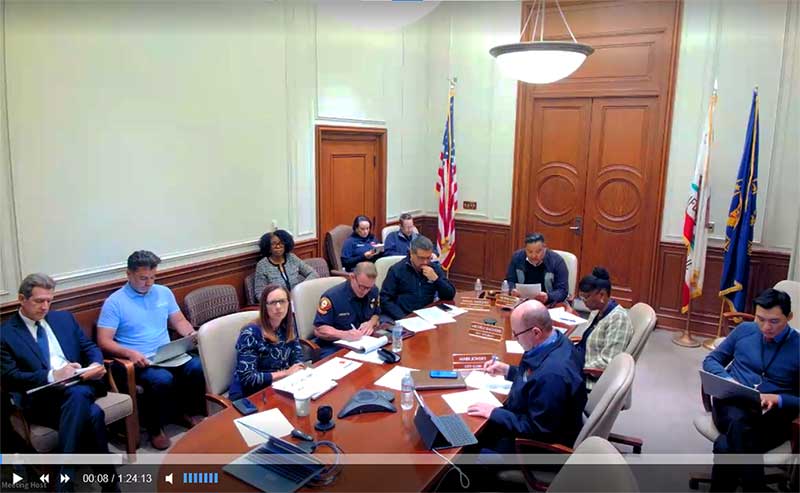
Pasadena City Council Emergency Meeting, Jan. 15, 2025 (Photo – Screengrab)
A recap of a Special Pasadena City Council on January 13 and an Emergency meeting on January 15, 2025.
By Nicolas Perez
Jan. 13 Council Meeting
At the January 13th Pasadena City Council meeting, officials provided updates on city conditions following a state of emergency declared due to severe windstorms and fires. To ensure the health and safety of attendees, the meeting was held remotely. Items 4 through 6b on the consent calendar were approved without discussion. The agreements related to Fuller Theological Seminary, along with general plan and land use zoning amendments, were canceled.
The mayor, fire chief, and police chief reported Pasadena’s preparedness for the emergency. Fire Chief Chad Augustin emphasized the importance of staying on high alert as red flag conditions persisted. Emergency operations were activated early, including mutual aid deployment to assist with the Palisades Fire. This was described as a one-in-20-year event, and resources were stretched due to the Palisades Fire, with hurricane-force winds preventing aerial fire suppression, while embers blew up to two miles downwind.
The fire began at 6:15 pm, growing rapidly to 10 acres within 14 minutes, expanding to 200 acres within an hour, and reaching 400 acres by 8:14 pm. Evacuation orders were issued at 7:12 pm on January 7. By 8:00 pm, a command post was established at the convention center and an incident command post at the Rose Bowl. Trees fell, blocking access to neighborhoods. Police Chief Eugene Harris described the law enforcement response, noting officers were on call for the wind event and were surprised by the fire’s rapid spread. Initial evacuation efforts covered 32,800 residents and 12,453 structures, later expanding to warnings for 42,000 people and 11,000 more structures.
Due to shifting wind conditions, the Eaton Fire moved in multiple directions simultaneously before winds pushed it westward, leading to the evacuation of all areas north of the 210 freeway. The fire has burned 14,117 acres as of January 15th and is 45% contained, according to fire.ca.gov. Approximately 3,400 personnel, 275 engines, 50 hand crews, 29 bulldozers, 90 water tenders, and 16 helicopters have been deployed in ongoing firefighting efforts, with urban search and rescue teams working with the city and Cal Fire to assess damaged buildings.
Evacuation shelters were established by Pasadena and the Red Cross, with medical support from Kaiser and AltaMed. LA County also provided the Family Assistance Center, and a disaster recovery center has been set up by FEMA, state, and local resources at Pasadena City College, operating from 9:00 am to 8:00 pm seven days a week for the next 30 days. Sixty-one city employees have lost their homes, with 357 still under evacuation orders, representing 16% of the active city workforce.
The Water and Power General Manager advised residents in the northern portion of the city not to drink tap water due to compromised reservoir integrity. Further updates on the water situation will follow as conditions improve.
Jan. 15 Emergency Council Meeting
On January 15th, Pasadena’s Emergency City Council met to discuss whether the city should participate in FEMA’s disaster mitigation program following recent property damage and destruction. The program aims to cover costs for affected properties.
The program’s first phase is federally managed, while the second phase details remain undetermined. Homeowners would not incur direct costs, as FEMA coordinates with insurance companies and covers remaining expenses after insurance payouts.
Councilmember Jess Rivas noted debris removal had not yet begun, as some sites remain hazardous. Councilmember Gene Masuda confirmed that FEMA covers 100% of eligible costs within the first 180 days.
Keith McGowan from the Los Angeles County Office of Emergency Management outlined FEMA’s reimbursement categories (A-G). Category A addresses hazardous debris removal, while Category B involves protective measures. Categories C through G cover infrastructure, including roads, public utilities, and public facilities.
After the initial 180-day period, FEMA reassesses coverage caps. Continued full coverage would require presidential and congressional approval. If coverage decreases to 90%, the federal government would still cover the remaining 10%. Under the Stafford Act, FEMA could lower coverage to 75%, with state and local governments sharing the remainder—18.25% and 6.75% respectively—for cleared properties only.
The citizens of Pasadena and affected areas have shown remarkable resilience in the face of devastating fires that have threatened their homes, communities, and natural landscapes. They will rebuild and remain united in the aftermath of destruction, not only fighting the fires themselves but also supporting each other in the recovery process. This unwavering determination and solidarity showcases the strength and endurance of the people, demonstrating their commitment to protecting what matters most, even in these challenging times.













Leave a Reply