






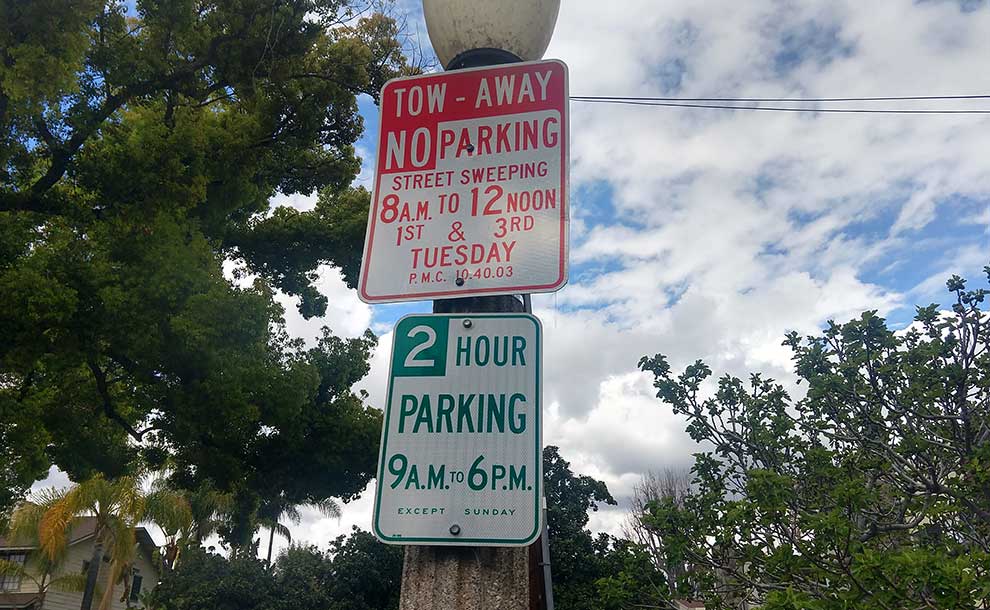
Pasadena parking signs (Photo – ColoradoBlvd.net)
On January 23, 2025, Pasadena’s City Council convened for a special meeting to address the aftermath of the Eaton fire and windstorm, which caused significant damage across the city.
By Nicolas Perez
Parking
A resolution was passed to suspend parking fees for guest passes, overnight permits, and city garage facilities for vehicles registered to fire-damaged properties to assist residents. The Department of Transportation also temporarily halted parking enforcement, prioritizing emergency response, traffic control, and staffing shelters.
Fire Update
Fire Chief Chad Augustin provided an update, reporting that the fire had scorched 14,021 acres and was 95% contained. While power had been fully restored, repairs to water infrastructure were ongoing, with a “do not drink” advisory affecting only 4% of the service area. Preparations for potential mudslides were underway, as rain was forecast for the weekend.
Councilmember Justin Jones raised concerns about possible evacuations and debris on streets. Chief Augustin estimated that cleanup would take at least three more weeks. Stacie Takeguchi of Pasadena Water and Power assured the council that the risk of a hillside collapse was minimal but warned of potential sloping mudslides due to the fire damage.
Air Quality
Public health measures were also discussed. FEMA tasked the U.S. Army Corps of Engineers (USACOE) with removing topsoil from damaged properties. The South Coast Air Quality Management District confirmed that pre-disaster air quality monitoring would continue but declined to expand testing efforts due to the variabilities in measuring, such as environmental factors and cleanup activities, which could affect the accuracy of readings. For residents, real-time air quality data is available via the PurpleAir network. Residents with homes undamaged by the fires were cautioned to avoid disturbing soot and advised to wear PPE during cleanup. Misting the area with water while cleaning soot or dust will help keep contaminants surface-bound and prevent them from becoming airborne before cleanup.
Air Quality Sensors
Environmental scientist Paul Wennberg recommended that the city consider installing low-cost air quality sensors in schools via the South Coast AQMD. He noted that residents could handle minor dust issues independently but advised professional assistance for homes heavily affected by the fires.
Road to recovery
Despite the challenges posed by the Eaton fire, Pasadena’s residents have demonstrated remarkable resilience. The city’s swift response, combined with the strength and unity of its community, reflects a shared determination to rebuild. Though the road to recovery will take time, Pasadena’s history of perseverance assures us that its residents will overcome this adversity and emerge stronger and more connected than ever.












Leave a Reply