




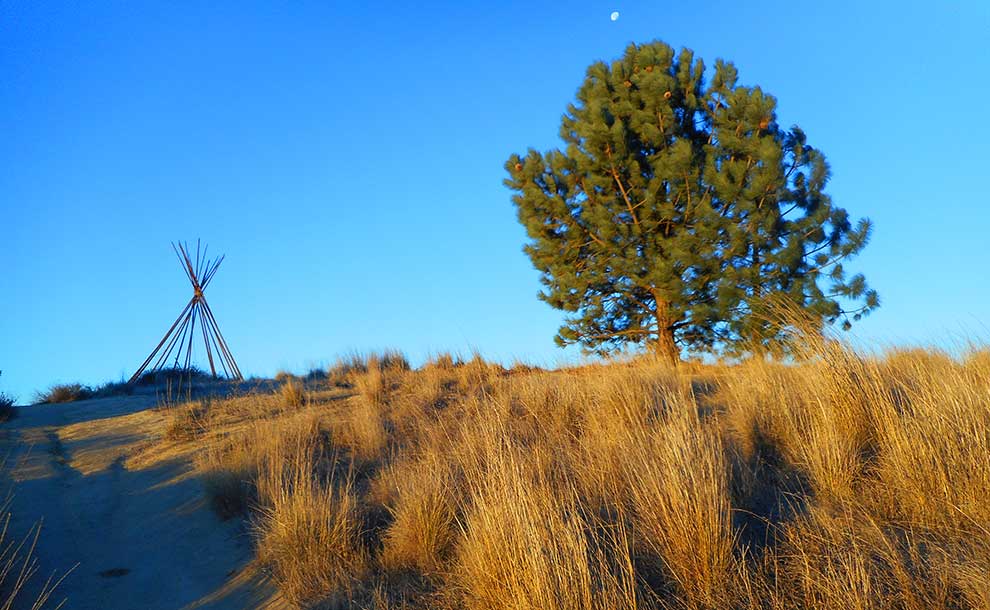
The framework of the much-loved tepee, just off the Mt. Lukens fire road, overlooks the entire Los Angeles basin (Photo – Reg Green).
Did you know that our very own San Gabriel mountains, are as rugged a terrain as any in America? Or that they have had some of the most concentrated rainfall in the history of the US? I didn’t, until a friend lent me John McPhee’s book, “The Control of Nature.”
By Reg Green
I knew they were rugged, of course, and that at times the rainfall is breathtakingly heavy. Who, going into them almost every day, as I do, could think otherwise? But the superlatives take them to a new level. It is this element of melodrama that attracts me so much. And, though humans are sparse on the trails – Robinson Crusoe’s island was a social whirl by comparison – when they do appear they are a welcome sight.
My most frequent companions are what I called the Four Cyclists of the Apocalypse, now down generally to three – Famine dropped out, not wanting to face the climb on an empty stomach. I see them twice a week – or perhaps I should say hear them – as their voices ascend from below. Somehow they lack the menace of the traditional Four Horsemen as they gradually approach, never ceasing in conversation. “I did this….” pant, pant. “Yes, the same thing happened to me….” puff, puff. And that continues after they pass and the voices, instead of rising from hell, descend from heaven.
On the way down, however, all this decorum is thrown to the winds. Did you ever see the Disney cartoon, “Motor Mania” in which Mr. Walker becomes Mr. Wheeler? It’s about a kindly, neighborly man, so gentle that he won’t step on an ant, but once in his car turns into a monster, cutting off other drivers, yelling at pedestrians. There is a similar transformation in cyclists on mountain roads – all cyclists not just these – as they hurtle down, brakes screeching, cutting corners, years younger than when they went up. Instead of the slow, stately approach of fate, as they seemed then, they now represent the maniacal uncertainty of life.
Then, a few weeks ago at around 8 o’clock on a Sunday morning, some other humans appeared in my solitary world. I had walked up to the tepee that is built, astonishingly, two or three miles up the Mt. Lukens fire road from Angeles Crest Highway at a spot with an incomparable view but in the middle of nowhere. Only the framework was there – the owners being meticulous about taking the covering down with the advance of colder weather — but next to it were a backpack, two shot glasses and a bottle of bourbon.
While I was contemplating what to do about this gift from the gods, two guys appeared and invited me to join the 21st birthday party they were celebrating. They even produced a third glass. Evidently the generous-hearted pair were well prepared to succor any of the world’s thirsty they came across. The bourbon itself was not quite of this world either. It was a brand that, its whimsical distillers explain, had been put into barrels when young and carried round the globe on a ship, touching four continents, rocking and rolling incessantly, to produce a briny taste and a drink ‘beyond its years.’ I supped gratefully and, yes, I thought I did detect in the satisfying mix a strain of the Gulf of Mexico.
I’m tempted to say, ‘Only in America’ but standing there under the warm morning sun, next to that wholly improbable tepee with, faraway to the right the Sespe wilderness, which is home to a condor sanctuary, to the left the Mt. Wilson telescope, which at one time could peer deeper into space than any other, far to the left the huge mountains above Palm Springs, in front the Hollywood hills and Catalina Island, below NASA’s Jet Propulsion Lab, now bringing outer space into every room with a television set, and, behind, mile after mile of terrain as-rough-as-any-in-America, it seems more accurate to say, ‘Only in the San Gabriels.’
Reg Green is a journalist who lives in La Cañada. His seven-year old son, Nicholas, was shot in an attempted carjacking in Italy in 1994 and his organs donated to seven Italians. Since then he has run a charity, The Nicholas Green Foundation, whose purpose is to increase organ donation worldwide. This article is from his latest book, “90 And Not Dead Yet.”








Leave a Reply