



Editor’s Note: In honor of National POW/MIA Recognition Day, the Prisoner of War (POW)/Missing in Action (MIA) flag will be flown at full-staff at all LA County facilities on Friday, September 19, 2025.
GUEST OPINION
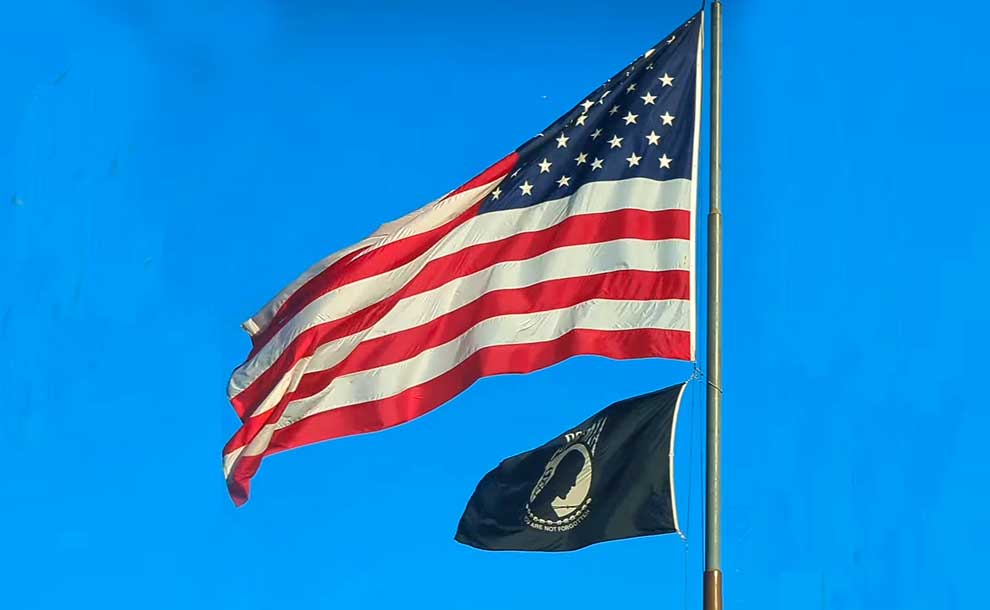
The POW/MIA flag raised at a Post Office location in Pasadena (Photo – Staff)
Whether their service took them to the jungles of Vietnam, the deserts of Iraq, or countless other battlegrounds, America’s missing in action are owed an immeasurable debt of gratitude. Their sacrifice is not simply history, it is a living legacy that must be remembered by the nation.
By William Paparian
The nation owes a continuing debt to those missing in action, one that words alone cannot repay. As the years go by and memories fade for many, the reality of loss remains vivid for the families still awaiting answers. They hold on to hope and honor the legacies of their loved ones, whose stories are preserved in memorials and cherished in the hearts of those who remember. These missing service members are a solemn reminder of the price paid for freedom and duty. It is the nation’s responsibility to keep faith with our POWs and missing in action, ensuring their courage is never forgotten.
No other country demonstrates the same steadfast commitment to bringing home its war dead as the United States. Each year, the Defense POW/MIA Accounting Agency—a dedicated branch of the Pentagon—sends teams to former battlefields around the world. Their mission is to account for every missing American, providing answers to families and honoring the fallen. This ongoing effort is a testament to the nation’s promise to its service members and their families.
More than 81,000 Americans remain unaccounted for from World War II, the Korean War, the Vietnam War, the Cold War, and the Gulf Wars. Each number represents not just a statistic, but a person with a unique story and a family who has never stopped hoping. Behind every figure are lives interrupted and loved ones left waiting, reminders of sacrifice that numbers alone cannot convey.
The story of America’s missing service members is deeply human. They are not just names or numbers, but individuals, soldiers, sailors, airmen, Marines, and Coast Guardsmen, whose lives and sacrifices have lasting impact. The families who wait and hope are bound by connections of duty, love, and remembrance. Each missing person leaves a legacy, a story paused, not ended, that inspires the ongoing responsibility to honor and remember them.
For many families, the wait continues. Their loved ones are still missing, their stories unresolved. The nation’s duty is not only to remember, but to work tirelessly for the return of those still missing, even if it takes decades. Providing support and care to these families and survivors is an ongoing obligation. This unwavering commitment shows that the sacrifices of the missing will not be forgotten and that families seeking closure will always find support.
The absence of missing loved ones is a daily reality for their families, felt in both ordinary moments and important milestones. An empty chair at a gathering symbolizes a profound loss. Parents are deprived of seeing their children grow, and children are left with unanswered questions about the family members they never knew. This enduring absence shapes family histories and memories, marking generations with longing and hope for resolution.
Many missing service members remain unrecovered, their stories suspended in time. The fields, jungles, and beaches where they fell still hold their memory, offering the promise that they may one day be found and returned home. These resting places are reminders of sacrifice, and of the nation’s ongoing mission to bring every service member home.
One of Pasadena’s notable missing in action was Colonel James Louis Carter, U.S. Air Force, who served as an aircraft commander on a mission along the Laos–South Vietnam border on February 3, 1966. After his plane disappeared over Quang Tri Province, neither the crash site nor Carter’s remains were found. His story became widely known through POW/MIA bracelets and the efforts of a supportive nation.
Carter is honored on Pasadena’s Vietnam Veterans Memorial, where the POW/MIA flag flies to recognize his status as the city’s only MIA among 31 fallen service members. The memorial, a triangular granite and bronze monument, commemorates both those killed and those missing, with Carter’s story serving as a reminder of the continuing need for accountability.
In 2004, after a joint U.S.–Vietnamese investigation, Carter’s remains were identified through forensic analysis, and he was laid to rest with full military honors at Arlington National Cemetery. His name also appears on the Vietnam Veterans Memorial Wall in Washington, D.C.
In 2019, the Defense POW/MIA Accounting Agency announced that Marine Corps Staff Sgt. Wesley L. Kroenung, Jr., of South Pasadena, who was killed in World War II, had been accounted for at last. Kroenung died on November 20, 1943, during the Battle of Tarawa. Although his remains were not identified at the time, advanced scientific analysis led to their return to his family. He was buried with full military honors at Miramar National Cemetery on August 14, 2019.
As time passes and the memories of war grow distant for many, the reality of loss remains for the families whose loved ones are still missing. The nation must always remember its POWs and missing in action—honoring their service and sacrifice for generations to come.












Leave a Reply