






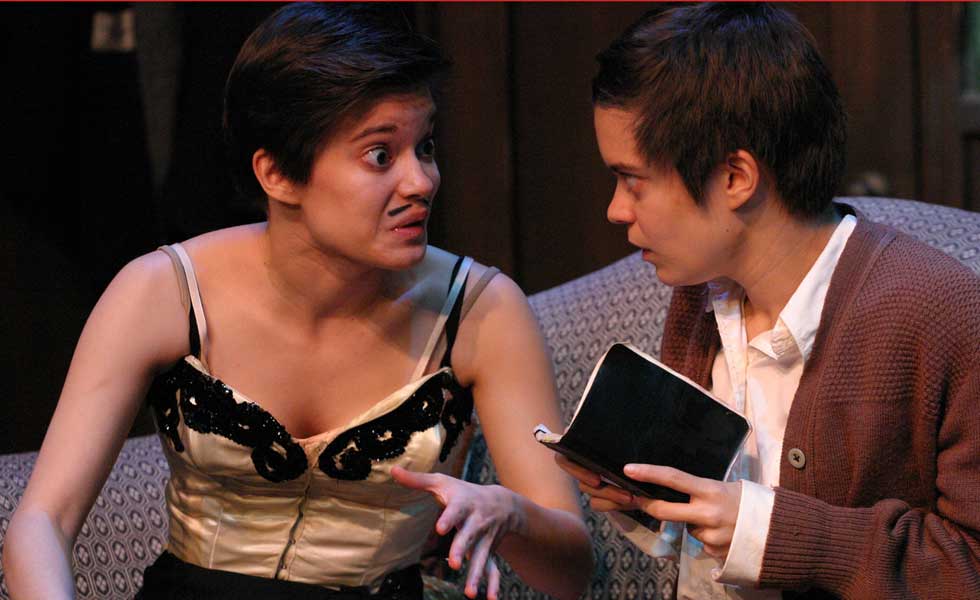
My Sister at the Odyssey Theater (Photo – Enci Box).
Emily Hinkler and Elizabeth Hinkler, young and talented twins, portray twin sisters Magda and Matilde, respectively, in Germany in the 1930’s in a play specifically written for them by playwright and professor, Janet Schlapkohl.
By Carol Edger Germain
They share a rather dismal flat but their creativity, youthful hope, and dedication to each other brighten their small piece of the world as they each strive to make a mark in the arts, Magda as a cabaret singer, and Matilde as a writer. Meanwhile, Magda supports them both by working in a hospital and Matilde remains at home writing and following the world on her short wave radio because she has severely crippling cerebral palsy and can barely walk. Her mind, however, is not affected, and it races with intelligence, creativity, and playfulness as she writes sketches for her sister to perform on the cabaret stage. They both work hard to reach their dreams and are buoyed by the belief that anything is possible.
Meanwhile, Hitler and the Nazis are beginning their march (those terms are never used in the play, there are just references to the National Socialist political movement, a wise decision, as it allows the audience to get into the exact time period, i.e., before Hitler was in full power). Although we already know what was going on in Germany when Hitler ruled and can surmise where the play is going, the action takes place specifically during the initial phase of the Nazi rise to power, when they began rounding up the disabled, ostensibly for “advanced treatment,” before the next phase corraled and exterminated gypsies, and finally Jews. It’s a powerful insight into the stealthy way they crept into various aspects of society and how society could let it happen. Watching the play, and already “getting it” because it’s history, was intense. I found myself holding my breath more than once, and the theater was dead silent, no squirming, no talking, I’m certain others were as engrossed and emotionally stirred as I was.
Matilde is the more intelligent and clever of the two, and when explaining her sketches or other information to Magda repeatedly tells her, “Pay attention!” That admonishment gave me chills near the end, because as we know, the masses did not pay attention, did not stop the Nazis, and the entire world is still paying dearly for it.
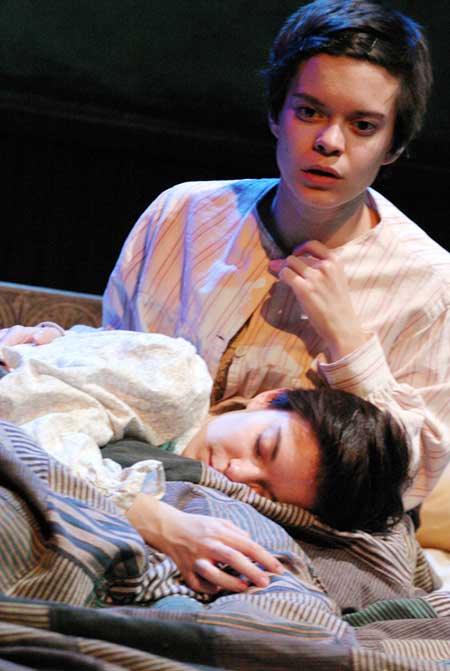
My Sister (Photo – Enci Box).
The staging (the cabaret stage on the left, with Barbara Rottman accompanying Magda as she performs her comedy sketches and sings original songs by Christopher Gene Okiishi, and the girls’ apartment on the right) serves to emphasize how life was going on as usual, with only a few “paying attention.” Even as the movement begins to connect everyday life with the horror about to happen, German citizens dismissed the military encroachment, thinking it would go away, or things would settle down, or it wouldn’t go any further, or even believing the government had their best German interests at heart. In the play, new rules for performances gradually crept in. First “lesbian night” at the cabaret was toned down, Magda’s semi-political and out-of-the-mainstream sketches and jokes were sanitized a bit, and you see the struggle between the sisters as Magda goes along with it to achieve her goals, not really understanding the change or perceiving how far it would go, and Matilde becomes alarmed as she listens to the BBC on her short wave radio (until the government decides to replace everyone’s radio with a government-issued, station-controlled “free” radio – an option at first, then mandatory). One of the most powerful scenes is when Magda insists that Matilde must give up her radio, especially since their neighbor down the hall is always in their business as he works toward his personal goal of being a block leader for the government, and she fears they will be reported.
There are several profound moments, where I clenched my teeth and absorbed the impact of the next step, then the next step, but I don’t want to mention any spoilers, as I hope you will see the play and experience the emotions for yourself. They are not happy emotions (although there is much humor and levity in the first half of the play, making it all the more human and “normal”), but they are important emotions, and if you don’t feel them, beware.
This is an unstable and gut-wrenching time in American history, when the thought of the country being led by any of the leading contenders for president is as frightening as the danger of anti-Americans, foreign and domestic, hell bent on destroying our country, our culture, our infrastructure and our people. I just hope our guts wrench enough that the citizens of this country wake up, “pay attention” and proudly steer the country back to its founding goals and do what is necessary to secure our freedom and safety, as we are ripe for the picking by the violent forces seeking to undermine us. Ironically, it is my belief that there is a takeaway for the right, the left, and the middle, and will all get some warnings from rethinking the situation in Nazi Germany for different reasons, I just hope we all heed the warnings, unite, and bring the country together again.

My Sister play (Photo – Enci Box).














Leave a Reply