







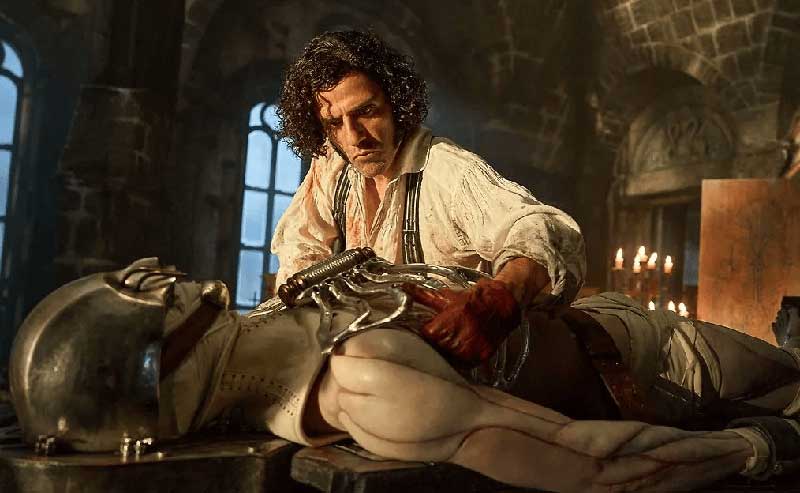
Frankenstein (Photo – Netflix)
“You are the monster,” Victor Frankenstein, played by Oscar Isaac, is told by a hulking Jacob Elordi as the creature at the end of Frankenstein, the new movie by Guillermo Del Toro.
Frankenstein
Directed by Guillermo Del Toro – 2025
Reviewed by Garrett Rowlan
There have been many Frankensteins since Boris Karloff donned the bolts and boots back in 1931; this is one of the more retrograde versions in the sense that it stays close to the spirit of Mary Shelley’s 1818 novel.
Beginning where her novel ends, we see an ice-bound boat in the “Farthermost North” and the subsequent rescue of the stranded Victor Frankenstein. No sooner is he hauled half-dead onto the vessel than an unkillable mass of rage in rags attacks the boat, only to be repelled long enough for Frankenstein to tell his story. It’s one of those movies within a movie.
Browbeaten by a martinet father (Charles Dance) and bereft in the wake of his mother’s death, Victor Frankenstein becomes obsessed with disproving his father’s dictum that “No one can conquer death.” To do so, he rummages through gallows and war trenches for suitable body parts to mix and match. At last, he’s offered a workspace by Harlan Hollander (Christoph Waltz), whose laboratory is topped by a spire that suggests the Tower of Babel.
It’s a striking image in a movie full of them: Mia Goth is introduced while holding a human skull, like Hamlet addressing that of his once-playmate Yorick; we see the creature lifted in a crucifix-like posture to receive the bolt of animating lightning; and Victor instructing the creature by an underground stream reminded me of Anne Bancroft teaching Patty Duke in The Miracle Worker. Much of the imagery looks influenced by the paintings of the German Romantic Caspar David Friedrich, especially whenever a character is filmed from behind with some panoramic landscape stretching beyond.
The film is described as science fiction, horror, and gothic in its mixed genre—all true—but there’s a distinct touch of the high Romantic as well, evidenced in lines like, “Of all the parts that make the man, which one holds the soul?”
The imagery, the music by Alexandre Desplat, and the acting all make this film a treat for the eyes, justifying its 2½-hour running time.
> Playing at Landmark Theatres Pasadena and streaming on Netflix.












Leave a Reply